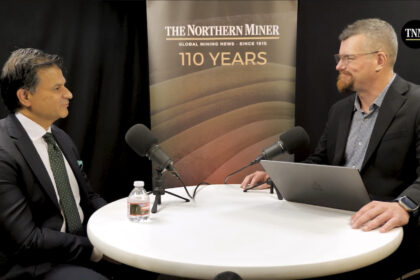
Robert Friedland’s Ivanhoe Mines (TSX: IVN) has cut its 2027 copper production forecast for Kamoa-Kakula in the Democratic Republic of Congo for the second time this year while raising costs, extending the recovery of one of the world’s largest new copper mines.
The Canadian miner, which released the update after markets closed Tuesday, now expects to produce 300,000 to 350,000 tonnes of copper next year, down from 380,000 to 420,000 tonnes, removing 75,000 tonnes from the plan at the midpoint. Its target stood at 500,000 to 540,000 tonnes before a more cautious mine plan emerged in March.
Ivanhoe also raised its 2027 cash cost (C1) guidance to $2.50 to $3.00 per pound from $2.10 to $2.50, citing prolonged high diesel prices, lower ore grades and reduced production.
“The revised production and cost guidance over the short term reflects a disciplined approach to the ongoing turnaround at Kamoa-Kakula, prioritizing operational stability, mining flexibility and the sustainable recovery of annualized copper production to approximately 500,000 tonnes,” Friedland, Ivanhoe’s founder and co-chairman, said in the statement.
The downgrade highlights the difficulty of restoring major copper operations even as miners race to bring new supply to market. While Freeport-McMoRan has approved an expansion at its Bagdad mine in Arizona targeting additional production in 2030, Kamoa-Kakula’s recovery is taking longer than expected.
“The path back to about 500,000 tonnes per year has become longer, more capital intensive and more dependent on future execution,” TD Cowen analyst Craig Hutchison wrote Tuesday. He downgraded Ivanhoe to hold from buy and slashed his target price to C$9 ($6.42) from C$14.
Recovery delayed
Ivanhoe lowered the expected steady-state annual production capacity of Kamoa-Kakula’s existing Phase 1, 2 and 3 concentrators to 400,000 to 450,000 tonnes as it prepares to introduce shallow open-pit mining alongside its underground operations.
The company plans to begin stripping waste rock from two high-grade starter pits in the first quarter of 2027, with first ore expected in the third quarter. The new mining approach is intended to improve flexibility while the underground Kakula mine recovers.
That turnaround has suffered another setback. Ivanhoe now expects production mining on the eastern side of Kakula to restart in late March 2028, rather than late 2027, following further geological and engineering work.
Kamoa-Kakula produced 76,401 tonnes of copper in saleable products during the third quarter, up from 64,328 tonnes in the preceding three months. Full-year 2026 output is expected to reach approximately 290,000 tonnes.
The company also reduced the upper end of its 2026 capital spending forecast by $200 million, deferring that expenditure to 2027. Next year’s spending guidance now stands at $950 million to $1.15 billion, excluding an estimated $100 million to $200 million for open-pit pre-stripping.
Supply outlook
Ivanhoe plans to begin detailed engineering for a Phase 4 concentrator expansion in the first quarter of 2027, aiming to lift annual copper production capacity to approximately 500,000 tonnes.
The expansion has not yet received project approval. Ivanhoe estimates construction would take 18 to 24 months after approval, with an updated life-of-mine plan scheduled for March 2027.
Copper prices fell 2.1% to $14,034 a tonne on the London Metal Exchange on Tuesday, its lowest level since mid-August, as uncertainty surrounding the US midterm elections weighed on metals.
Investment in future copper supply continues despite the near-term setbacks. Within the same 48-hour period, Canadian producer Hudbay Minerals (TSX, NYSE: HBM) agreed to lead a C$49.8 million investment in Pecoy Copper, which is exploring an undeveloped copper-gold project in southern Peru.
Hudbay will contribute approximately C$30.1 million, while an unnamed second strategic investor will provide C$19.7 million. Each is expected to hold just under 10% of Pecoy following the financing.
The contrasting developments underline a growing divide in the copper market: established producers face operational constraints while developers seek the financing needed to bring new deposits into production.
Source: https://www.mining.com/coppers-biggest-new-mine-stumbles-again-as-costs-soar/