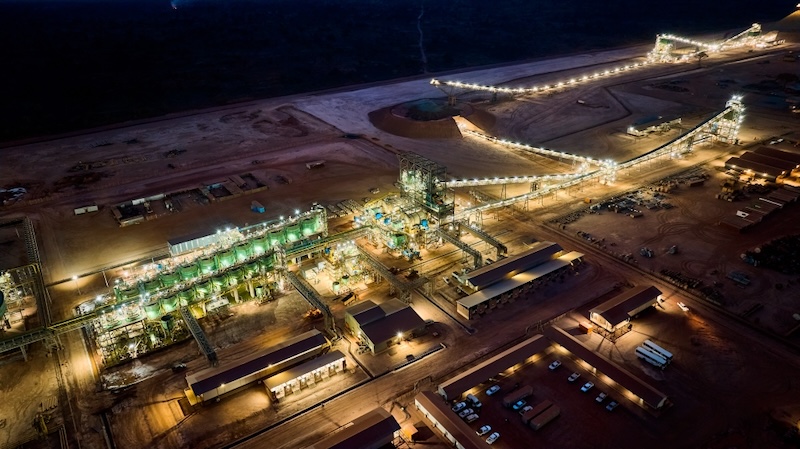
Robert Friedland’s Ivanhoe Mines (TSX: IVN; US-OTC: IVPAF) has cut next year’s copper production outlook at Kamoa-Kakula by 19% as recovery work at the flood-hit operation in the Democratic Republic of Congo (DRC) takes longer than expected. The stock hit a four-year low.
Vancouver-based Ivanhoe now expects 300,000 to 350,000 tonnes of copper in saleable products in 2027, down from 380,000 to 420,000 tonnes, according to a statement issued Tuesday after the close of trading. This year’s forecast has narrowed to about 290,000 tonnes, the bottom of the miner’s previous 290,000-to-310,000-tonne range.
The setback means Ivanhoe needs another expansion to reach the copper output it previously expected from Kamoa-Kakula’s existing plants before operations were disrupted by seismic activity and flooding in May 2025. That adds spending and execution risk as shareholders wait for the operation to recover from last year’s flooding, while leaving the global market with less copper than anticipated.
“The path back to about 500,000 tonnes per year has become longer, more capital intensive and more dependent on future execution,” TD Cowen analyst Craig Hutchison wrote Tuesday. He downgraded Ivanhoe to hold from buy and slashed his target price to C$9 ($6.42) from C$14.
Ivanhoe had already lowered its 2026 and 2027 output targets in late March after shifting its near-term focus at Kamoa-Kakula from production to underground development, rehabilitation and access work.
Shares of Ivanhoe fell 7.2% to C$8.24 Wednesday morning in Toronto, cutting the company’s market capitalization to about C$11.8 billion and extending their drop to 49% since Jan. 1. Earlier they dropped as much as 14% to C$7.64, their lowest level since July 2022.
Eastern side
“The revised production and cost guidance over the short term reflects a disciplined approach to the ongoing turnaround at Kamoa-Kakula, prioritizing operational stability, mining flexibility and the sustainable recovery of annualized copper production to approximately 500,000 tonnes,” Friedland, Ivanhoe’s founder and co-chairman, said in the statement.
Production mining on Kakula’s eastern side is now expected to begin late in the first quarter of 2028, rather than in next year’s fourth-quarter, Ivanhoe said Tuesday. Ivanhoe also reduced its estimate of Kakula’s maximum mining rate after drilling and engineering studies informed updated geological, groundwater and rock-stability models.
The implications stretch beyond next year. Steady-state output from the three existing concentrators is now forecast at 400,000 to 450,000 tonnes annually, compared with a previous outlook exceeding 500,000 tonnes. The plants should be fully utilized from mid-2027 while processing lower-grade ore.
Located 1,520 km southeast of the DRC capital Kinshasa, Kamoa-Kakula is one of Africa’s major copper mining sites. Ivanhoe and China’s Zijin Mining each own 39.6% of the operation while the DRC government holds a 20% stake. All production forecasts are on a 100% project basis.
Ivanhoe plans to introduce open-pit mining at shallow Kamoa deposits to increase flexibility while Kakula recovers. Initial waste stripping should begin in first-quarter 2027, with first ore in the third quarter. That material would help fill the mills, although lower grades require more processing capacity to achieve the same copper output.
Fourth concentrator
Detailed engineering for a fourth concentrator is scheduled to start early next year. Construction would take 18 to 24 months after approval, with the expansion targeting roughly 500,000 tonnes annually. An updated life-of-mine plan is due in March.
Costs are climbing alongside the production setback. Ivanhoe raised its 2027 cash-cost forecast to $2.50-$3 a lb. from $2.10-$2.50, citing elevated diesel prices, lower grades and reduced output.
About $200 million of capital spending has shifted into 2027, lifting Kamoa-Kakula’s budget to between $950 million and $1.2 billion. That excludes $100 million to $200 million for open-pit stripping.
RBC Capital Markets analyst Sam Crittenden described the spending shift as “extending capital intensity and cash flow pressure into 2027–28.” However, he expects a stronger fourth quarter as copper inventories decline, recoveries improve and solar power reduces energy costs.
Bullish for prices
Ivanhoe’s outlook cut “will serve to further tighten up the fundamental outlook for the global copper market in the 2027-2029 period, which is bullish for prices,” Scotiabank analyst Orest Wowkodaw said in a separate note.
Third-quarter profit attributable to shareholders rose to $50.6 million, or 4¢ a share, up from $33.1 million, or 2¢, a year earlier, Ivanhoe said. Adjusted earnings of 4¢ missed the 7¢ consensus cited by Jefferies analyst Fahad Tariq.
Kamoa-Kakula generated record quarterly revenue of about $1 billion and earnings before interest, taxes, depreciation and amortization of $478.2 million, producing 76,401 tonnes of saleable copper. Cash costs rose to $3 a lb. from $2.84 in the second quarter.
Sulphuric acid credits of 69¢ a lb. more than offset smelter operating costs of 51¢. Newly commissioned solar facilities should reduce energy costs by 10¢ to 20¢ a lb. as dewatering switches away from diesel generators.
Kipushi, Ivanhoe’s zinc-copper-lead-germanium-silver mine in the DRC, provided a brighter result, producing a record 77,147 tonnes of zinc and lifting its 2026 guidance floor to 270,000 tonnes from 240,000.
Ivanhoe ended September with $643 million in cash.
Source: www.northernminer.com — article syndicated from the publisher’s feed; all rights remain with the original publisher.