Cameco (TSX: CCO; NYSE: CCJ) expects Westinghouse’s new reactor business to contribute more to its growth by 2030 than uranium mining if some of the proposed projects go ahead, president and chief operating officer Grant Isaac told The Northern Miner.
Westinghouse has identified up to 91 potential reactors over more than 20 years. Eleven have reached front-end engineering and design, but none had reached a final investment decision when Isaac spoke in October. Three planned reactors in Poland and two in Bulgaria are furthest along, he said.
“Without a doubt, the greatest growth potential for Westinghouse is the Energy Systems Division, which is the new build,” Isaac said. “But of course, the magic of it is it then pulls along the reactor services and the fuel fabrication part of the business.”
Cameco assumed no new AP1000 reactor construction when it bought into Westinghouse in 2023. It now sees reactor development as a way to create demand for its own uranium. A build can bring in years of engineering and procurement revenue, while a completed reactor could buy fuel and services for 80 to 100 years. At its mines, Cameco is waiting for utilities to sign long-term contracts before it commits to producing more.
Reactor pipeline
Of the 91 potential reactors, 29 are in more advanced stages of development and 62 remain in preliminary study or evaluation. Projects under evaluation in Canada and the United States are among those following Poland and Bulgaria, Isaac said.
Cameco has raised its estimate of the share of spending on a new AP1000 project that could flow to Westinghouse to 40% to 45%, from 25% to 40%. A two-reactor development could generate $8 billion in U.S. currency (C$11.2 billion) to $11 billion in Westinghouse revenue over roughly a decade, with $1.6 billion to $2.2 billion in earnings before interest, taxes, depreciation and amortization, Scotiabank estimates.
Washington and Seoul announced a non-binding framework on Sept. 30 that envisages up to $120 billion in South Korean investment to help finance as many as eight U.S. reactors. The proposal includes six AP1000 reactors and up to two Korean APR1400 units, which incorporate Westinghouse technology. It remains subject to definitive agreements and other conditions, Cameco said in its third-quarter results.
Cooperation with South Korea builds on the settlement of an intellectual property dispute that turned the country’s reactor industry from a competitor into a partner, Isaac said.
“The industrial logic of combining Westinghouse technology with Korean capability has always been the smartest logic in the Western world,” he said.
Building at scale
Westinghouse provides engineering and procurement services. Developers must assemble construction partnerships, secure financing and obtain regulatory approvals before they can build, Isaac said.
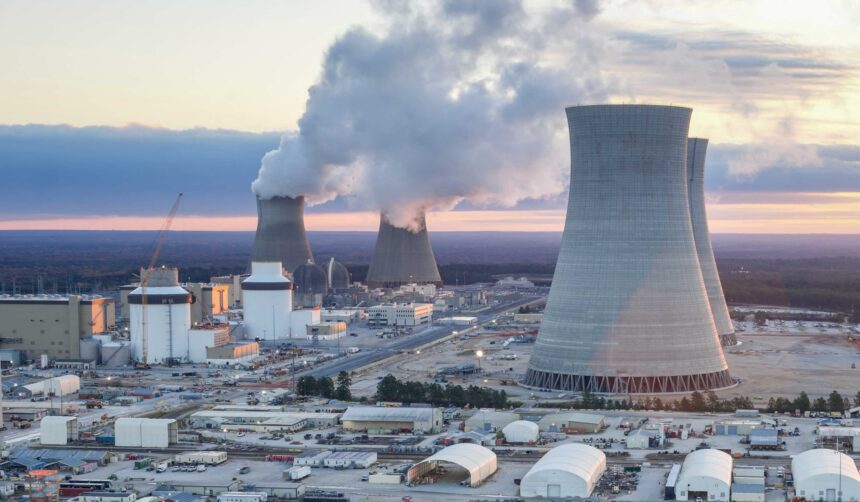
Construction delays and cost overruns, notably at Georgia’s Vogtle plant, remain a concern. Isaac said repeating a design that has already been built and licensed could reduce some of the uncertainty developers face with a first-of-a-kind project.
“We have built nuclear at scale,” he said. “Where it succeeded, we standardized, we sequenced and we simplified.”
Cameco acquired its 49% stake in Westinghouse alongside Brookfield Renewable Partners (TSX: BEP.UN; NYSE: BEP) in 2023. Westinghouse confidentially submitted a draft registration statement for a proposed U.S. listing on July 31. Bloomberg News reported in September that Westinghouse was targeting a valuation above $50 billion.
Uranium discipline
At McArthur River in Saskatchewan, unexpected clay content has slowed the ground freezing needed to access new mining zones. Cameco has held off spending heavily to recover lost time because utilities haven’t committed to enough additional long-term purchases, Isaac said.
“Don’t take heroic actions. Don’t put in more freeze holes,” he said, describing management’s response when demand doesn’t justify accelerating development.
About 30% of Cameco’s licensed and built production capacity remains constrained by deliberate supply discipline or on care and maintenance, Isaac said. That includes unused capacity at McArthur River and Kazakhstan’s Inkai operation, as well as suspended assets such as Rabbit Lake.
Cameco could produce as much as 36 million lb. of uranium annually from its existing portfolio, compared with attributable production in the mid-20-million-lb. range, he said.
Supply pressure
Global uranium demand is running at about 220 million to 230 million lb. annually and rising by about 3.5% to 4% a year, said David Talbot, a mining analyst at Toronto-based Red Cloud Securities.
New reactors will add to demand, though lengthy construction schedules limit near-term growth. More immediate pressure could come from U.S. utilities replacing Russian nuclear fuel supplies as existing exemptions expire in January 2028.
Talbot expects long-term uranium contract prices, around $90 to $96 per lb. when he spoke, to keep climbing. Many projects still need higher prices to become economical, he said. He estimates only four million to five million additional pounds of U.S. output could come online over the next two years.
For Isaac, the value of helping utilities build reactors lies in what they’ll buy once those plants are running.
“Over the long run, the value of selling uranium for 80 to 100 years is way greater than the five to seven years of building a reactor,” Isaac said. “So think of it as our strategy is about not waiting for others to create new demand for us. We’re out there building our own demand.”
Source: www.northernminer.com — article syndicated from the publisher’s feed; all rights remain with the original publisher.