Let’s do the math before anyone gets misty-eyed about a press release.
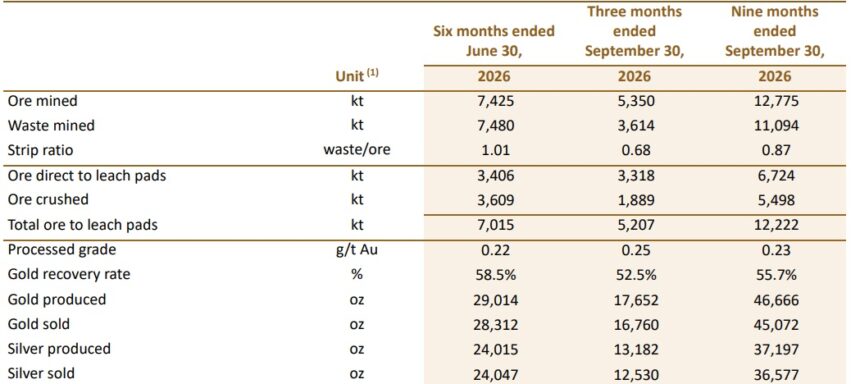
Integra Resources produced 17,652 ounces of gold at Florida Canyon in Q3. That’s roughly 8% above Q2 and about 40% above Q1, which management conveniently pre-labeled as the “weakest quarter of the year.” How thoughtful—setting the baseline low makes every subsequent quarter look like genius. Nine-month total: 46,666 ounces. Full-year guidance: 70,000–75,000 ounces. Which means Q4 must deliver at least 23,300 ounces just to hit the bottom of the range. That’s not a ramp-up story; that’s a company that needs its biggest quarter of the year to avoid missing its own guidance. A 32% quarter-over-quarter jump, minimum. Possible? Sure. A “trend”? No. It’s a hurdle, and hurdles get clipped.
Now the part that actually matters: US$119 million in cash. That’s the real headline, not production percentages dressed up as momentum. Juniors live and die on the balance sheet, and a nine-figure treasury while permitting DeLamar in Idaho buys time—which, in mining, is the only currency that reliably appreciates. Sustaining capex at Florida Canyon is expected to fall meaningfully in 2027 and 2028, and the DeLamar Final Investment Decision is targeted for H2 2027. Note the language: “targeted,” “expected.” Not committed, not funded, not built. Between here and there sit two years of permitting risk, capex reality checks, and—this being a junior miner—the ever-present temptation to issue shares at exactly the wrong moment, diluting everyone who thought they were buying ounces.
And can we talk about the disclosure? The author holds a long position and Integra sponsors the website. That’s not disqualifying, but it does mean every 8% production uptick gets a headline while a guidance miss would presumably get a paragraph about “challenging market conditions.” Read sponsored coverage the way you’d read a stock pitch from someone holding the bag: with interest, and skepticism.
Here’s the broader point for anyone tempted to rotate their index portfolio into single-name juniors on a production ramp: a company doubling output can still be a bad investment if it needed a 40% equity dilution to get there. You will never see the dilution number in the headline. Production is a vanity metric; per-share value is the metric. A 40% production increase with 45% more shares outstanding is a shareholder rounding error.
Position sizing matters too. If you insist on owning this, it belongs in the speculative satellite—single-digit percentages, money you can incinerate without altering your retirement date. Your core should be low-cost index funds quietly compounding at 0.03% expense ratios, not a Nevada heap-leach operation that needs a perfect Q4. Opportunity cost is real: every dollar in a lottery ticket is a dollar not riding a century of market returns.
Seventeen thousand ounces sounds impressive until you remember the market pays for per-share value, not noise—and junior miners have an unbroken record of converting impressive ounces into unimpressive shareholder returns.