
China has stood up a new state-backed investment vehicle — Guangyan International Investment Co., also operating as Vast Rock International Investment Co. — under the National Development and Reform Commission. The entity will take direct equity stakes in selected overseas mining projects and provide Chinese operators with commercial analysis, regulatory guidance, and risk assessment before deals close. Strip away the policy language and this is a capital allocation signal: Beijing is formalizing a bid desk for hard assets. Price is the truth, and the truth is that the buyers of physical resources are consolidating their purchasing power.
Whether this moves commodity prices is another question entirely, and it deserves a technical answer, not a narrative one.
What the Structure Actually Tells Us
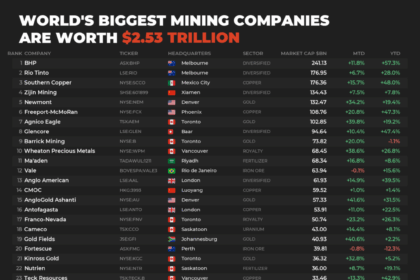
Chinese firms have deployed over US$100 billion into outbound mining M&A since the early 2000s, per Bain & Co. estimates, across copper, cobalt, iron ore, nickel, lithium, and gold in Africa, Asia, and Latin America. That is two decades of cumulative demand absorption. Guangyan does not create new demand; it coordinates existing demand. Coordination reduces transaction frictions and, over time, places a structural bid under producing assets in politically unstable jurisdictions — the kind of names that trade at persistent discounts to net asset value because the market prices jurisdictional risk aggressively.
Watch how that discount behaves on the mid-tier and junior producers with African and Latin American asset bases. A state-backed co-investment partner changes the probability distribution on financing outcomes. When a financing risk is removed, the market typically re-rates the equity toward peer multiples. That re-rating shows up on charts as a gap-and-go off consolidation, followed by volume expansion. If you see gaps that fill within days on weak relative volume, disregard them — those are noise, not structure.
Central Role in Future Overseas Deals
Guangyan will invest directly alongside Chinese mining companies and advise on local regulations, financing structures, market conditions, and political risk. Notably, one stated objective is pushing Chinese firms toward joint ownership rather than full control — shared exposure, lower capital intensity per project, and more flexibility when host governments change the rules. That is disciplined capital management, and it mirrors what a competent fund would do: size positions so no single political event impairs the portfolio.
The larger miners will continue making independent decisions, though some are being encouraged to submit project plans for review before finalizing agreements. Recruiting activity on Chinese social media suggests staffing has been underway since roughly February. This was not a reactive announcement; the build-out has been in progress for months. Markets front-run nothing they cannot see — but positioning tends to show up in price before the headline confirms it. Review the copper and lithium complex charts from February through April and ask whether accumulation signatures were already printing. In several large-cap copper names, the answer is yes: higher lows on declining sell volume, MACD holding above the zero line through corrective phases, and RSI basing in the 40s rather than breaking down. That is institutional behavior, not retail churn.
Jurisdictional Risk Is Being Repriced
Guangyan’s creation lands in an environment where host governments are tightening terms across the board. The DRC has imposed cobalt export controls. Guinea is pushing domestic processing for bauxite and iron ore. Zimbabwe now requires domestic lithium processing before export. For multi-jurisdiction operators, every one of these measures widens the risk premium the market demands.
Technically, this policy trend is visible in how these equities trade around policy headlines. Cobalt export controls produced a vertical move in DRC-exposed cobalt names — a gap up on a news catalyst with no prior base is the lowest-quality setup in technical analysis. Price is the truth, and price said the move was entirely event-driven. Names that resolved higher on that news without prior accumulation have since given back most or all of the gain. This setup lacks confirmation. Compare that to copper, which has been building a multi-month base with rising open interest and consistent volume on up-days versus down-days — a far superior risk/reward structure.
Part of a Larger Government Strategy
Guangyan joins China Mineral Resources Group, the state entity centralizing iron ore purchasing for Chinese steelmakers. Two organizations, one theme: visibility and coordination over strategic mineral supply chains. China pairs offshore mine ownership with decades of refining investment and now controls roughly 70% of global critical-mineral processing capacity, per IEA figures. The launch arrives as the US, EU, and Japan expand their own critical mineral partnerships and stockpiles.
From a pure price perspective, this is a structural demand floor story, not a momentum catalyst. State buyers do not chase. They accumulate into weakness. That is why the actionable read is not to buy strength on headlines — it is to identify where long-term accumulation zones sit and let price come to you.
On the copper complex: the weekly charts of the major producers remain in intact uptrends, with the 40-week moving average acting as support on every pullback since the trend reasserted. As long as that holds, dips toward it are statistically favorable entries, and a state coordination layer underneath physical demand only reinforces the thesis. A weekly close below that average on expanding volume would invalidate the structure, and nothing else in the news flow would matter.
On lithium: the sector remains in a downtrend on the higher timeframes — lower highs, lower lows, price below declining moving averages. Some individual names have printed bullish RSI divergence against price lows, which is the first condition for a base, but a condition is not a signal. Divergence without a change in market structure — a higher low on expanding volume and a MACD bullish crossover on the weekly — is exhaustion, not reversal. Do not confuse the two. Beijing’s coordination efforts do not override an oversupply-driven downtrend; they may eventually support a floor, but the chart has to confirm before capital goes to work.
Gold and the precious metals producers continue to demonstrate the cleanest technical structure in the sector: sustained volume on breakout attempts, pullbacks holding above prior resistance-turned-support, and moving average alignment stacked bullishly across timeframes. State-level competition for strategic metals is a tailwind, but the charts did not need this headline to justify the trend.
The Practical Read
Guangyan is a structural development, and structural developments show up slowly — in the behavior of pullbacks, in the persistence of bids at prior support, in the quality of volume. They do not produce tradeable spikes; event-driven spikes produce those, and spikes fade.
Three things worth monitoring:
- Copper majors — trend intact, 40-week moving average is the line in the sand. Above it, the path of least resistance remains higher.
- African-exposed mid-tiers — watch whether jurisdictional risk discounts compress over time. That compression is the market voting on what state co-investment is worth.
- Lithium — divergence present, trend still down. Requires a structural higher low with volume confirmation before it earns capital. Anything else is anticipation, and anticipation is how accounts get drained.
The headline crowd will frame this as China flexing or a new resource war chapter. Irrelevant. What matters is whether the physical