



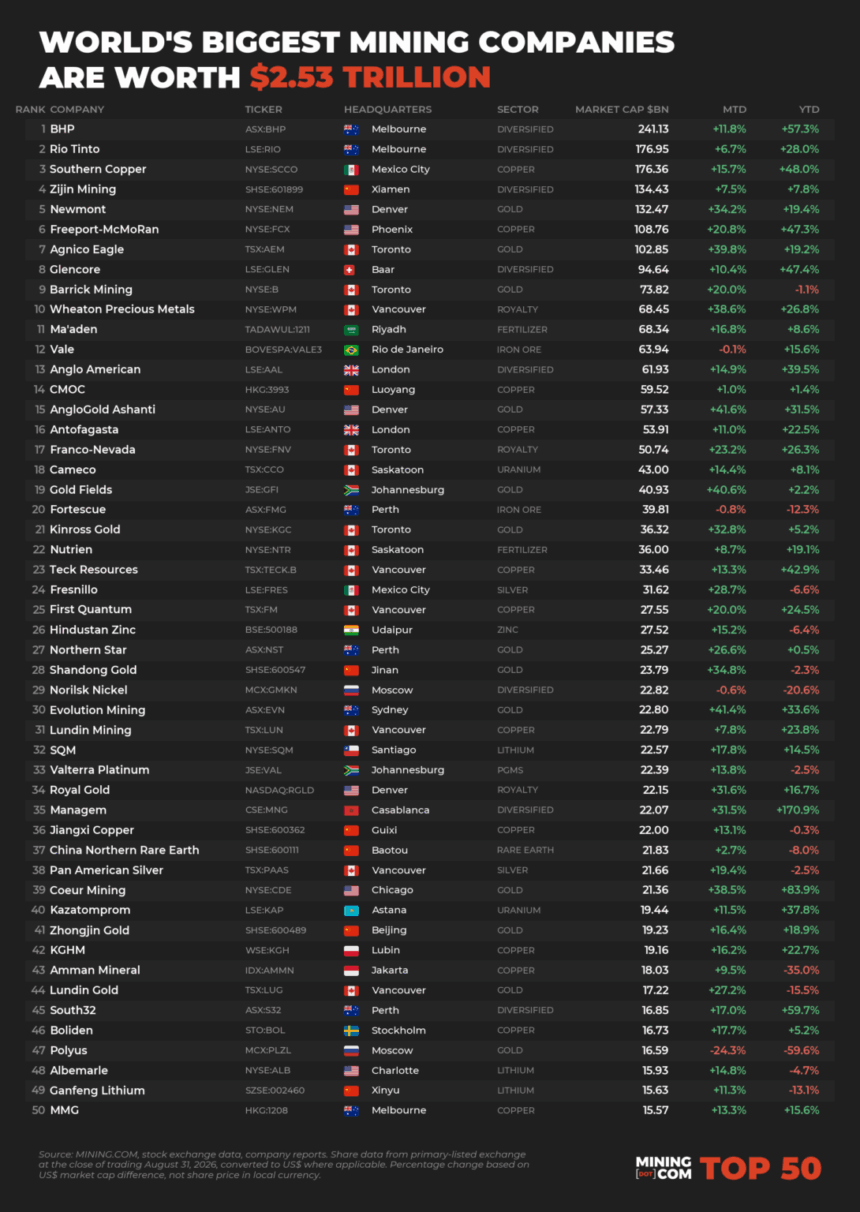
Value of top 50 mining companies surge by $357 billion after monster August rally
The gain took the ranking back above $2.5 trillion for the first time since February when gold stocks were shining brightest thanks to bullion trading close to $1,000 per ounce above today’s levels.
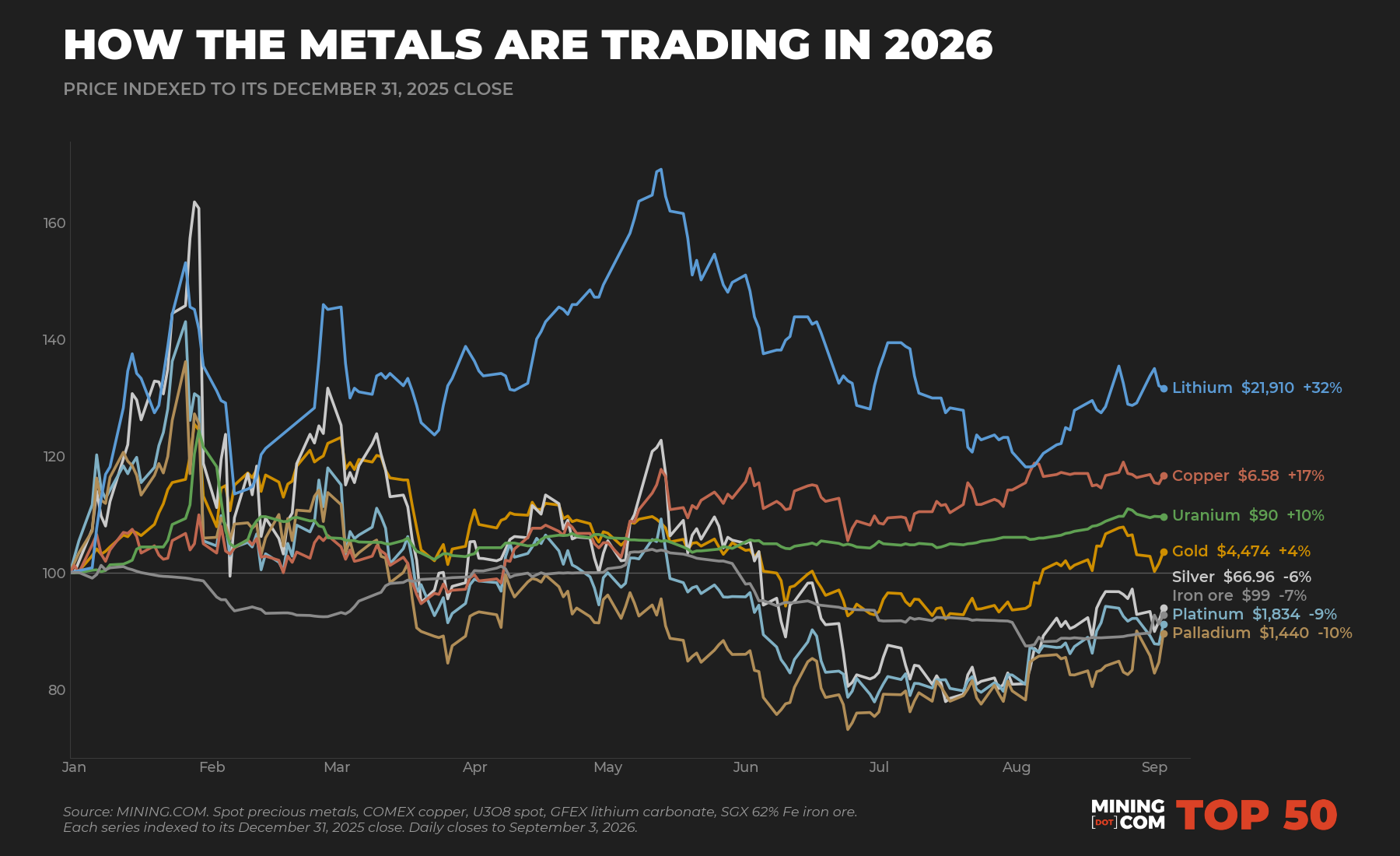
Gold started the month at $4,043 an ounce and climbed to almost $4,660 by 25 August, its highest since mid-May, before a hawkish Jackson Hole speech from Federal Reserve chair Kevin Warsh and fresh US strikes on Iran knocked it back. Even after that retreat bullion finished almost 10% higher, its best month since January, and silver did better still, at one point up 20% inside three weeks to $70 an ounce.
The gold standard-bearers
What was different this time is that the gold miners, so often left behind by their own product, kept up.
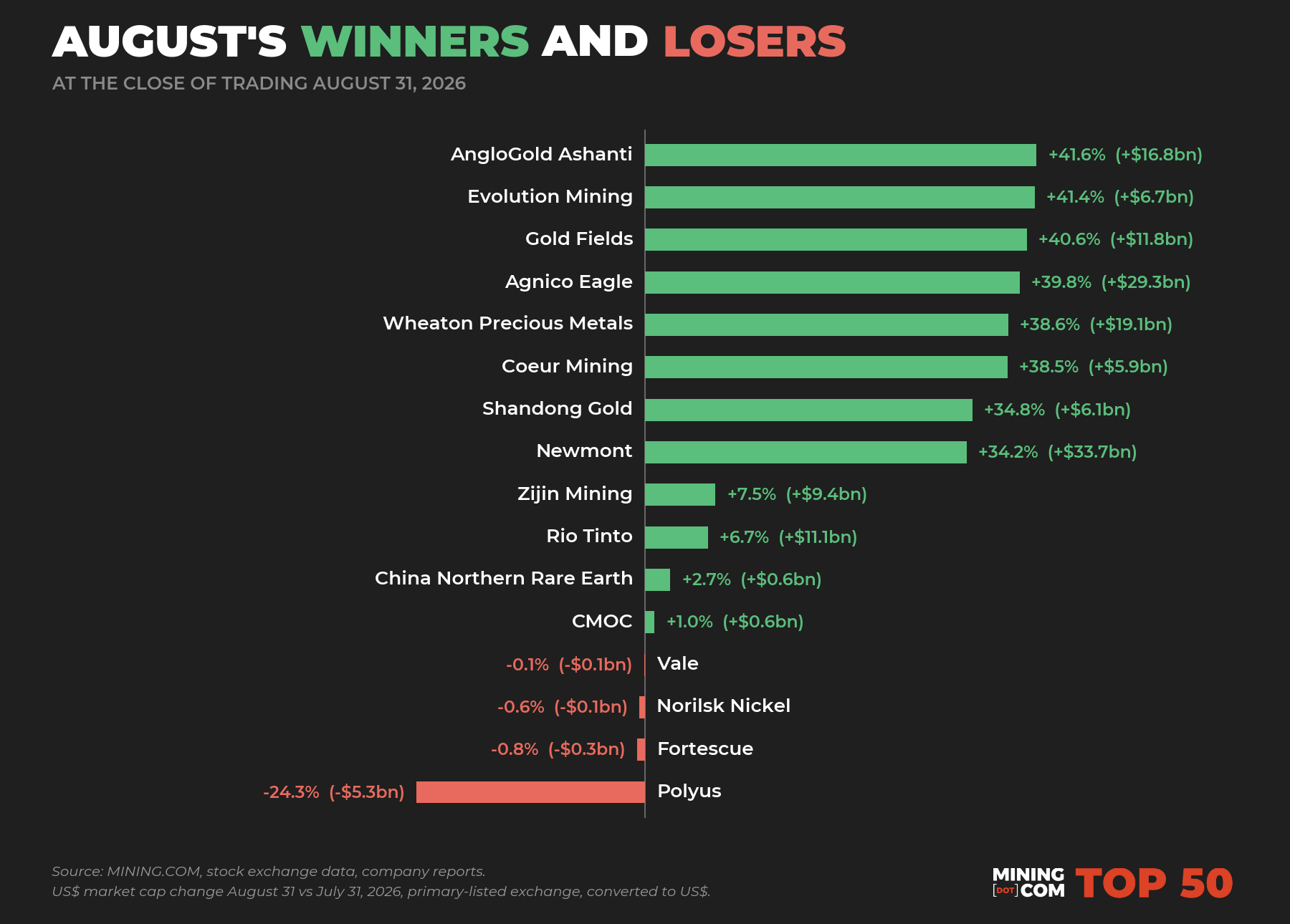
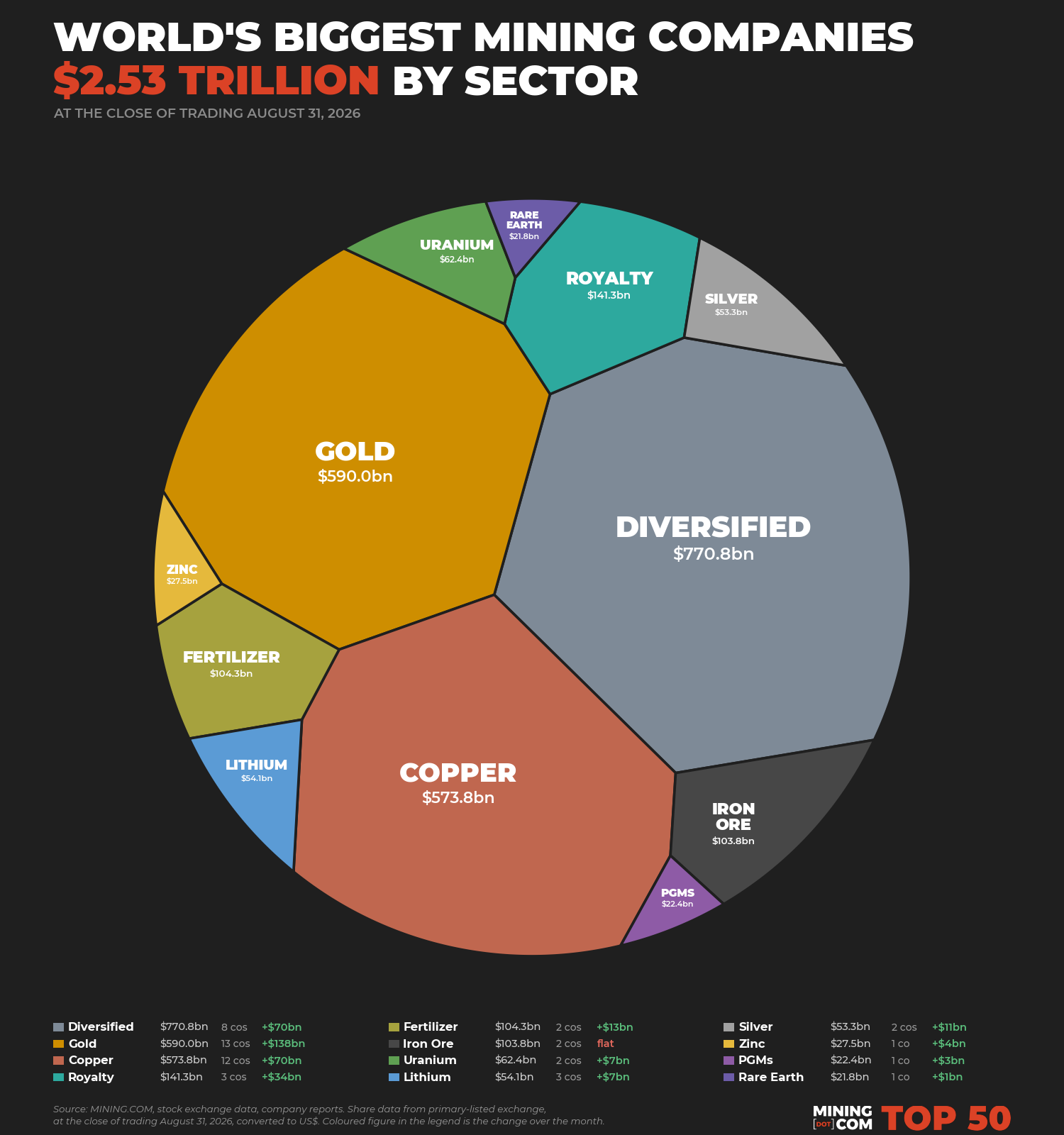
Between them the gold, silver and royalty companies supplied $183 billion of the month’s gain. The gold miners alone added $138 billion, a 31% rise in four weeks, and twelve of the thirteen in the ranking finished higher with one glaring exception.
AngloGold Ashanti led on percentages with a 41.6% advance worth almost $17 billion after second-quarter profit rose 58% and the board approved a $2 billion buyback. Australia’s Evolution Mining, up 41.4% on a record full-year profit and a 62% dividend increase, and Gold Fields, up 40.6% as Salares Norte carried the half-year while older mines faltered, were a fraction behind.
The heavy lifting in dollars came from the two largest. Newmont added $34 billion, the biggest single gain anywhere in the table, after beating profit estimates on the strength of the gold price even as output slipped, and Agnico Eagle added $29 billion on record free cash flow and record shareholder returns. Both now sit above $100 billion.
As a group, precious metals stocks are still trading 19% below their end-February peak (which is technically close to a bear market, but certainly does not feel like one) and August only gave back half the value lost since then.
Southern Copper breaks up the old firm
For as long as this ranking has been compiled, and for decades before that, BHP and Rio Tinto have been the industry’s number one and number two.
On 24 August that pairing was broken, if only for a few days. Southern Copper, riding record quarterly results and a copper price that set a fresh record above $14,000 a tonne, touched an all-time high of $220.78 a share and a market value of roughly $183 billion, a few billion clear of Rio Tinto.
Copper’s pullback in the last week of the month restored the old order, but only just. Southern Copper closed August at $176.4 billion against Rio Tinto’s $177.0 billion, a gap of $600 million between two companies that between them are worth more than a third of a trillion dollars. Rio Tinto is up 6.7% for the month after its highest first-half earnings in four years.
Southern Copper is up 15.7% for the month and 48% for the year. With copper still within a stone’s throw of all-time highs and iron ore’s prospects much dimmer, the question may be not whether the Mexican-Peruvian producer takes second place for good, but when. Indeed, on this ranking’s own 1.5 times revenue test (see methodology below) Rio is, strictly speaking, an iron ore company enjoying editorial clemency.
Red metal redemption
Copper’s rally to the mid-$14,000s was mostly on paper thanks to the will-he won’t he tariff overhang, but mining investors continued to ride the red metal in August.
The twelve copper companies in the ranking added $70 billion over the month. Freeport-McMoRan gained 20.8% after beating profit forecasts despite the slump at Grasberg and is now worth 47% more than at the start of the year.
BHP, which added $25 billion in August, more than any company outside the gold sector, had copper overtake iron ore as its biggest earner in the full-year results it reported mid-month, and is up 57% for 2026, an eye-watering performance for the only ever $200 billion plus mining stock. BHP, like 30 other counters in the ranking, hit an all time high in 2026.
It is the pattern of the whole year in miniature. Gold has supplied every lurch on the chart, up and down. Copper has supplied the climb underneath it, and the diversified majors that sit at the top of the table are, increasingly, a copper bet. When Anglo American and Teck Resources become Anglo-Teck, another 100-year old diversified company will officially move to the copper column (but not before Glencore takes its pound of flesh).
The $100 billion club fills up
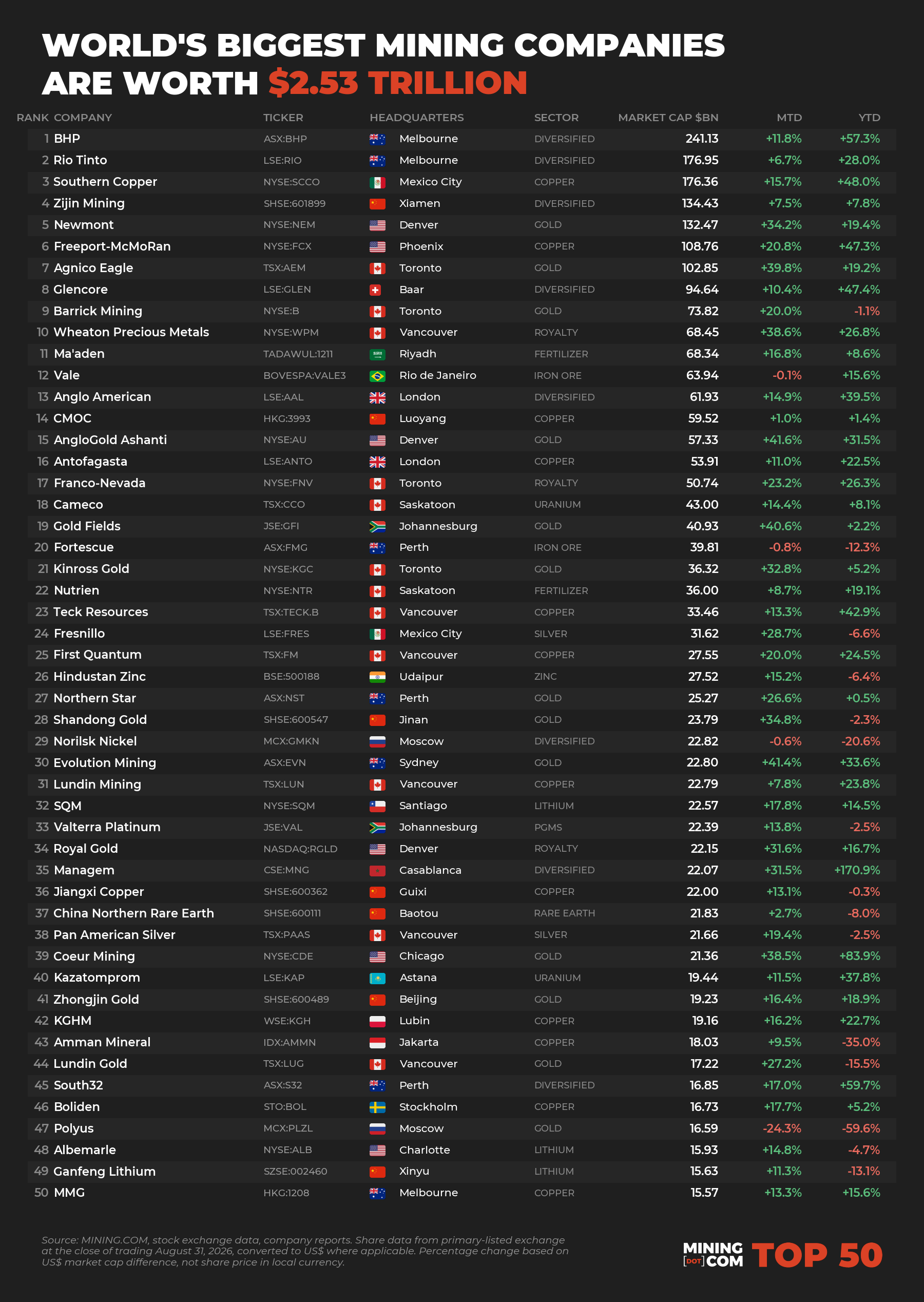
The rally repopulated the top of the table. The number of companies worth more than $100 billion rose from four to seven as Newmont, Freeport-McMoRan and Agnico Eagle cleared the mark to join BHP, Rio Tinto, Southern Copper and Zijin Mining. Glencore, up 10.4% in August and 47% for the year on a 15% jump in copper output and near-record trading profits, is the one left waiting at $94.6 billion.
Polyus pulls the other way
Only four of the fifty ended the month lower, and the sharpest fall ran directly against the tide. Polyus, Russia’s largest gold miner, lost 24.3% and $5.3 billion of market value, sliding from 28th to 47th and coming to rest two places above the cut-off.
The reasons have nothing to do with the metal. Polyus shocked its shareholders in July by suspending dividends until 2030 to fund a wave of new projects, the stock lost a quarter of its value in a session, and it has kept falling since amid talk in Moscow of a windfall levy on miners.
Divide each gold miner’s market value by the ounces it produces in a year and the ranking turns upside down. Investors are paying about $30,000 for every annual ounce at Agnico Eagle and $23,700 at Newmont. Polyus, which produced 2.6 million ounces last year from some of the lowest-cost mines in the industry, is valued at little more than $6,000 per annual ounce. At Newmont’s multiple the Moscow-listed company would be worth more than $60 billion rather than $16.6 billion, and at Agnico Eagle’s it would top $78 billion
Fellow Russian Norilsk Nickel was flat in dollar terms, a modest interim dividend doing nothing for a stock that is down a fifth this year.
The other two fallers were iron ore’s. Fortescue slipped 0.8% after cutting its final dividend to the lowest since 2018 despite record shipments, and Vale was unchanged after a 35% fall in second-quarter profit. With the benchmark below $100 a tonne, iron ore is the one major commodity the rally passed by.
The revolving door
The price of admission jumped to $15.6 billion from $13.6 billion a month earlier, and the bottom of the table churned accordingly. Lundin Gold, which narrowly missed July’s cut, came back in at 44th after a 27% month built on new discoveries around Fruta del Norte and a record quarter. Western Mining, which had scraped in at 50th in July, went straight back out.
Over the year the door has swung further. Since the end of 2025 five names have climbed into the fifty and five have dropped out. Managem, the Moroccan gold and base metals group, is the standout arrival, up more than 170% in dollar terms, alongside Coeur Mining, Kazatomprom after a 9% rise in first-half uranium output, South32 after agreeing to sell its aluminium business to Alcoa for $5.6 billion, and MMG, holding on at 50th.
Going the other way, Ivanhoe Mines fell out after slashing its Kamoa-Kakula copper guidance, Alamos Gold slipped below the line after seismic damage cut output at Young-Davidson and now sits 51st, $230 million short. Zhejiang Huayou Cobalt and Impala Platinum lost their places, and Vedanta left as a single name once its demerger split the group into five listed companies, with Hindustan Zinc now carrying the flag on its own at 26th.
The best of months and the worst of them
August’s $357 billion is the largest single-month gain in a series that runs back to 2019, and the company it keeps is striking. The previous record was set in January, when the Top 50 added $338 billion, and February added a further $267 billion on the way to the ranking’s all-time high of $2.75 trillion.
The year owns the other extreme as well. In March, as gold fell away from its record, $420 billion evaporated inside a month, the worst the ranking has recorded. No twelve months have moved the industry the way the last twelve have.
The map redraws
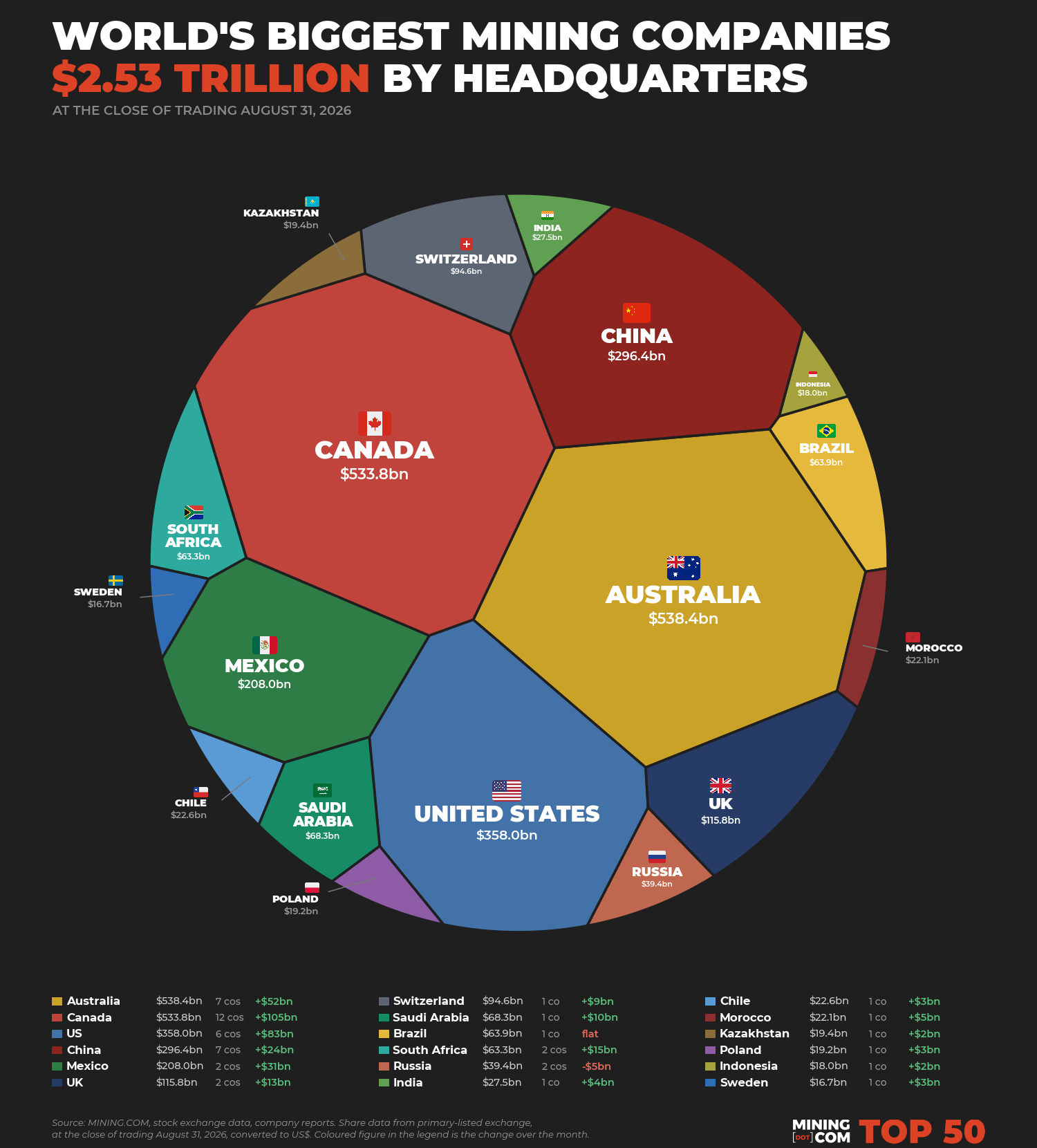
The rally shifted the industry’s centre of gravity. Australia, home to BHP, Rio Tinto, Fortescue and South32, edged past Canada to become the most valuable mining address on the planet, $538 billion against $534 billion, even though Canada sends twelve companies into the ranking to Australia’s seven.
The United States is third at $358 billion on the strength of its gold and copper names, ahead of China at $296 billion. Russia, with Polyus collapsing and Norilsk standing still, is worth $39 billion, down 44% since December and the heady days when Uralkali and Alrosa managed to rank in the middle and Polyus and Norilsk vied for the top 10 are well and truly over.
METHODOLOGY

Source: MINING.COM, stock exchange data, company reports. Share data from primary-listed exchange at the close of trading August 31, 2026, converted to US$ where applicable. Percentage change based on US$ market cap difference, not share price change in local currency.

As with any ranking, criteria for inclusion are contentious. We decided to exclude unlisted and state-owned enterprises at the outset due to a lack of information. That, of course, excludes giants like Chile's Codelco, Uzbekistan's Navoi Mining, which owns the world's largest gold mine and is in the process of readying an IPO, Eurochem, a major potash firm, and a number of entities in China and developing countries around the world.

Another consideration is diversified companies such as Anglo American with separately listed majority-owned subsidiaries. Anglo has interests in platinum (Valterra), and in the past diamonds (De Beers) and iron ore (Kumba), but the listed subsidiaries are excluded when consolidated on the parent's books. The same principle sees Hindustan Zinc enter the ranking in place of the slimmed-down Vedanta following the Indian group's demerger. Where mining arms are separately listed like Grupo Mexico's Southern Copper or Penoles' Fresnillo, those are added to the ranking and not the holding company.

Each company is assigned a single sector, and judgment calls abound. Vale appears under iron ore rather than diversified: the Brazilian company's fortunes remain overwhelmingly tied to the steelmaking ingredient, and its plans to separately list its base metals unit in Toronto (copper and nickel assets responsible for roughly a quarter of revenue) only sharpen the distinction. Rio Tinto, by contrast, stays diversified: iron ore may pay the bills, but the breadth of the portfolio, from aluminium and copper to lithium and titanium, is the company's defining feature. As a general rule we classify a company as diversified if no single commodity brings in more than 1.5 times the revenue of its next biggest earner, but as always there are exceptions.

Where the numbers are too close to call, history can settle it. Fresnillo now earns roughly as much from gold as from silver, but the Mexico City-based company is the world's largest primary silver producer and has been mining the metal at its namesake district in Zacatecas since the 1550s, so it stays under silver. Pan American Silver, where gold has come to dominate the revenue mix following the Yamana and MAG deals, keeps its silver classification on the same grounds. The company itself chose to keep the moniker after all.

Royalty and streaming companies Franco-Nevada, Royal Gold, Wheaton Precious Metals and Triple Flag are included on the basis of their deep involvement and funding role in the industry, but pure smelting and refining companies, as well as steelmakers with large mining assets, are excluded. Conglomerates and trading houses like Japan's sōgō shōsha are also excluded, which means well-known names like Marubeni, Mitsui, Sumitomo, Itochu and Mitsubishi, with their prominent stakes in mines and mining companies, do not qualify either.

Vedanta Aluminium, despite being India's largest producer of the metal, is excluded as a smelter without captive mining, and Sumitomo Metal Mining does not make the ranking on the same test, with smelting and refining now the vast majority of its business. On the flipside, rare earth miners are included. Rare earth specialists tend to aim for vertical integration (and companies like MP Materials are far along) and the refining, metalization and ultimately magnet making divisions are where the income and margins lie.

While earlier rankings included coal miners, the monthly series covers mined metals and minerals only. We exclude coal companies based on the fact that many derive most of their revenue from utilities, power generation and transport rather than mining, and, as with the steelmakers, their inclusion would crowd out the industry the ranking is meant to capture. That means no Coal India, despite the Kolkata company's standing as the world's largest coal producer. For comparability, previous rankings have been recalculated on the same basis.

Head office refers to a company's operational base where applicable (BHP and Rio Tinto both appear under Melbourne), but Antofagasta is the exception that proves the rule: we place the copper miner in London, where it has been listed since the late 1800s, rather than Chile where it mines.

Norilsk Nickel and Polyus, thanks to captive investors on the MCX, maintain their standing in the ranking despite sanctions and trading restrictions, and are valued on Moscow Exchange pricing converted to US dollars.

Please let us know of any errors, omissions, deletions or additions to the ranking, or suggest a different methodology: email Frik Els at fels@mining.com with Top 50 in the subject line.
Source: https://www.mining.com/top-50-biggest-mining-companies/