Okay babe, if you’ve ever wondered where your lithium, gold, and coal actually come from — and what’s happening to the planet while we mine it — this one’s for you.
Let’s talk about something I genuinely geek out over: the intersection of money, mining, and the planet. Because here’s the thing — if you’re investing in the energy transition (and honestly, if you’re building wealth in 2026, you probably are, even through your ETFs), you’re indirectly invested in mining. So when new data drops about how mining overlaps with biodiversity, I pay attention. And now you will too. 💚
The International Council on Mining and Metals (ICMM) just released something called the Global Mining and Metals Biodiversity Dataset, and it’s basically the first-ever global map showing where 12,000 mining and metals facilities sit in relation to the world’s most important ecosystems. Think of it like a credit report, but for the planet — it shows where things are healthy, where there’s risk, and where opportunity lives.
Why should you care? Because this dataset gives governments, investors, and companies — yes, the companies your money is in — a way to make smarter decisions about supplying the minerals we need for decarbonization without torching biodiversity in the process. There’s a global agreement called the Kunming-Montreal Global Biodiversity Framework (GBF), where 196 countries committed to nearly zero loss of high-integrity landscapes by 2030 and protecting 30% of land, water, and sea. That’s a big promise, and mining sits right in the middle of it.
Here’s what the data actually says
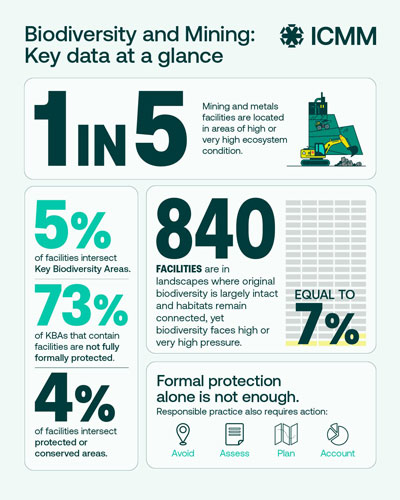
The findings are honestly more encouraging than I expected. Only 22% of mining facilities are located in landscapes of high or very high ecosystem condition — meaning places where original biodiversity is largely intact and habitats are still connected. Just 5% intersect Key Biodiversity Areas (KBAs), and only 4% overlap with Protected or Conserved Areas. Is that perfect? No. But is it better than the doom-scroll version I was bracing for? Absolutely.
Here’s what I’d do with this info as an investor: pay attention to which minerals carry which risks, because not all supply chains are created equal.
The dataset shows real differences across materials. Facilities producing antimony, diamonds, and lithium are overrepresented in high ecosystem condition areas — meaning more of that mining is happening in pristine environments, which is riskier from a biodiversity standpoint. On the flip side, platinum group metals, barium, and chromite are underrepresented in those areas. When it comes to KBAs specifically, manganese, tin, and diamond operations are overrepresented, while steel, lithium, and coal are actually below the global average there.
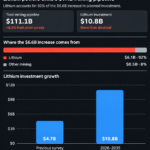
This is why I tell my coaching clients: when you invest in “green” themes like lithium for EV batteries, you’re not buying a risk-free story. Lithium shows up in both lists — overrepresented in high-condition landscapes but underrepresented in KBAs. Nuance matters. Your money has fingerprints on it, even through index funds.
The red flags worth knowing
One stat stopped me in my tracks: in Indonesia, 84% of mining and metals facilities — mostly thermal coal — are in high ecosystem condition areas that are also facing pressure from other drivers. That’s a compounding risk situation, like carrying credit card debt while also having a shaky income. Multiple pressures at once.
Then there’s Chrissiesmeer (Chrissie Pans) in South Africa — a wetland that is 100% irreplaceable for the survival of one species globally. Eighteen coal facilities operate there, and not a single one falls within a protected area. Eighteen. That’s the kind of concentration risk that makes both ecologists and responsible investors nervous.
And here’s the part that really matters for how your investment dollars create change: 73% of the KBAs with mining facilities inside their boundaries are not fully formally protected. The conservation values those sites were designated for depend largely on voluntary responsible mining standards and company commitments. Translation: right now, a lot of the protection happening is because companies choose to do it — not because the law requires it. Governments still have a major role to play in formalizing and enforcing protection.
What this means for your money
I’m not telling you to dump your portfolio or panic-sell anything. I’m telling you this: the energy transition and biodiversity protection are two goals that have to happen together, and data like this is how pressure gets applied where it matters most. When you invest in funds or companies that take biodiversity seriously, you’re voting with your dollars for a version of the future where we get clean energy without sacrificing the planet we’re trying to save.
This is why I always say investing confidently isn’t just about returns — it’s about knowing what you actually own. Ten minutes of curiosity about