# LiuGong’s Electric Mining Push: Impressive Numbers, But Do the Math Yourself
LiuGong threw its annual distributor conference in Liuzhou in November, themed around zero-carbon electric intelligence, and pulled in over 2,000 guests from 120-plus countries. Here’s what this really means: Chinese heavy equipment makers are no longer dabbling in electrification — they’re building entire product lines around it, and they’re doing it faster than Western incumbents like Caterpillar and Komatsu are comfortable with. That’s the part worth paying attention to, not the conference slogans.
The headline product is the DE100CE, a battery electric mining truck with a 97-tonne payload — the bigger sibling of the DR50C 50-tonner already in the field. There’s also the 110-tonne class DW165CE battery wide body truck. LiuGong showed off the diesel-electric DR100C at Mining Indaba earlier this year; this was the first public look at the all-battery version, which gets another spotlight at bauma CHINA in Shanghai. This isn’t the first time we’ve seen this circus — OEMs parading concept electric iron at trade shows — but LiuGong’s twist is that much of this kit is actually deployed, not just rendered on a screen. That distinction matters more than any press release.
The live demo was reasonably substantive: 11 machines across seven operational scenarios, covering stripping and loading, in-mine haulage, unmanned transport, site levelling, and road maintenance — a mix of electric, manned, unmanned, and remote-controlled equipment working in sequence. They also ran a live charging demonstration of a battery wide body truck off a solar microgrid with stationary storage. Show, don’t tell. Whether that microgrid setup pencils out at scale in a mine without Liuzhou’s weather is the real question, and nobody at a customer festival is going to answer it for you.
Overall, LiuGong displayed 210 pieces of equipment, 96 of them new energy. Nearly half the lineup. Five years ago that number would have been a rounding error at any heavy equipment show.
## The Conch Case Study Is the Real Story
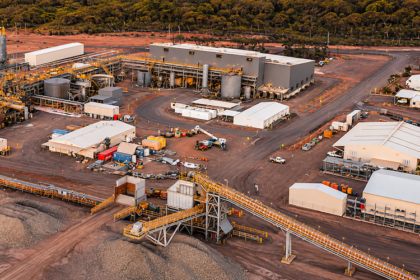
The most credible piece of evidence here isn’t the trade show — it’s what’s happening at actual mine sites. A customer delegation visited Xingye Kuiyang Conch Cement in Guangxi, part of Anhui Conch, where LiuGong battery equipment — the 995FE cable-powered excavator, 8128TE battery loader, DR50CE truck, and unmanned DW105AE wide body trucks — is doing real production work.
Conch is not a company that buys equipment for press photos. Since 2023, its transportation equipment procurement has been 100% electric. Its Baimashan operation in Anhui has been running since 2025 as a pilot for full electrification of drilling, loading, and hauling. When a cement giant with razor-thin margins commits its entire procurement pipeline to electric, that’s a stronger signal than any distributor conference keynote. Conch runs on cost per tonne, full stop.
And the unit economics, per LiuGong’s own figures, are the crux: the 995FE electric backhoe cut energy cost per tonne by 0.33 yuan, saving roughly 600,000 yuan annually. Converting Conch’s TR100 mining trucks from diesel to electric saves 0.636 yuan per tonne of limestone — about 31,800 yuan a month on 50,000 tonnes of production, or 380,000 yuan a year per truck.
Take these with the appropriate grain of salt — they’re the manufacturer’s numbers, not audited ones, and they assume diesel prices and grid electricity tariffs that won’t hold forever. That said, a diesel-to-electric spread of that magnitude in China is plausible given Chinese industrial electricity costs and diesel pricing. If the maintenance savings on electric drivetrains are real — and they usually are, because electric drivetrains have far fewer failure points — the total case gets stronger. The residual value question on used battery mining trucks, however, remains completely unanswered. Nobody knows what a five-year-old electric haul truck with cycled-out batteries is worth. Keep that in mind before assuming the TCO math is settled.
## The Full-Stack Play
LiuGong is positioning itself as a systems provider, not just a truck maker: a mining equipment matrix covering drilling, loading, hauling, and site levelling, anchored by the 995FE excavator, 8128TE loader, and DW105AE trucks, rounded out with a hybrid grader and electric dozer. On top of that sits a Smart Mine Management Platform integrating 5G, BeiDou, and AI for production scheduling, remote control, and safety warnings. And on the service side, lifecycle offerings covering energy consumption audits, charging planning, and TCO control.
This is the same playbook the whole industry is running — sell the mine, not the machine. What’s notable is that a Chinese OEM is executing it at this scale this fast. The autonomy claims deserve skepticism; “unmanned” trucks in controlled demo environments and unmanned trucks in production at a complex open pit are different animals. BeiDou-guided haul trucks on fixed routes are achievable. Fully autonomous loading cycles are still hard everywhere, for everyone.
## What Investors Should Actually Watch
If you have exposure here — Chinese equipment makers, battery supply chains, mining electrification services — the signal to track is not conference attendance or product announcements. It’s repeat orders from cost-disciplined operators like Conch, battery replacement cycles and their true costs, and whether these trucks hold up in mines without state-subsidized electricity or gentle climates. Africa, South America, and Southeast Asia will be the stress test.
The macro logic is straightforward: energy is the biggest controllable cost in surface mining, and hauling is the biggest energy consumer. Whoever electrifies hauling profitably wins a large slice of a very large replacement cycle. LiuGong is making a serious bid for that slice, backed by a customer whose purchasing decisions are driven by arithmetic, not slogans.
That’s not a hype cycle. That’s a cost curve. And cost curves, unlike trade show themes, don’t lie — though they can be selectively quoted. Verify the numbers at your own mine before you believe anyone else’s.