




# MasterMined Wants to Fix the Whole Mine, Not Just the Pieces. Here’s What That’s Actually Worth.
Mines have been “optimized” discipline by discipline for decades. Geology planned here, mine design there, ventilation somewhere else — each silo polished until it gleams, and the money leaks out through the cracks between them. MasterMined, an Australian outfit founded in late 2023, is pitching a systems-led approach: optimize the mine as one integrated system, and prove the gains with data, simulation, and modeling rather than consultant slideware.
Here’s what this really means: most of the losses on a mine site don’t belong to any single department. Bottlenecks nobody owns. Schedules that don’t reconcile between development and production. Capital spent relieving a constraint that actually sits three links downstream. Anyone who’s run an operation knows this in their bones. The question has always been whether you can *evidence* it well enough to force change — because mines don’t change because a consultant tells them to. They change when the numbers are undeniable.
**The operator credentials matter**
Tony Sprague, MasterMined’s CEO, carries a resume from Newcrest, Rio Tinto, Fortescue, KCGM, and Barrick. That’s the right pedigree for this pitch, because the hardest part of this business isn’t the math — it’s the change management. Site crews are drowning. Sprague’s own description is blunt and, in my experience, accurate: productivity has been sliding for a decade, development costs keep climbing, annual budgets get missed routinely, and operations are so stretched they can’t stop to talk to you. The place is a house of cards and everybody on site knows it.
There’s also an uncomfortable truth baked into this pitch: the incentive structures on site *reward* siloing. Monthly and quarterly budgets discipline everyone into short-term, department-level thinking. A systems approach asks people to optimize something they don’t personally get bonused on. That’s why most of these initiatives die. Not because the model was wrong — because the culture was.
**The product stack**
MasterMined runs a small core team with a bench of 15–20 specialists, and three products:
**FlowCycle** simulates underground development and production cycles in detail, showing where the schedule bleeds time — bottlenecks, uplift potential, design flaws. The claimed target is a 15–20% productivity uplift from the *same* fleet and crews. Now, I’ve watched vendors promise double-digit gains from existing assets for thirty years. Most of the time the real number lands at half that, and the gains erode once the consultants leave. What distinguishes a serious offering is methodology, and FlowCycle’s is at least disciplined: three states, in order. First, a calibrated model of how the mine actually performs, built from the site’s own data and signed off by the site before anything is compared against it. Second, the same mine run on FlowCycle’s operating logic — nothing bought, nothing replaced. Third, improvement initiatives quantified in dollars per metre against that stable baseline. That sequencing is correct. Any claim of improvement made against an unstable, uncalibrated baseline is worthless, and most operational “uplift” studies I’ve seen skip straight past this step to make the numbers look good.
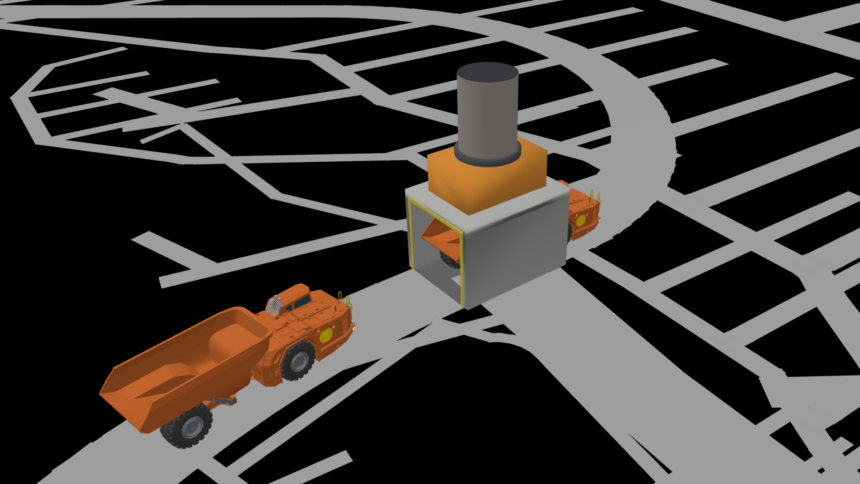
**GreenLeap** is a physics-based simulation of the entire materials handling system — fleet, ramps, declines, ore passes, crushers, conveyors, shafts, hoisting — plus the energy draw, heat load, and ventilation demand that follows. Critically, it’s OEM-independent, comparing diesel, battery-electric, hybrid, and trolley solutions on equal footing. This is the most immediately valuable of the three products in my view, because the battery-electric fleet conversation right now is being driven by OEM marketing decks and conference keynotes. This isn’t the first time we’ve seen this circus — every technology transition in mining gets oversold by the sellers and under-modeled by the buyers. A physics-based, vendor-neutral comparison of energy, heat, and ventilation load across real mine geometry is exactly the kind of sober analysis the electrification hype cycle needs. Sprague says OEMs are cooperating to make sure their options are modeled correctly, which is encouraging but also self-interested — trust the model, not the vendor’s enthusiasm for it.
**OreMaster** is the newest piece: an AI-native planning tool that goes from block model to cost model. Built in-house, with over 1,000 embedded engineering rules covering stoping, sub-level caving, block caving, and open pit. The design is granular — stopes, levels, declines, portals, ventilation, escape routes — and every option is checked against true 3D geometry and tested against the process plant, paste fill, infrastructure, and materials handling before it’s valued. The same cost model is applied to every option, so the client sees why one beats another, with human engineers signing off the plan.
The AI framing deserves scrutiny. Every software vendor on earth is stamping “AI-native” on their product now, because that’s what raises money. Here, at least, the claim has substance: the AI generates and costs planning options at a scale a human team can’t, while the rule base and engineer sign-off constrain it. That’s the right architecture — machine breadth, human judgment at the gate. I’d still want to see how the rule base handles a genuinely unusual orebody. Rules encode accumulated experience; the deposits that destroy projects are the ones that violate the accumulated experience.
**Adoption and the honest constraints**
Two Tier 1 miners are already running combinations — one on OreMaster with GreenLeap, another on FlowCycle with GreenLeap — and a third is lining up all three together. GreenLeap reportedly has broad use among major miners for studies and assessments. Tier 1 adoption is the real tell here; big miners have procurement processes designed to filter out exactly this kind of vendor promise, and they don’t sign up twice by accident.
But the risks are real and worth naming. First, the 15–20% figure is a target, not a guarantee, and it depends entirely on the site having bandwidth to absorb new work practices — which, per Sprague’s own house-of-cards description, most don’t. Second, the gains only stick if the culture holds after the engagement ends. MasterMined’s own emphasis on stability and site sign-off suggests they understand this, which is more than can be said for most of the industry.
Third, integration risk. The pitch — “no other system links design, mining, materials handling, processing and backfill like OreMaster does” — is either the future of mine planning or an integration nightmare waiting to happen, depending on how well these tools talk to the legacy systems already entrenched on site. Mines have been burned by grand unified platforms before.
**The bottom line**
The core insight here is sound and unglamorous: the losses live between the disciplines, and you can’t fix what you can’t simulate. A company run by actual operators, selling calibration-before-claims methodology and vendor-neutral fleet comparisons, is a rarer animal than the usual tech pitch. If the numbers hold up under site sign-off, this is the kind of unsexy operational engineering that actually compounds value — the kind markets routinely ignore while chasing the next narrative.
Just keep your skepticism calibrated. Twenty percent is the ceiling they’re selling. The floor is what matters, and that’s what the State 1 calibration exists to find out.
Source: https://im-mining.com/2026/11/18/mastermined-intent-on-showcasing-minings-operational-potential/