




# Containerised UF/RO Water Plants at Remote Mine Camps: Why the Specs Fail Six Months After Handover
Here’s what this really means when a mine camp asks for a packaged ultrafiltration and reverse-osmosis plant: the enquiry usually arrives with two numbers — cubic metres per day and a TDS figure off a lab sheet. Both matter. Neither tells you whether that plant is still running six months after the handover. I’ve watched enough projects get sold on container size and daily volume to know that the thing that kills them is almost never the membranes. It’s everything the tender forgot to mention.
This is a technical discussion for engineers and camp-services managers, not a case study, and it doesn’t report results from any named site. The gaps below are specification and design gaps that show up on packaged membrane plants with depressing regularity.
## The usual train — and where it gets gutted
The treatment train is straightforward: pre-treatment, then ultrafiltration where a tight particle barrier is needed, then reverse osmosis where dissolved solids have to come down, then re-mineralisation and disinfection before the water hits the camp distribution. Sounds simple. Then somebody prices a container that holds only an RO skid and leaves the rest for “site installation.” That’s where the trouble starts. This isn’t the first time we’ve seen this circus — cheapest bid wins, and the camp drinks the consequences later.
## The raw-water sheet is usually too thin
Membrane plants fail first on the water nobody told them about. A TDS figure and a pH are not a design basis, no matter how confident the procurement officer sounds. The enquiry should include turbidity, silt density index (SDI) where measurable, iron and manganese as both total and dissolved, hardness, alkalinity, sulphate, barium, strontium, reactive silica, organics, temperature — and, critically, whether the sample came from the dry season, the wet season, or a well that’s only just been pumped.
Anoxic groundwater often carries dissolved iron and manganese that are invisible in a fresh sample. Once they meet air or an oxidant, they form particles that plug cartridges and the lead RO elements. UF retains those particles; it does not remove dissolved Fe²⁺ or Mn²⁺. Hardness and reactive silica are also untouched by a particle filter — they concentrate in the RO reject in proportion to the concentration factor, 1/(1 − recovery). At 75% recovery that factor is 4. At 80% it’s 5. At 85% it’s about 6.7. A water that looks comfortable at 70% recovery can be staring at a silica or carbonate limit at 80%. Here’s what this really means: recovery is the output of a scaling projection, not a number somebody wrote into the tender because the well yield is tight or the pond is small. I’ve seen more specs ruined by an optimistic recovery figure than by any equipment failure.
Seasonal change is the other routine omission. The same well field, or a blend with surface water after rain, often shows rising turbidity and shifting iron. A train designed around a dry-season sample is usually the first one to struggle after handover. Samples should be taken after the borehole has been pumped long enough to be representative, and each well that might be used needs its own data. One sample, one well, one season — that’s a guess, not a design.
## Pre-treatment and the limits the RO actually sees
Spiral-wound RO elements are not a substitute for pre-treatment. Membrane manufacturers commonly require the 15-minute SDI of the RO feed below 5 and recommend a lower working target, often below 3, with feed turbidity below 1 NTU. What matters is whether the filtrate stays inside those limits after a backwash and after a season change — not a single good result on a clear day. Anybody can look good on a clear day.
Multimedia filtration is often sufficient when the raw water is consistently low in turbidity and the filtrate meets those limits with margin. But it’s not a tight physical barrier: after backwash the bed is still settling, and a pulse of solids can reach the cartridges. UF, usually hollow-fibre, is the more reliable barrier when the water is variable, attendance is limited, or a consistently low-SDI feed is required. Published work on integrated membrane systems typically reports UF filtrate turbidity around 0.04 to 0.1 NTU and SDI values of roughly 0.3 to 2 in normal operation. Those are typical practice figures to be confirmed on the actual water — not a performance guarantee, and any vendor quoting them as one is selling you something.
The specification should say which barrier is required, how it will be cleaned, and how backwash waste, cleaning waste and concentrate will be handled. Do the arithmetic. Even a modest camp plant producing 100 cu.m/d of permeate at 75% recovery discharges about 33 cu.m/d of concentrate. At a remote mine that volume has to go somewhere — an evaporation pond, blending with other site water, or another permitted route. Leaving it as “by others” is how a plant that works beautifully on paper never gets started. I’ve seen paper plants before. They’re cheap and they run forever, right up until someone turns a valve.
## After the membranes: water the camp can actually drink
RO permeate is low in dissolved minerals and often slightly acidic. It can be unpalatable and aggressive to pipes and heaters. The WHO hasn’t set a health-based guideline value for TDS; it notes palatability is generally good below about 600 mg/L and becomes significantly and increasingly unpalatable above about 1,000 mg/L. Re-mineralisation — typically a calcite contactor or a controlled dose of calcium and alkalinity — and pH adjustment belong in the train, not as a later add-on when someone complains the water tastes like nothing and the hot-water system starts corroding.
Disinfection after the membranes is equally part of the plant. UF and RO reduce microorganisms, but they leave no residual for the distribution system — and water sitting in pipes 500 metres from the container doesn’t stay sterile on goodwill. WHO guidance for small supplies is to keep turbidity below 1 NTU for effective disinfection (below 5 NTU if that target can’t be met), to maintain a free chlorine residual of at least 0.2 mg/L at the point of delivery, and to raise that to around 0.5 mg/L where users collect and store water themselves. Chlorination works as intended only when pH is below 8, with a usual working range of about 6.5 to 8.5. A camp that skips this step, or can’t measure residual chlorine and turbidity after start-up, is relying on membranes for a duty they were never designed to carry. That’s not engineering. That’s hope.
## The container, the power and the people
A container is a convenient way to ship a plant. It’s also a small room that can overheat, freeze, collect dust and lose power. FilmTec elements, for example, have a normal feed-temperature limit of 45°C. In a closed box in a hot climate, the air around panels, pumps and membranes can exceed what the equipment was designed for. The specification should cover insulation, ventilation or air-conditioning, freeze protection where needed, and access to change a cartridge or membrane without dismantling the container. Power quality belongs there too: high-pressure RO pumps and variable-speed drives do not forgive a generator that sags or spikes. Any veteran of remote-site operations already knows what site power looks like. Write it into the spec.
Redundancy is a camp-services question, not a luxury. If the camp cannot be without water, duty and standby pumps and enough capacity to run while one train is cleaned should be stated in the enquiry. So should a commissioning spare-parts list: cartridges, anti-scalant, cleaning chemicals, seals, at least one spare membrane element. A plant that waits six weeks for a filter cartridge is not a reliable camp supply — it’s a boat anchor with a logo.
Factory acceptance testing is necessary and not sufficient. FAT usually runs on clean water: it proves the skid starts, the instruments read and the control sequence works. It does not prove the pre-treatment can handle the borehole. Site commissioning on the actual raw water, with operating staff present and a manual that states cleaning triggers in measurable terms — pressure drop, normalised flow, SDI, residual oxidant — is what closes the job. And if attendance after handover will be limited, that’s a design input: it argues for a more robust barrier, clearer interlocks and, where communications allow, remote monitoring of flow, pressure and conductivity. Ignore this and you’ve bought a plant that needs a full-time operator you haven’t hired.
## What the specification should cover
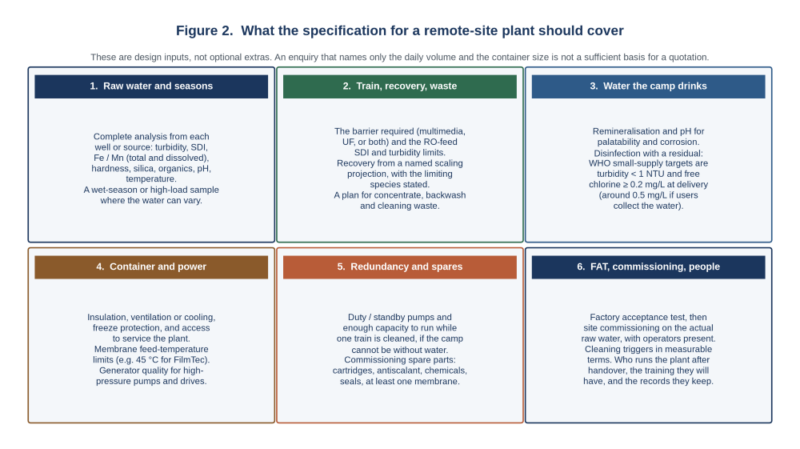
All of the above fits into a short specification: a complete raw-water analysis from each source, including a wet-season or high-load sample; peak and average demand; the treatment train and the RO-feed limits it must meet, with recovery tied to a named scaling projection and a stated plan for concentrate; post-treatment for palatability, corrosivity and disinfection; the container environment and power supply; and redundancy, spare parts, FAT, site commissioning on the raw water, and — the one everybody forgets — who will operate the plant after handover.
None of this requires exotic equipment. It requires the