




Ada Tepe, Bulgaria’s first greenfield mine in over 40 years, shut down in July as planned — and now it’s being held up as a case study in mine closure done right. I’ve been around long enough to be suspicious of “world-class case study” language coming out of a company’s own PR machine, but after looking at what DPM Metals actually did here, the substance holds up better than most. Let me walk through it, minus the confetti.
**The basics, stripped clean**
Ada Tepe is an open-pit gold mine 3 km south of Krumovgrad, commissioned in 2019, owned by Canada-based DPM Metals. Mining wrapped July 15. Over roughly seven years, the operation moved about 6 Mt of material at an average grade of 4 g/t gold, producing roughly 50,000 t of gold concentrate. Standard drill, blast, load and haul. Crushing, milling, flotation. Nothing exotic on the extraction side — the interesting part is what happens after the trucks stop rolling.
Here’s what this really means for the bigger picture: DPM spent more than double the mine’s operating life getting permits and building community support — including negotiating agreement with Greece as a trans-boundary stakeholder. Seven-plus years of paperwork and diplomacy for seven years of production. Anyone telling you the bottleneck in Western mining is geology or capital hasn’t done a project in the EU lately. permitting risk is the asset class nobody prices properly. Companies that master it — slowly, expensively, unglamorously — are the ones that actually deliver.
**The constraints that shaped everything**
The site sits inside an EU Natura 2000 protected habitat area, with a protected underground water body in the alluvium of the Krumovitsa River — which flows below the mine’s waste facility. Oh, and archaeologists found the earliest known gold mine in Europe on the same hill. Talk about a stakeholder list: regulators, tortoises, aquifers, and ancient Thracians. That’s the modern mining reality, and DPM engineered around all of it rather than fighting it. That pragmatism, frankly, is the real lesson — not the equipment.
**The waste facility: the actual story**
The Integrated Mine Waste Facility (IMWF) is the centerpiece. Instead of the conventional setup — a tailings pond over here, a waste rock dump over there — DPM combined waste rock and thickened (dry-stack style) tailings into a single engineered facility with a 41 ha footprint and 23 Mt capacity. Going integrated cut the disturbed area from roughly 100 ha to 41, which happens to protect habitat for two protected tortoise species. The approach qualifies under the EU’s Best Available Techniques framework, which, for those who haven’t navigated EU regulation, is the bar you clear or you don’t operate.
The tailings management is the differentiator. Integrated facilities aren’t new — what’s new is the active drainage design. A network of drainage layers continuously pulls moisture out of the thickened tailings, so the material gets denser and more stable throughout operations and long after closure. Conventional tailings storage keeps water locked in the mass for decades; that’s precisely what turns tailings dams into the industry’s recurring nightmare. Brumadinho, Mount Polley, Stava — this isn’t the first time we’ve seen this circus, and it won’t be the last where water-saturated tailings are left sitting behind an embankment. Draining them is the single most effective risk reduction available, and every operator storing wet tailings without a credible dewatering plan is carrying a liability that will eventually show up on someone’s balance sheet, possibly violently.
The build itself was staged. Platforms went in first in both gullies, thickened tailings piped from the plant to discharge points in cells, and waste rock used to construct the berms that contain everything — outer berms for containment, internal berms separating cells and supporting equipment access. The sequencing discipline mattered early on when storage was tight; you need tailings consolidated before you stack the next cell on top. No shortcuts available.
**Progressive rehabilitation: close it as you go**
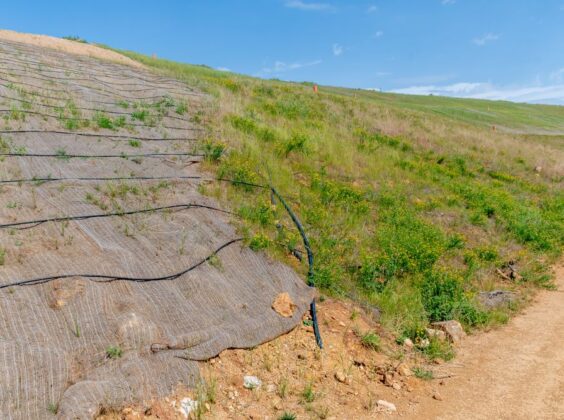
Here’s a practice I wish was universal: individual cells were closed and rehabilitated while the mine was still running. That cuts erosion, cuts dust, and — this is the part bean counters miss — it means the final closure bill doesn’t arrive as a single, politically ignorable lump sum at the end. Deferred closure costs are where mining companies historically underfund and then beg for leniency. DPM front-loaded the work. Capping is expected complete by end of November, full technical rehabilitation of the IMWF by end of 2026, active rehabilitation site-wide by end of 2028, with a stable landscape handed to Krumovgrad by 2032. Roughly two-thirds of the facility’s footprint already has technical and biological rehabilitation done. Vegetation is Natura 2000-compliant, chosen with the regional forestry authority, using local species.
**Water: the make-or-break variable**
The Krumovitsa River sits 150 m east of the facility, over a protected aquifer. One failure here and the whole “responsible mining” narrative collapses, so the water engineering deserves scrutiny. An underdrain system collects rainfall and water released by the consolidating tailings. A two-zone filter prevents tailings particles migrating through the berms. Water collects in sumps and gets pumped back into the mine’s water circuit for reuse — in a region with a negative water balance, that’s both environmental and operational sense. Surplus water gets treated before discharge, with the plant designed to hit drinking-water quality on chemical parameters. A grout curtain — roughly 540 m injected into bedrock along the facility’s base — limits seepage toward the river, backed by a drainage system and inclined wells down to 45 m that lower groundwater pressure on the barrier.
The waste itself tested as non-hazardous, non-inert: arsenic, cadmium, mercury, lead and the rest of the usual suspects all under hazardous thresholds, and acid-generation tests came back negative for both rock and tailings. Annual testing continues to verify those assumptions. Sensible. Assumptions without ongoing verification are how these stories go sideways.
DPM is also testing two water treatment options for the post-rehabilitation phase, with treatment continuing until inflows cease or water quality naturally hits drinking standard. That’s a real, funded, indefinite-ish obligation — exactly the kind of tail liability that should be priced into any miner’s enterprise value. Most aren’t. Read the footnotes.
**Monitoring: the boring part that matters**
Post-closure monitoring runs at least 10 years: 40 standpipe piezometers, 54 electrical piezometers for pore pressure, 20 inclinometers, seven extensometers, survey points tied to fixed benchmarks. Results reviewed by an Engineer of Record, plus an annual Independent Tailings Review Board. None of this is sexy, but pore pressure in tailings is what kills people when it’s ignored. Any tailings facility without independent review should make you walk — I’ve sat through enough management presentations to know that self-grading is not a risk management system.
**The community piece — with appropriate skepticism**
DPM signed a 2015 memorandum with the Krumovgrad municipality and set up a $5 million fund supporting small and medium enterprises outside mining, plus healthcare and education spending. Now, I’ve watched enough “community benefit funds” to know they can be reputational window dressing — a rounding error against project NPV with a ribbon-cutting photo op. But the structure here at least attempts something durable: building an economy that outlives the mine, which is the only test that matters. Company towns that die with the pit are a story as old as mining itself. Whether this fund actually delivers in 2040 is unknowable today. Track it.
**The takeaway for investors**
The genuinely transferable lesson from Ada Tepe is sequencing: closure and rehabilitation were designed in from day one, not bolted on when the ore ran out. That philosophy — dry tailings, progressive closure, water recycling, funded monitoring — costs more upfront and returns less headline gold per dollar of capex, which is exactly why most operators don’t do it. When you evaluate mining companies, the quality of their closure and tailings plans is a proxy for management quality generally. Companies that engineer for the end before the beginning tend to run everything else with the same discipline. DPM set a real benchmark here. Whether the rest of the industry follows it before the next tailings disaster forces the question — well, I’ve seen that movie, and I don’t love the ending.
Source: https://im-mining.com/2026/11/06/a-global-benchmark-for-mine-waste-management/


