




Let me save you the corporate translation work: District Metals (DMX.V) has spent the last few years pushing its Viken uranium-vanadium project in Sweden hard enough to produce an updated mineral resource estimate and economic studies, and now the real bottleneck emerges—bureaucracy, not geology. Drill testing of MobileMT conductive anomalies continues while the company navigates permitting. Yes, there’s a PDF you can download. Thrilling.
The economics first, because that’s the only part that matters. Viken hosts 4.8 billion tonnes of alum shale—456Mt indicated, 4.33Bt inferred. Using a base case uranium price of $85/lb (fairy generous, though actually on the lower end of what junior miners have audaciously used in their own studies), the PEA spits out an after-tax IRR just under 46% and an NPV8 of US$2.9 billion. And here’s the part people keep repeating like it’s a magic incantation: that mine plan uses only ~3% of the total resource. Impressive on paper. Also entirely irrelevant until something is actually permitted in Sweden.
An independent BDO Canada study from July calculated the broader economic impact of a 13-year first-phase mine: US$7.66 billion added to the economy, US$7.63 billion of it staying in Sweden. That breaks down into roughly US$1.58 billion in corporate income tax, ~1,065 direct and indirect full-time jobs with ~US$200 million in associated income tax, US$1.48 billion in domestic construction and operating spend, and a rounding-error US$29 million in mining fees split 3:1 between landowners and the state. Nearly US$1.8 billion in total tax revenue—from 3% of the resource. If you’re impressed by that math, good. It is genuinely good math. It’s also a hypothetical sitting behind a political process that moves at glacial speed.
The sensitivity table shows the project still clears a 30%+ after-tax IRR with metal prices 20% below base case. That’s a real margin of safety, which is more than you can say for 95% of junior mining “NPVs” paraded around chat forums by people who don’t understand what a discount rate is.
Now the actual obstacle. Sweden lifted its uranium moratorium on January 1, 2026, and removed the municipal veto on uranium processing on July 15, 2026. Two real wins. But Viken sits in alum shale, and the government launched an inquiry into alum shale mining—possibly including a new municipal veto on that specific geology. Results due February 17, 2027. That single date is worth more to your investment thesis than every drill hole combined.
Meanwhile, the country has no government. Sweden voted September 13, 2026, and six weeks later the caretaker administration is still running things. The centre-left won 176 seats to 173—a margin of roughly 50,000 votes nationally—while the Social Democrats posted their worst result in over a century. Andersson’s proposed minority government got exactly one party’s vote in the Riksdag: her own. The Centre Party’s 25 seats are kingmakers, but they refuse coalitions with both the Left Party and the Sweden Democrats, making a majority bloc nearly impossible. If the Speaker burns through four failed PM candidates, the constitution forces new elections. A snap election isn’t good or bad for District specifically—but delay is the enemy, and delay is what this process manufactures.
The genuinely encouraging data point: only 77 of 349 Riksdag seats went to parties opposing the end of the uranium ban. The Social Democrats flipped on nuclear and now accept uranium mining as a by-product—which is exactly how Viken works, with uranium as a credit to vanadium production. Whatever government emerges, that political current is flowing the right way.
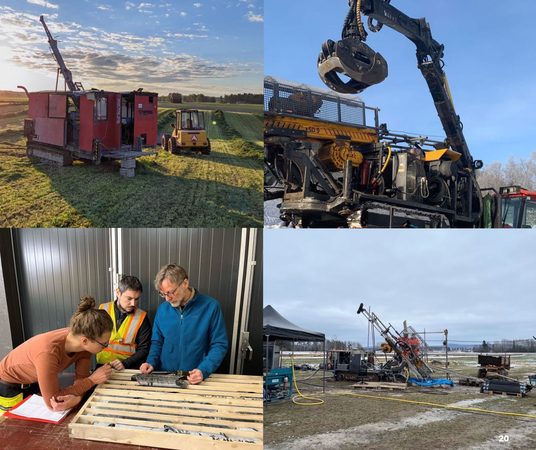
On drilling: Target A and B, two conductive anomalies from the 2025 MobileMT survey, sit 1.7 and 7.5 km from the known deposit and are actually larger and stronger than the anomaly hosting the 4.8 billion tonne deposit. Hole VIK-26-001 hit alum shale from ~44m down to ~199m—roughly 155 metres of core length in a 300m hole—and subsequent holes hit up to nearly 200 metres of shale starting near surface. Let me be the adult in the room: visual logging confirms rock type, not mineralization. Visual shale is not uranium. The assays arrive in December or early 2027, and until then any excitement you feel is self-generated.
The satellite properties are optionality, nothing more. At Nianfors, 34 rock samples returned 4–937 ppm U�


