Oman’s Minerals Development Oman (MDO) just handed a 10-year operations management contract for the Mazoon Copper Project to Hongda Blasting Engineering Group — via its overseas arm Hongda International SPC — at a price tag north of US$416 million. Here’s what this really means: Oman is serious about getting copper out of the ground, and it’s renting Chinese expertise to do it instead of building it at home. That’s pragmatic, not romantic. Whether it’s wise depends on how the next decade of copper prices unfolds.
The scope is straightforward mining work — ore extraction, waste stripping, hauling to the concentrator, all executed to spec and safety standards. Announced November 2 at the Oman-China Investment Partnership Horizons Forum. No surprises there. Gulf states have been courting Chinese capital and contractors for years, and mining is the newest dance partner.
Hongda Blasting sits under Guangdong Handar, founded in 1988, HQs in Guangzhou and Beijing. They run integrated mining services — design, construction, open-pit and underground work, extraction, processing — with the usual “smart and sustainable mining” talking points you’ll want to discount by half. The real numbers: roughly 100 active operations, 4 billion tons a year of open-pit mining and stripping, 60 Mt of underground ore annually. They’re the biggest contractor in Pakistan’s Thar Coal Field Blocks I and II and a major services supplier to Zijin. That’s a real track record, not a pitch deck. This isn’t the first time we’ve seen Chinese contractors undercut Western incumbents on large resource projects, and frankly, in the mining services game, they’ve earned the business through volume, not slogans.
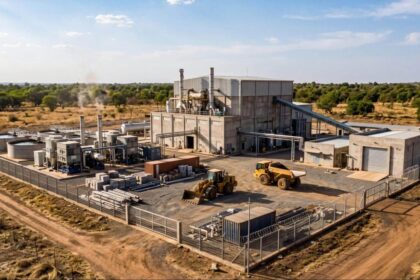
Now, the asset itself. Mazoon — formerly the Yanqul Copper Gold Project — is Oman’s largest integrated copper concentrate play, sitting on 20 square kilometres in block 12A-2 in the Wilayat of Yanqul, Al Dhahirah Governorate. Five open pits, 23.4 Mt of copper ore reserves. Startup targeted for 2027, producing around 115,000 tonnes a year of 21.5% copper concentrate from 2.5 Mt/y of mined ore. Pre-stripping started September 2026.
Some context the press release won’t emphasize: a 21.5% concentrate grade is respectable but not spectacular — clean concentrates run mid-to-high 20s. The reserve base is modest by global standards. This is a mid-sized operation, not an Escondida. What makes it interesting is jurisdiction. Oman is politically stable, infrastructure-adequate, and hungry to diversify away from hydrocarbons. In a world where the big copper discoveries are locked up in Chile, Peru, the DRC, and Indonesia — each with their own extraction costs, political or literal — a reliable 115,000 tonnes a year from a cooperative Gulf state is worth something.
The buyer of that concentrate matters too. Smelters across Asia, particularly in China, have been hungry for concentrate supply for years as mine-side growth lags smelting capacity. Odds are strong this material gets sold east before it’s even pulled from the pit. Oman knows who its customer is.
The project has been assembled the way these things usually are — a shopping list of tier-one vendors. Lycopodium took the EPCM contract in late 2023 for A$45 million, a firm with a solid reputation for mid-tier projects that actually get built on schedule. In early 2025, Metso locked in roughly US$30 million for the core process equipment: Nordberg C130 jaw and HP200e cone crushers, apron feeders, SAG and ball mills, reline equipment. Flotation includes TankCell mechanical cells and Metso’s high-intensity Concorde Cell units, with HRT thickeners running a Reactorwell feed system. MHC hydrocyclones for classification, Larox PF60 and FFP 3512 filters for concentrate and tailings dewatering. A PSI500i particle size analyser and a Courier 6X SL on-line elemental analyser for continuous grinding and flotation optimization — recovery up, waste down.
This isn’t exotic equipment. It’s the standard playbook, and that’s a good thing. When I see a junior-flavored project buying proven gear from vendors with global service networks, I breathe easier. The graveyard of mining is full of projects that tried to innovate on the comminution circuit and died on commissioning. Mazoon isn’t trying to reinvent anything, which tells me the operators intend to actually produce copper rather than produce headlines.
The risks, then, plainly. First, execution. A 10-year contract with a Chinese contractor is cheap on paper and complicated in practice — labor logistics, local content requirements, and the inevitable frictions of operating in a Gulf regulatory environment. Second, grades. That 23.4 Mt reserve will need to grow or the project is a decade-long story, not a generation one. Expansion depends on exploration success in a geology that’s proven but not extraordinary. Third, and most importantly for anyone reading price charts: copper’s long-term story is real — electrification, grid buildout, data centers — but the market has a habit of front-running the narrative. The last time everyone agreed copper was structurally short, prices corrected hard and stayed down for years. The metal is needed; the timing of when you pay for it is everything.
For Oman, the calculus is simpler. This is economic diversification with a real commodity attached, not a sovereign fund bet on venture dreams. Copper revenue in the 2030s is worth locking in now. For Hongda, it’s another foothold outside China’s borders, following the Pakistan coal work — geographic diversification of revenue at a time when Chinese domestic mining margins are tightening.
The sane takeaway: this is a well-structured, conventionally equipped, moderately sized copper project in a friendly jurisdiction, with competent contractors, timed to a metal that the world genuinely needs more of. No circular economy fairy tale, no tech hype, just shovels in Omani dirt. Watch the 2027 ramp-up. Projects live or die in the first eighteen months of production, and the ones that matter are the ones that ship.