




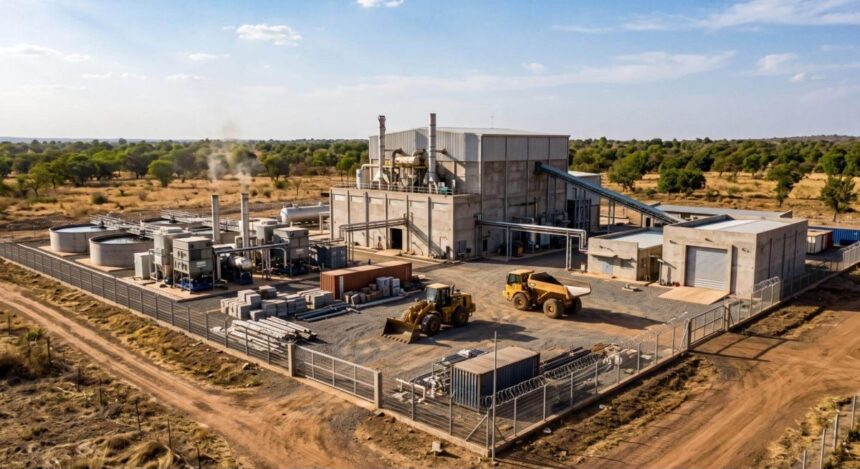

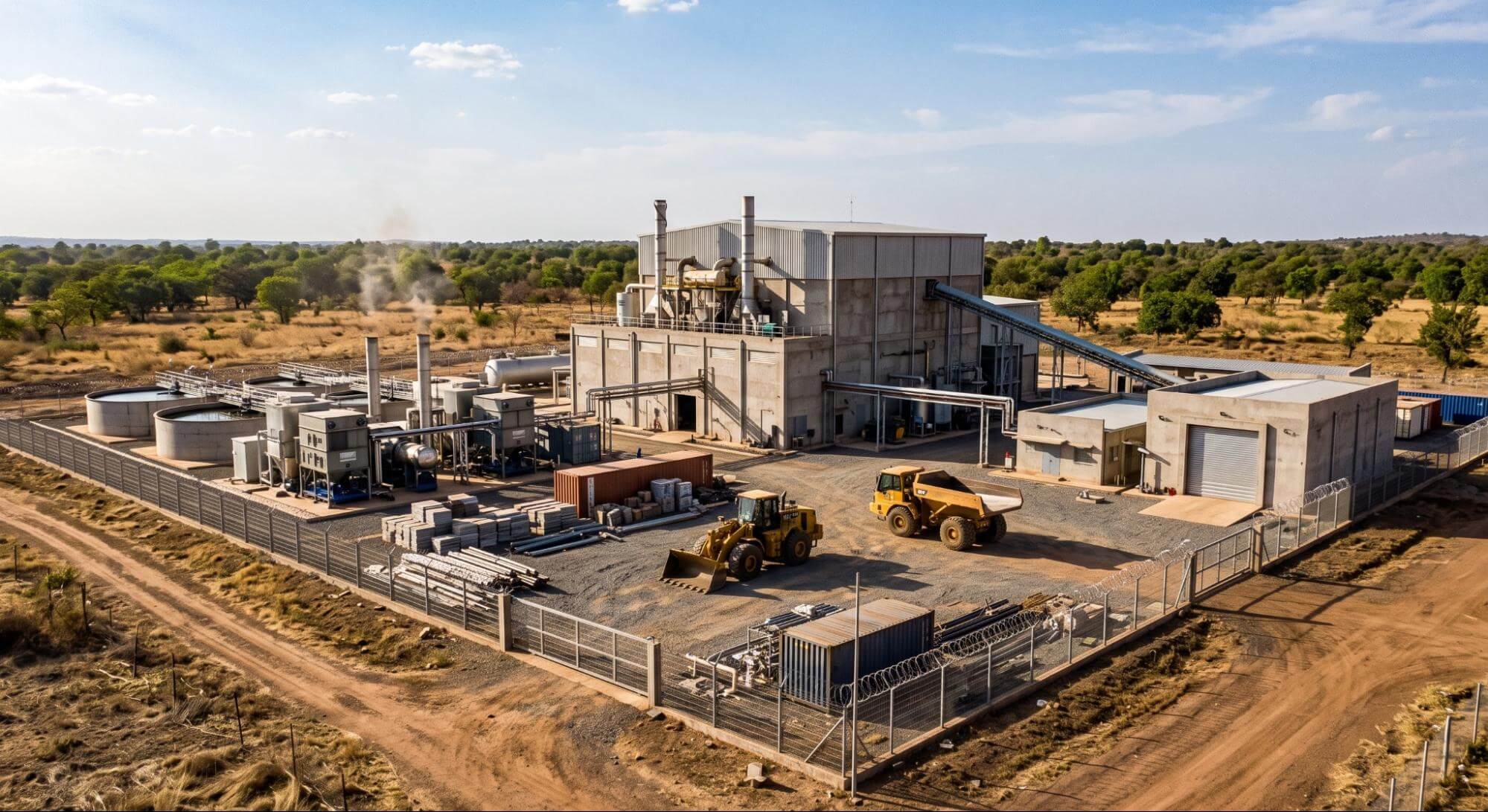
Burkina Faso has commissioned its first domestic gold refinery. Strip away the press-release framing and the setup is straightforward: the state now controls refining, assay, certification, and storage of bullion produced within its borders. Capacity announced is 164 tonnes per year at Raffinor-BF in Ouagadougou, against national output of roughly 94 to 100.7 tonnes in 2025. That is a structural mismatch worth dissecting, because capacity far exceeding supply is rarely accidental.
The facility cost more than 11 billion CFA francs, approximately US$19 million, financed through public channels including the National Precious Metals Company (SONASP) alongside private domestic capital. A second phase would lift capacity to 515 tonnes annually — over five times current mine output. When a refinery builds throughput capacity that dwarfs domestic feed, the implied thesis is regional consolidation. The design assumption is that material will be imported from across West Africa, not merely processed locally. Whether that assumption gets validated is a supply-chain question, and supply chains are where these sovereign downstream projects tend to break.
The Capacity Equation
Break down the 2025 production profile. Industrial mines — 15 of them — delivered approximately 58 tonnes. Artisanal and semi-mechanized operations contributed more than 42 tonnes. That second number is the one that matters for this refinery, and it is the least reliable number in the dataset.
Artisanal output is the portion of Burkina Faso’s gold economy that historically leaked out through informal channels and smuggling. The state suspended gold exports from artisanal and semi-mechanized operations in 2024, explicitly to tighten control over informal trading. Building a refinery is the next step in the same sequence: capture the unregulated flow, force it through a state-monitored node, and formalize what was previously uncounted. The 42-tonne artisanal figure was always a floor estimate, not a ceiling — much of that metal moved without documentation. Routing it through Raffinor-BF will produce a cleaner statistical picture, and officials will inevitably present the resulting uptick in recorded volume as growth. It is not growth. It is measurement change. Traders who confuse the two will misprice the trend.
The plant itself sits on roughly five hectares, with refining, laboratory assessment, certification, and secure storage under one roof. Vertically integrating those stages domestically means value retention that previously exited the country with doré shipments. That is real, but it is a policy outcome, not a market signal. Price is the truth, and the price of gold does not care where doré gets refined.
Dependency Metrics
Gold accounted for nearly 94% of Burkina Faso’s export earnings in the first seven months of 2026. Read that number as a risk metric, not a strength metric. A single-commodity concentration above 90% means the national balance sheet is effectively a leveraged position on one asset class with no hedge. Every downstream policy move — refinery, export bans, state buying monopolies — is an attempt to add margin to that position because the country cannot diversify the underlying exposure.
For operators with producing assets in Burkina Faso, the relevant question is margin compression, not demand. A state-controlled refinery with a captive domestic supply is a monopsony buyer in waiting. Jurisdictions that consolidate the offtake side of a commodity chain historically extract economics from producers over time, through pricing, fees, or regulatory leverage. Companies with Burkina Faso assets should be modeled with wider jurisdictional discounts, not narrower ones, despite the official narrative of value addition.
The Policy Sequence
The refinery is one leg of a coordinated build-out since President Ibrahim Traoré took power in September 2022. The state raised its free-carried interest in mining projects from 10% to 15%. It established SOPAMIB, a state mining company. It expanded public involvement in purchasing and managing precious metals. It suspended artisanal gold exports. Now it owns the refining node.
This is a textbook sequence: increase equity stakes, nationalize the trading layer, cut off informal export channels, and finally capture downstream processing. Each step reduces the negotiating power of foreign operators relative to the state. None of it is hidden. Markets that continued to price Burkina Faso mining assets as if the 2022 status quo held were ignoring the tape. The trend in state control has been one-directional for four years, and one-directional trends do not reverse on hope.
The security overlay remains the dominant unpriced variable. Armed groups connected to al-Qaeda and Islamic State have operated across mining regions for years, and illegal gold trading has been linked to their financing. Insecurity restricts state control in parts of the country — which means the refinery’s effective feed volume depends on territory the government does not fully control. Announced capacity is a ceiling, not a forecast. Actual throughput is the number that will matter, and that number will not be published with any reliability. This setup lacks confirmation at the operational level.
The Regional Picture
Burkina Faso is not acting in isolation. Guinea has prohibited raw gold exports outright. Ghana has restricted exports of unrefined material from small-scale miners. Mali is developing its first refinery. Ivory Coast plans to commission one next year. The entire region is converging on the same playbook: keep doré in-country, force domestic refinement, capture the margin.
Aggregate the announced refinery capacity across Mali, Ivory Coast, and Burkina Faso and compare it to aggregate West African mine output. The numbers will not reconcile. When every jurisdiction builds processing capacity sized for ambitions rather than production, the result is a regional capacity glut competing for a fixed feed. The refiners with the cheapest logistics and the strongest state enforcement will run at utilization; the rest will sit idle. Raffinor-BF’s 515-tonne second phase is a bet that Burkina Faso wins that contest. The 164-tonne first phase is the only commitment with visible funding, and even its utilization rate is an open question. Treat the expansion number as an option, not a plan.
The stated employment figures — roughly 100 direct jobs, more than 5,000 indirect — are political framing. They do not
Source: https://www.miningfeeds.com/burkina-faso-opens-first-gold-refinery-with-164-tonne-annual-capacity/


