




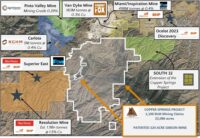
Coyote Copper Mines Inc. has secured an option agreement to acquire 223.85 acres of patented mining claims — the Gibson mine — from the Franciscan Friars of California for an aggregate price of $1.4 million. From a structural standpoint, the transaction’s most significant feature is the nature of the tenure itself: patented claims convey outright ownership of both surface and mineral rights. That materially reduces permitting friction for exploration drilling and grants the right to build permanent surface infrastructure, including core storage and field offices. In a jurisdiction where permitting timelines frequently dominate project risk, this is a quantifiable advantage.
The property sits within Arizona’s Globe Miami copper district, adjacent to the company’s “Donut Target.” CEO Dan Weir draws a structural analogy to the Magma mine above the Resolution deposit — a reasonable comparison, though one that should be treated as hypothesis rather than evidence until drilling substantiates it.
The historical production record provides a partial data foundation. During its primary operating period (1906–1918), the Gibson mine produced approximately 12 million lb of copper and 3,500 oz of silver. Smaller-scale operations between 1918 and 1950 recovered roughly 260,000 lb of copper from sorted ore, and the historic workings were solution-mined intermittently from the 1960s through the 1990s.
August 2025 sampling adds preliminary geochemical data: ten samples across the Gibson Structural Corridor returned copper values from 0.091% to 22.41%, with silver up to 69.3 g/t. Four selective grab samples from historic ore piles in the West Gibson area graded roughly 10–22% copper.
Investors should weigh these results carefully. Grab and selective samples are, by design, biased toward mineralized material and carry no statistical basis for grade estimation. The wide range across the sample set — nearly three orders of magnitude — reflects spatial variability consistent with vein-type mineralization, not a resource. The appropriate test is whether systematic drilling confirms continuity of high-grade structures at depth and along strike.
The acquisition structure itself is disciplined: a modest, optioned purchase price against a property with documented historical production, unencumbered title, and permitting advantages. The risk profile now hinges on exploration outcomes. Until drill data replaces surface sampling, the rational position is to monitor results rather than extrapolate from selective grades.
Source: https://www.e-mj.com/breaking-news/coyote-copper-to-acquire-gibson-mine/


