Okay, so there’s a major business move happening in the heavy equipment world that’s actually a masterclass in strategy — and yes, I’m going to connect it to your money. 💅
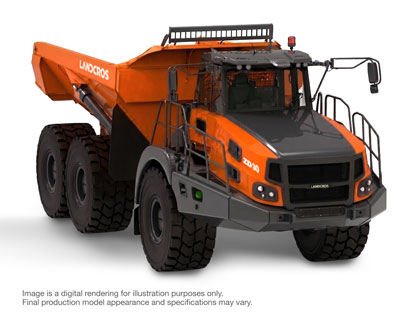
Hitachi Construction Machinery Americas — which will be rebranded as LANDCROS Americas in April 2027 — just announced it’s expanding its North American equipment lineup with three articulated dump trucks (ADTs) through a collaboration with Bell Equipment. The models are the ZD30, ZD45, and ZD50 (ranging from 30 to 50 tons), and they’re scheduled to launch in early summer 2027, followed shortly by offerings spanning 20 to 60 tons. All of it will be supported by Hitachi’s dealer network across the United States and Canada.
Here’s why this move matters — and this is where I get a little giddy, because it’s basically investing logic dressed up in steel and horsepower.
North America is the world’s largest market for articulated dump trucks, with an estimated annual demand of 5,000 to 6,000 units. Before this partnership, Hitachi had amazing excavators and wheel loaders but was sitting on the sidelines during a huge chunk of the haul-cycle action. These new ADTs put the company right in the equipment classes that account for roughly 90% of the North American ADT market. That’s not a tweak — that’s a full-on expansion into the space where the money actually moves.
Think of it like this: imagine you already have a gorgeous diversified portfolio, but you’re missing exposure to one of the biggest sectors out there. You’re doing great, but you’re leaving growth on the table. That was Hitachi. Adding ADTs completes the picture.
For customers working on large-scale projects, the new trucks help complete the jobsite. Contractors can now source excavators, wheel loaders, and ADTs through one dealer network, with consistent access to parts, service, and support. This is the corporate version of what I tell my coaching clients all the time: consolidation creates efficiency. When everything lives under one roof — your banking, your investing, your budgeting system — you spend less energy managing the pieces and more energy growing the whole.
Simon Wilson, COO of Hitachi Construction Machinery Americas, put it plainly: the company is excited to keep expanding its equipment lineup in North America with the three new ADT models, and Bell’s reputation for quality, reliability, and proven ADT engineering makes these machines an excellent addition to the LANDCROS lineup. Just as importantly, it expands the solutions dealers can offer, helping them serve top-tier customers and strengthening their position as full-line equipment partners.
Notice what he emphasized? Partnership. Hitachi didn’t try to build ADT expertise from scratch — they teamed up with Bell, a company that already earned its reputation in that lane. Here’s what I’d take from that as an investor: you don’t have to do everything yourself, and you don’t have to pick the company that does everything. Sometimes the smartest players are the ones who know exactly which gaps to fill and who to fill them with. That’s the same energy as using a robo-advisor for your core portfolio while you hand-pick a few individual stocks you actually understand. Play to your strengths; borrow expertise everywhere else.
Now let’s talk about the machines themselves, because the feature list is lowkey impressive — and honestly, it maps beautifully onto smart money habits.
**Power and durability.** The class-leading engine output and torque performance handle demanding haul cycles. The articulation joints are designed specifically for high-load applications, with high-tensile steel and widely spaced tapered roller bearings adding strength. Translation: this equipment is built to handle heavy loads repeatedly without breaking down. That’s your emergency fund, bestie. You build it strong enough that when the demanding cycles hit — job loss, surprise bills, a downturn — you don’t buckle. High-tensile steel energy. 💪
**Standard safety technology.** Three features stand out. On-Board Weighing shows the operator the load in real time during loading. Bin Tip Prevention monitors the rear chassis angle during dumping, and if the angle gets too great — raising rollover risk — a warning displays on the monitor and the bed automatically stops rising. Geofencing works through the fleet management system to block entry into restricted areas, set speed limits by zone, mark dump-prohibited areas, and help prevent theft.
This is the part that made me grin, because it’s literally risk management built into the machine. On-Board Weighing? That’s knowing exactly how much you owe, own, and spend in real time — not guessing. Bin Tip Prevention? That’s automatic safeguards like setting a cap on your credit card or automating transfers before you can overspend — the system stops you before you tip over. Geofencing? Those are your guardrails