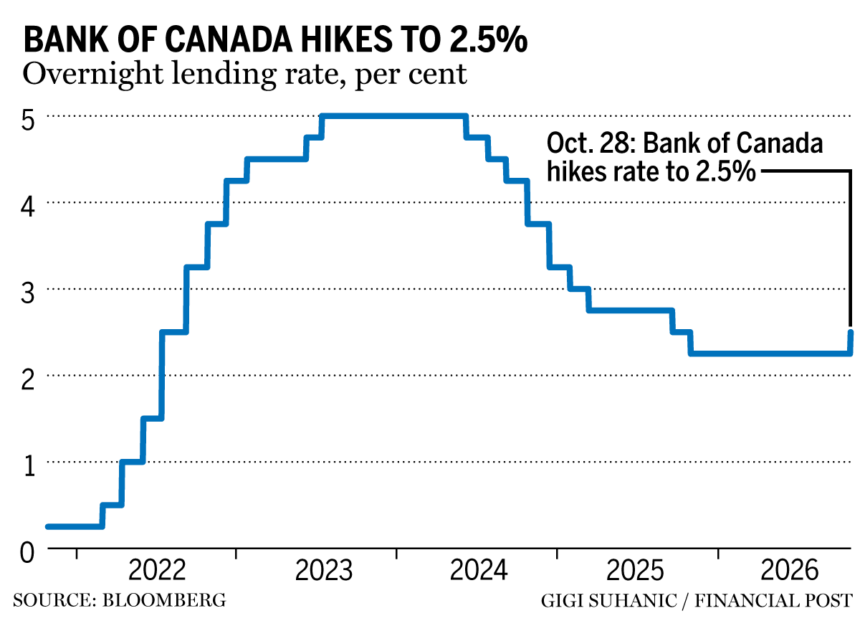
The Bank of Canada has discovered inflation — again — and this time it took a 25 basis point hike to 2.5 per cent to prove it. First increase since 2023, and naturally the central bankers are shocked, shocked, that energy prices up 19 per cent year over year might actually feed into the broader price level. Did anyone at the Bank not see this coming, or is it simply more convenient to feign surprise after the IMF coffee klatch where Macklem rehearsed his hawkish soundbites?
The official story deserves scrutiny. Headline CPI hit 3.1 per cent in September after pinning 3.0 in July and August, and the October Monetary Policy Report now projects inflation above three per cent through the rest of 2026 and much of 2027. Average inflation is forecast at 2.9 per cent for 2026 — a full 0.4 points higher than the July projections — and 3.1 per cent for 2027, revised up a striking 1.1 points in just three months. Think about that: a central bank whose entire institutional purpose is forecasting inflation missed the trajectory by nearly a percentage point within a single quarter. Yet we’re expected to treat their 2028 “easing” forecast with reverence. These are the same people who called 2021 inflation “transitory.” The forecast errors aren’t random noise; they’re structural, and they always err on the side of optimism because optimism is what keeps the political masters happy.
Here’s the wrinkle the media coverage buries: core inflation is sitting around two per cent. So the “inflation problem” is essentially gasoline, travel services, and intercity transportation — a supply-driven shock, not an overheating economy. A central banker from the Volcker era would recognize this instantly and know that hiking into a supply shock doesn’t create more oil; it just crushes demand elsewhere while doing little for the actual price driver. Macklem’s stated goal — preventing energy pass-through from embedding into wages and other prices — is at least coherent, and the Business Outlook Survey suggests the concern is warranted: roughly half of surveyed firms plan to pass fuel costs to consumers by year-end. But let’s not pretend the Bank is being bold here. At 2.5 per cent with a self-declared neutral range of 2.25 to 3.25, Macklem concedes the policy rate is “still low enough that it’s not restraining growth.” Translation: this isn’t tightening. It’s positioning. A pre-emptive gesture masquerading as resolve.
The growth projections warrant equal skepticism, if not more. The Bank now expects real GDP growth around one per cent in 2026 — revised up 0.3 points from July — accelerating to two per cent in 2027 and 2028 on the back of “strong consumer spending,” export pickup, improving business investment, the newly announced Productivity Mega Deduction, and a slate of major infrastructure projects slated for next year. One per cent growth for a G7 economy is hardly a boom; it’s roughly the pace at which per-capita living standards stagnate. And note the pattern: every upside inflation surprise arrives with a conveniently offsetting growth optimism revision. The Bank wants to hike without admitting the economy is weaker than advertised, because admitting that would mean confessing that 2.5 per cent — a rate they themselves call non-restrictive — is somehow appropriate for an economy allegedly strong enough to hit two per cent growth with above-target inflation. The internal logic doesn’t survive contact with arithmetic.
Then there’s the theatre of uncertainty. “One meeting at a time,” “no predetermined path,” “neutral is a range” — this is the standard boilerplate designed to preserve optionality while committing to nothing. Macklem points to Middle East war risk and U.S. trade policy as the fluid variables. Fair enough, but the neutral rate estimate of 2.75 per cent is itself a fiction built on models calibrated to a pre-2020 world of secular stagnation, cheap energy, and frictionless trade — all three of which are gone or going. If energy stays structurally dearer and supply chains keep fragmenting, neutral is higher than anyone’s PowerPoint suggests, and the Bank is lying to itself about how far behind the curve it actually is. The 1970s taught this lesson expensively: central banks that hiked in increments too small and too late ended up needing Volcker-style recessions to restore credibility. Macklem insisting 2.5 per cent is merely “approaching neutral” while inflation runs a full point above target for two more years has an uncomfortable whiff of Arthur Burns.
The pass-through risk is real and worth watching. Energy shocks become persistent inflation only when central banks accommodate them, and to its credit, the Bank seems to understand this — hence the hike. But the real test comes when the energy shock fades, as supply shocks do, and the Bank must decide whether to cut quickly back toward neutral or cling to hawkish rhetoric to rehabilitate its inflation-fighting credentials. Given the track record, expect the latter: a belated, grudging descent announced with great fanfare about “data dependence.”
For investors, the actionable read is straightforward. Rate cut expectations priced into the front end of the curve look generous given the Bank’s own inflation path. The Canadian dollar, already rate-decision dependent, likely catches a bid as long as Macklem keeps the option of further hikes alive — but that option is worth less if core inflation stays anchored near two per cent and the growth data disappoints. Watch the November 5 federal budget, where higher-for-longer rates directly pressure the fiscal bottom line; fiscal and monetary looseness don’t cancel out, they compound, and Ottawa’s arithmetic is about to collide with Macklem’s.
The deeper problem is credibility. A central bank that revises its inflation forecast up by more than a percentage point in one quarter, hikes 25 basis points while declaring the resulting rate non-restrictive, and simultaneously upgrades its growth outlook is asking markets to accept a narrative that is internally inconsistent. Maybe the data cooperates and 2027 delivers the soft landing fantasy. History suggests the more probable outcome is a central bank chasing an inflation target it set while inflation quietly becomes a fiscal problem — because with government borrowing costs rising and infrastructure spending locked in, the political will for genuine restriction is precisely zero. Macklem will take it one meeting at a time. The bond market will take it less patiently.
Source: https://financialpost.com/news/economy/bank-of-canada-hikes-interest-rate-october-28