Scotia Metals (CSE: SMET) has secured an option to acquire a lithium project in northeastern Brazil, where early exploration has identified suspected spodumene-bearing pegmatites along a 3.3-km corridor.
The Vancouver-based junior can acquire a 100% indirect interest in the 16,566-hectare Nordestina project in Bahia state for $2 million, payable if it exercises the option by May 31, 2028. Under the agreement, Scotia must pay $10,000 monthly but has no minimum exploration spending commitment and can withdraw with 30 days’ notice.
“Our team has built and re-engineered lithium projects in Brazil, including Sigma’s Grota do Cirilo and Lithium Ionic’s Bandeira, and Nordestina is the kind of ground we look for, with lithium minerals at surface,” Scotia CEO Rodrigo Roso said in a release Monday.
The acquisition would give Scotia a second hard-rock lithium exploration project alongside its Acadia property in Nova Scotia. Nordestina’s appeal rests on the possibility that surface mineral occurrences form part of a larger, chemically evolved pegmatite system, although laboratory testing and drilling are needed to establish the extent and significance of mineralization.
Surface mineralization
Geological mapping identified 166 pegmatite-related sites among 280 observation points across the property. Geologists visually identified suspected spodumene at 100 locations, lepidolite at 13 and pollucite, a cesium-bearing mineral, at three.
The occurrences extend across an area measuring approximately 3.3 km by 1.4 km within one of the project’s nine mineral permits. Some exposed pegmatites appear several hundred metres long, with estimated thicknesses of 10 to 30 metres.
The project lies within the São Francisco Craton, a geological setting Scotia compares with regions hosting well-known lithium-cesium-tantalum (LCT) pegmatites, including the Tanco deposit in Manitoba and Bikita in Zimbabwe.
“At the historic pit, spodumene, lepidolite and pollucite are present, indicating a highly fractionated LCT pegmatite system — a lithium–cesium assemblage characteristic of the most evolved zones of world-class zoned pegmatites such as Bikita in Zimbabwe,” Scotia vice-president of exploration James Abson said.
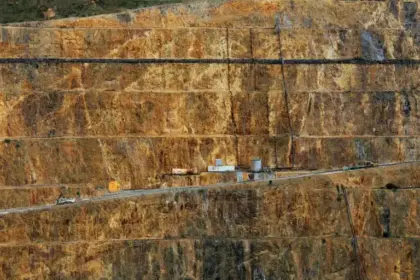
The historic workings expose all three minerals, while two nearby shallow pits contain lepidolite on their floors. A third exposes quartz-albite pegmatite without visible lithium minerals.
Scotia interprets the geological variations as potentially reflecting a zoned system, where lithium-rich material may occur beneath less mineralized outer sections.
However, the suspected spodumene identifications remain unconfirmed by laboratory analysis. The estimated pegmatite thicknesses also require drilling, and the company has yet to establish whether the occurrences belong to one continuous complex or several separate bodies.
Exploration next steps
Scotia expects initial assay results from 1,355 samples in late November, subject to laboratory capacity. The samples, comprising 1,208 soil samples and 147 rock grab samples, are undergoing analysis at SGS Geosol in Belo Horizonte.
The company also has 156 line-km of drone magnetic and radiometric survey data and 3.86 sq. km of LiDAR coverage to help refine its geological interpretation.
These datasets will guide the selection of initial drill targets and help determine whether the surface occurrences warrant more extensive exploration.
Nordestina’s pegmatites were absent from regional geological maps produced by Brazil’s geological survey. Historic artisanal workings provided evidence of their presence before field mapping in 2026 documented the broader corridor.
Source: https://www.mining.com/scotia-metals-targets-hidden-lithium-in-brazils-bahia/