




Seven holes out of fourteen. Two came back empty. And yet here we are, being invited to get excited about a junior explorer with a “historical” resource estimate from 2018. Let’s do what the press release hopes you won’t do: math.
Canterra Minerals (CTM.V) released assays from 7 of 14 holes drilled this year at Lemarchant, the largest satellite deposit in its Buchans District in Newfoundland, roughly 20 kilometers southwest of Teck’s old Duck Pond mine. The deposit carries a historical resource—2.42 million tonnes indicated at 4.89% copper-equivalent, plus 560,000 tonnes inferred at 3.66% CuEq. Historical meaning: never validated under current standards, which is exactly the kind of adjective junior explorers love because it sounds authoritative while obligating them to nothing.
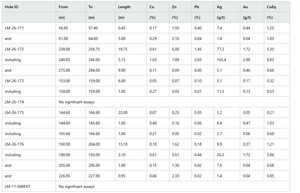
The headline number: hole LM-26-172 hit 18.75 meters of 5.35% copper-equivalent, including 5.15 meters at 8.83% CuEq. Breaking that down: 0.61% copper, 6% zinc, 1.45% lead, 77 g/t silver, 1.72 g/t gold. Notice the actual copper grade is 0.61%—barely above what many copper mines treat as marginal. The “5.35% copper-equivalent” headline is doing enormous lifting here, propped up by zinc and lead, two metals with historically depressed margins and smelter terms that quietly eat into your revenue. Anyone quoting the CuEq number without mentioning the payability assumptions is selling you something. Equivalent grades are a spreadsheet fantasy until a metallurgical study confirms the credits are actually recoverable.
Let’s contextualize the tonnage, because this is where junior mining enthusiasm goes to die. Call it roughly 3 million tonnes across all categories. At, say, a realistic mining rate, that’s a deposit with a mine life measured in single-digit years—before you account for dilution, recovery losses, and the fact that inferred material has the reliability of a weather forecast. This is a satellite deposit, meaning it only makes economic sense if bigger infrastructure exists nearby to absorb it. It doesn’t, because Duck Pond closed. So now you’re pricing in roads, processing options, and capex against a small polymetallic resource. The math gets ugly fast.
Meanwhile, 2,064 meters of a planned 5,240-meter program have been assayed, results for the remaining seven holes—including step-outs at the Northwest Zone and deeper targets—are pending. Translation: this stock will trade on headlines for months, and each press release is a coin flip dressed up as a catalyst. Speculators call that “upside.” Engineers call it variance.
The sponsor disclosure is refreshingly honest: the author has no position but may initiate one, and Canterra sponsors the website. Read that sentence twice. The content and the compensation stream from the same company. That doesn’t make the assay results fake—drill cores don’t lie—but it does explain the breathless framing.
Here’s the thing about polymetallic juniors: even when everything works, your expected return competes against dilution from endless financing rounds. A 3-million-tonne satellite deposit rarely supports the capex-to-value equation on its own. If you insist on owning lottery tickets, fine—size the position so a total loss is a rounding error in your net worth, and put the rest in low-cost index funds where compound interest actually does its job instead of funding someone’s drill program.
A hole with 8.83% over 5.15 meters is a great headline. It is not a business model.


