Simulation in mining has been around for decades, but every few years someone repackages it with a fresh interface and the trade press writes it up like it’s the invention of the wheel. The latest iteration is MineTwin, a discrete-event simulation platform from Amalgama Software Design out of Dubai, built specifically for open-pit and underground operations. Here’s what this really means: instead of committing $40 million to a truck fleet based on a spreadsheet and a prayer, you model the mine as a connected production system and see whether the plan survives contact with reality.
That’s not hype. That’s risk management. And in mining, where capital is sunk into holes in the ground that can’t be moved or resold, it’s the kind of discipline the industry has needed for a long time.
I caught up with the pitch via a conversation between International Mining’s Paul Moore and Jaco-Ben Vosloo, a simulation consultant with the company. Vosloo’s framing is honest enough: the platform targets mine operators, planning teams, and consultants, covering everything from greenfield studies and mine restarts to expansions and day-to-day operations. The questions he says managers bring to the table are the familiar ones — can we actually deliver this plan, what’s choking output, and will buying another machine move the needle?
That last question deserves its own paragraph, because I’ve watched management teams get it wrong for forty years. The reflex answer to a production shortfall is always more equipment. More trucks, more loaders, more capex. But if the bottleneck is a haul ramp, an ore pass that’s always full, or a crusher that can’t chew fast enough, the new trucks just queue up and idle. You’ve spent the capital and bought yourself a prettier traffic jam. Discrete-event simulation exists precisely to catch that before the purchase order is signed.
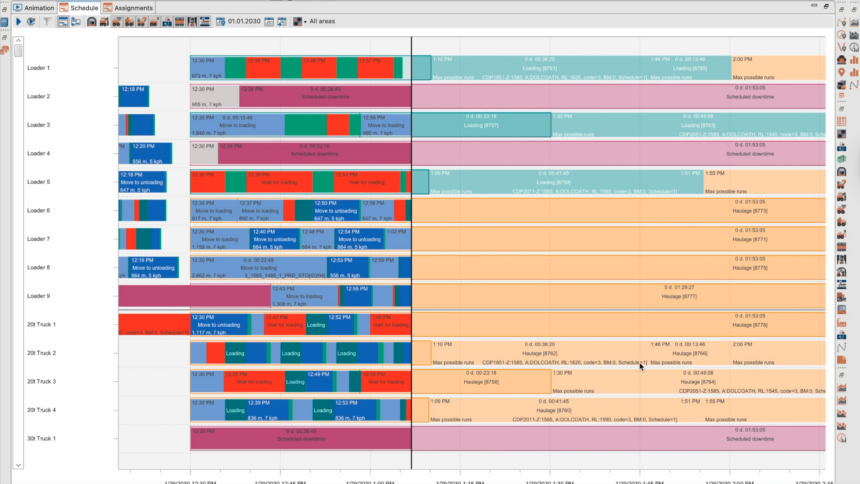
How the thing works, for those who care about the mechanics: DES models individual activities and the events that trigger or halt them. A truck waits on a loader. A working face opens up after blasting. A production task competes with development work for shared equipment. These interactions — not the nameplate capacity of any single machine — determine what the mine actually produces. Anyone who’s run an operation knows this in their bones: the sum of nominal capacities has almost nothing to do with real output. The gaps between the machines eat the production.
MineTwin’s scope covers drilling, charging, blasting, loading, and haulage, with development, backfill, and support activities modeled where relevant. Layouts can include ore passes, buffers, rail, crushers, and hoists. Access restrictions, road gradients, equipment availability, and shift rules all factor in. Vosloo’s point about breadth is the right one — it’s how you understand why improving one part of the mine doesn’t change total output. That lesson costs most operations a few painful capex cycles to learn the hard way. A model that teaches it cheaply is worth the license fee.
The platform builds on Amalgama’s simulation engine and layers on scenario management, layout editing, and visualization. Data comes in from mine design tools like Deswik and Vulcan, plus enterprise systems and spreadsheets, with consistency checks to catch the garbage before it poisons the model. Equipment histories and material flow reports let engineers trace delays and explain results — which matters, because a model nobody can interrogate is a model nobody will trust when the board asks hard questions.
The differentiator, according to Vosloo, is Studies — MineTwin’s environment for structuring simulation experiments. You start with a baseline, branch into alternatives, and compare results. Automated studies handle constraint analysis, fleet sizing, and sensitivity testing, and saved studies keep the analytical structure for reuse. Constraint analysis relaxes individual restrictions to show where investigation adds value. Fleet sizing tests equipment combinations against production and development targets. Sensitivity testing shows how results move when assumptions move. Multiple replications expose variability, not just averages — and let me be clear, variability is where projects die. A plan that works on the average and falls apart in the tail is not a plan; it’s a gamble with extra steps.
Reports come preconfigured with interactive charts, exportable as PDFs or as HTML files that keep their interactivity in a browser. For a planning department, the practical benefit is a reusable framework: a revised production plan or a changed equipment assumption gets assessed against the same baseline, the same logic, every time. That’s how experimentation becomes routine rather than a one-off consulting engagement that gathers dust after the deck is presented.
The truck example Vosloo walks through is worth repeating because it’s the classic case. Manager wants more trucks. First question: is haulage actually the constraint? If loading, access, or downstream handling is the bottleneck, more trucks wait longer and produce nothing. Run the comparison and the equipment request gets converted into what it should have been all along — an assessment of the whole production system and the investment it genuinely needs. This isn’t the first time we’ve seen this circus. Every commodity cycle peaks with order books full of machines that couldn’t pay for themselves because nobody asked the right question first.
The same logic extends to the big structural bets. In-pit crushing and conveying studies can model how trucks, crushers, buffers, and conveyors interact as a system. Open-pit operations weighing underground development can test future material flows, shared infrastructure, and equipment requirements before the decline is sunk. Autonomous haulage gets assessed through its real operational footprint — fleet composition, congestion, achievable production — rather than the vendor’s brochure numbers, with those operational results then feeding the financial model. Good. Autonomy in mining has been oversold in boardrooms for a decade. It works, but the savings live in the operational details, and if your model can’t capture them, your business case is fiction.
For operating mines, the smaller levers often matter more. Equipment allocation, shift arrangements, traffic priorities, buffer capacity — modest changes that release production without new capital. Simulation lets you compare these under common assumptions and see whether the benefit survives day-to-day variability. In my experience, operations teams know where these inefficiencies live; what they lack is a defensible way to quantify the fix and get it past the capital committee. That’s the real value proposition here.
Vosloo points to published applications as evidence. At South Crofty, Tomahee and Amalgama used MineTwin to assess the restart plan for the underground tin mine, surfacing equipment allocation and surface handling constraints. A separate study with Pronto.AI and Whittle Consulting ran 924 simulation experiments comparing autonomous and conventional haulage fleets. A South African coal mine study looked at stockpile buffering and fleet requirements together. I can’t independently verify any of this, and you shouldn’t take a vendor’s case studies at face value — but the pattern is right: each study addresses a specific operating decision rather than capacity in isolation. That’s how simulation earns its keep.
Now the caveats, because there are always caveats. MineTwin’s value depends entirely on building a credible model, which means suitable data, explicit assumptions, and validation with people who actually know the operation. A simulation is only as good as the inputs, and I’ve watched plenty of organizations weaponize models to justify decisions already made. If the baseline is garbage, every scenario built on it is garbage with confidence intervals attached. The discipline of validating against real performance — reconciling modeled output with actual production history — has to be non-negotiable.
There’s also a human factor no simulation captures well: execution. Crew competence, maintenance culture, contractor behavior, the foreman who runs things his own way. Models assume the mine runs to the rules. Mines, being staffed by people, don’t always. Treat the model output as a ceiling on realistic performance, not a floor.
Still, the core proposition holds. What matters is whether a change improves the mine as a whole, and simulation gives teams a way to test that connection, explain why a proposal works, identify where it’s constrained, and update the model as the mine evolves. The model becomes a living decision-support asset instead of a one-time study.
For anyone allocating capital in this sector: ask for the simulation before you approve the fleet. If the vendor or the mine plan can’t show you the bottleneck analysis and the variability runs, you’re being sold a spreadsheet wearing a hard hat. Test it before you buy it — in mining, you rarely get a second chance with capital that’s already at the bottom of a pit.
Source: https://im-mining.com/2026/11/13/minetwin-a-fast-reliable-and-safe-way-to-test-mining-decisions/