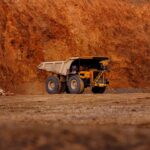
EACON just crossed 4,000 mining trucks running its ORCASTRA autonomous haulage system in China. That’s more than double the combined autonomous fleets of Caterpillar’s Command for hauling and Komatsu’s FrontRunner. Read that again. The American and Japanese incumbents — the names that have defined mining equipment for half a century — are getting lapped in truck autonomy by a Chinese company most Western investors have never heard of.
Here’s what this really means, and why I’m paying attention even as my instinct tells me to distrust anything growing this fast.
The growth curve is the kind that usually makes me reach for the smelling salts. ORCASTRA-equipped trucks went from 1,000 in 2024 to 2,000 in 2025 to over 4,000 in 2026. Cumulative autonomous driving distance passed 200 million kilometres, with the second 100 million logged in a single year — the first took seven. One mine alone, Baishihu, run by Guanghui Mining, operates more than 700 EACON-equipped trucks. That’s a fleet bigger than most entire countries’ autonomous mining deployments.
Now, exponential curves are where fortunes and careers go to die. I lived through dot-com “eyeballs” and the “this time is different” chorus of 2007. But there’s a critical difference here, and it’s the difference between a story stock and a business: this technology is making money for the people deploying it.
That last part deserves unpacking. Much of China’s early push into autonomy and green powertrains in mining was policy-driven — Beijing leaning on the massive mining hubs in Inner Mongolia and Xinjiang to clean up and automate. Policy-driven adoption is fragile; the moment subsidies dry up, so does demand. But the picture has changed. Autonomy is now genuinely profitable for mine operators and contractors. And China’s mining contractor market is enormous and brutally competitive. When four contractors work the same mine — two on overburden, two on coal, as one northwest China operation visited by International Mining’s editorial team showed — running three different AHS providers simultaneously (EACON, CiDi, Huawei), plus a mishmash of battery-electric and methanol-hybrid wide-body trucks from Tonly, Sinotruk, XCMG, with Zoomlion and TZCO kit also in testing — autonomy stops being a CSR slide and becomes a bidding weapon. Lower labor costs, higher utilization, better cycle times. Contractors with AHS win contracts. Contractors without them lose. That’s a real demand driver, not a subsidy mirage.
The market has also matured past the retrofit phase, which tells you something about durability. Most trucks today come factory-fitted with the AHS configured to the mine’s or contractor’s specifications, developed in close cooperation between the AHS provider and the truck OEM. That’s how real industrial ecosystems form — not press releases, but shared engineering. Charging infrastructure has matured alongside it, with a pragmatic mix of static charging and battery swapping depending on site economics. Nobody’s married to one answer; they’re picking what pencils out. That’s how engineers think, and it’s a healthy sign.
The cabless truck is the milestone I find most telling. EACON and Tonly’s EQ100E battery-electric truck ships without a cab at all. This isn’t the first time we’ve seen this circus — cabless vehicles have been “coming soon” in Western mining for a decade. Removing the cab is the ultimate statement of confidence in the system’s safety and reliability. You can’t put a driver back in a truck that doesn’t have a seat. China isn’t promising to trust its autonomy stack; it’s structurally committing to it. That’s conviction expressed in steel, not slides.
Now the skeptics’ section, because there always is one, and I’ve earned my skepticism the expensive way.
First, these are Chinese domestic figures, reported by the company itself and the trade press. Independent verification of utilization rates, downtime, and true cost-per-tonne is thin. Every vendor in the autonomy space — Western ones included — cherry-picks their metrics. More than 200 million kilometres is an impressive cumulative number, but cumulative distance doesn’t tell you about fleet availability in a Mongolian winter or maintenance burden on battery packs in fine coal dust. The data that matters to a mine planner isn’t in the press release.
Second, truck counts and kilometres are not profit. EACON is private and doesn’t publish financials. In a hyper-competitive market with three AHS providers fighting at a single mine site, pricing power is likely being donated to customers. Growth in units with compression in margins is a story I’ve watched destroy many a “leader.” The western AHS players — Caterpillar and Komatsu — make money on hardware, service, and integrated fleets. Whether EACON does is an open question.
Third, the Western expansion is still mostly potential, and potential is the cheapest commodity on earth. EACON’s overseas footprint is limited. The Komatsu HD1500 trial at Norton Gold Fields in Western Australia is the real tell — six trucks, with delegations from BHP and other majors already making the pilgrimage. If that trial converts into commercial deployments at a major, the game changes. If it stalls on integration, support, or regulatory friction, EACON remains a China story trading at China multiples. Note that Komatsu is hosting the trial — the incumbent OEMs would rather partner than be disrupted, a time-honored playbook. Whether those partnerships hold when the revenue at stake gets large is another matter. Most major miners, BHP and Rio Tinto included, now have dedicated China procurement teams, which tells you the interest is genuine. But procurement teams evaluate; they don’t commit. There’s a long road between a delegation visit and a fleet order, and that road runs through warranty terms, service networks, cybersecurity audits, and geopolitics — the last of which no amount of engineering can fix.
Here’s what this really means for the broader picture, and where the strategic weight sits: of EACON’s 4,000 AHS-equipped trucks, well under 1% are diesel. Roughly 47% are full battery-electric; the balance, about 53%, are hybrids. Compare that to Western mining, where diesel still dominates autonomous fleets and electrification pilots remain mostly pilots. EACON isn’t just scaling autonomy; it’s scaling autonomy on new powertrains simultaneously. That’s a decade of operational data — thermal management, charging cycles, swap logistics, battery degradation under mining duty cycles — that Western OEMs simply don’t have at equivalent volume. Data like that compounds. It benefits EACON and its OEM partners — Tonly, LGMG, XCMG — as they push overseas, and it’s a moat that’s expensive and slow to replicate.
If you’re an investor, here’s how I’d frame the risk ledger. The bullish case is real: a proven demand driver (contractor economics, not subsidy), a maturing ecosystem (factory-fit integration, charging infrastructure, mixed fleets), a structural trust signal (cabless trucks), and a hard-to-copy dataset on electrified autonomous hauling. The bear case is equally real: unverified operational claims, opaque profitability, brutal domestic competition compressing margins, minimal overseas revenue today, and a geopolitical wall between Chinese tech and Western mining procurement that could thicken overnight. One election, one incident, one export-control tit-for-tat, and the Western market closes.
If you have direct or indirect exposure — through OEM partners, mining contractors, or listed comparables — watch three things. The Norton Gold Fields trial outcome and whether it produces signed commercial agreements rather than another round of delegations. Any hard financial disclosure from EACON or margin commentary from its OEM partners. And whether cabless and battery-swap deployments keep scaling without a serious safety or availability incident, because one high-profile failure would set this entire curve back years.
The West’s mining incumbents aren’t asleep, but they’re being out-executed on this specific front, and history is unkind to incumbents who respond to a cost-curve disruptor with committee meetings. This isn’t a bubble yet — the unit economics appear to support it, which is more than I could say for most things that doubled annually. But fast growth and good business are cousins, not twins. Keep the enthusiasm, check the receipts, and size your conviction accordingly.