# Six Countries Walk Into a Coal Plant in Tianjin. Here’s What It Actually Tells You.
A delegation of six coal preparation experts — from the US, Australia, South Africa, Poland, the UK and Hungary — toured Tianjin Meiteng Technology’s R&D and manufacturing facilities on October 28, 2026, ahead of the 8th China International Coal Clean and Efficient Utilisation Exhibition. The visit was orchestrated by China’s National Coal Association, the China Coal Processing and Utilisation Association, and the CCPIT Coal Industry Sub-Council. In other words: a well-choreographed sales call dressed up as a technical exchange. I’ve sat through enough of these to know the difference between a factory tour and a due diligence trip. Usually it’s the first one wearing the costume of the second.
Still, the guest list deserves attention, because these aren’t marketing people. Barbara Arnold sits on the US National Academy of Engineering and teaches at Penn State. Devraj Reddy runs the Southern African Coal Processing Society and does process engineering at Exxaro. Marcin Lutyński leads the Polish Mineral Engineering Society. These are people who spend their careers evaluating separation equipment and don’t waste passport stamps on dog-and-pony shows — at least not willingly. When engineers of this caliber show up at a Chinese equipment maker’s door, something real is happening in the dry sorting space, and Western coal operators would be foolish to ignore it.
## What They Actually Saw
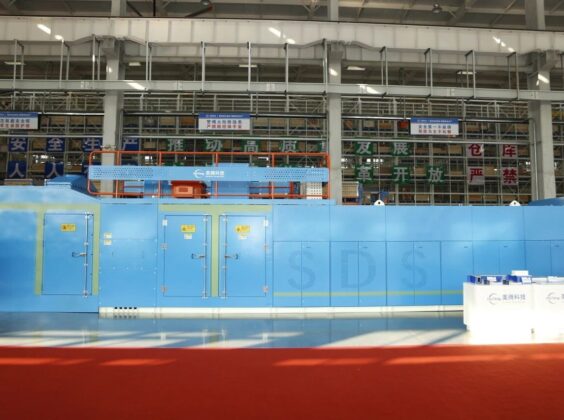
The tour covered Meiteng’s established products — the TDS/XRT sensor-based dry sorter and the TGS intelligent gradient-fluidised separator — plus live demonstrations under industrial conditions, a mineral analysis lab, and a remote monitoring and after-sales centre. The main event, though, was the forthcoming SDS “super-intelligent dry sorter,” which the company claims integrates multi-modal fusion recognition, large AI models, intelligent diagnostics, and autonomous decision-making.
Here’s what this really means, stripped of the brochure language: dry coal sorting has been quietly improving for a decade, and Chinese manufacturers are now the ones setting the pace. The XRT-based sorters already in the field are legitimate engineering — they use dual-energy X-ray transmission to distinguish coal from gangue and blast air jets to split the stream. It’s not exotic. It’s applied physics, executed at scale, at a price point Western OEMs have struggled to match. The “AI” framing is partly marketing varnish; underneath it, the machine is doing sensor fusion and real-time classification, which is impressive but not magic.
## The Numbers, With a Grain of Salt
Meiteng claims the SDS delivers 1.5–2x processing capacity over its predecessors, with coal loss in rejects and gangue misplacement in clean coal at ≤0.5% for easy-washability coal, ≤1% average for moderately difficult coal, and ≤2% for difficult-washability coal. The visitors also congratulated Meiteng on its advances in “Ultra-Clean Separation, Exceptional Capacity and True Intelligence.”
My advice: treat vendor numbers the way you’d treat a fund’s backtested returns. The ≤0.5% figure for easy coal is plausible — easy-washability material practically sorts itself. The ≤2% for difficult-washability coal is where I’d want to see independent test data on actual customer material, not lab demonstrations on curated samples. Difficult-washability means high near-gravity material, and that’s precisely where every separator — wet or dry — has historically underperformed its spec sheet. The delegation’s own questions about “separation accuracy, equipment suitability, and operation and maintenance under different coal conditions” suggest they had the same instinct. Good. That’s the right reflex.
One thing worth noting in Meiteng’s favor: they showed the delegation their sensor development and core component manufacturing. Companies with thin technology don’t usually invite professors to inspect their sensor production line.
## Why Dry Sorting Matters More Than the Hype Suggests
This isn’t the first time we’ve seen a processing technology shift the economics of a commodity, but the dry sorting story is less about innovation glamour and more about hard economics. Traditional wet preparation plants are capital-intensive, water-hungry, and increasingly problematic in regions where water is scarce — South Africa, Australia’s interior, large swaths of the US West, and, obviously, much of China. Dry sorting eliminates the water circuit, cuts tailings handling, and reduces capital and operating costs. For marginal operations, it can be the difference between viable and shuttered.
China deployed these systems at home first because it had to — water constraints and high-volume, lower-rank coal made dry separation a necessity, not a choice. Necessity is a better innovation engine than subsidies ever were. Now they’re exporting the capability, and the fact that six national coal societies sent their leadership to Tianjin tells you the international technical community has accepted that Chinese dry sorting equipment is worth evaluating seriously. That acceptance phase is usually short; procurement decisions follow.
## The Commercial Subtext
Read the closing paragraphs carefully. Meiteng talks about coal sample testing, technical validation, project cooperation, and “strengthening its presence in the global coal preparation industry.” That’s an export strategy. Chinese equipment makers learned from the solar panel and battery playbook: dominate the home market, drive costs down through volume, then undercut established Western OEMs abroad while they’re distracted or ESG-constrained. Coal processing equipment is a smaller pond, but the playbook translates.
For mining companies and coal operators, the practical implications are straightforward. First, dry sorting deserves a place in feasibility work for any greenfield or expansion project, particularly in water-constrained jurisdictions — the economics are no longer speculative. Second, don’t assume the incumbent equipment vendors will hold their pricing power for long. Third, be disciplined about the risks of buying into a nascent export supply chain: parts availability, local service capability, spare sensor logistics, and software support across time zones. Meiteng’s remote monitoring centre is a good sign they’ve thought about this, but a demonstration in Tianjin is not a service call in Queensland or the Witbank coalfield. Ask hard questions about mean time to repair before you sign.
There’s also the geopolitical angle nobody at the exhibition put on a slide. Western operators face mounting pressure over coal’s social license, and procurement policies at major miners increasingly screen suppliers. A Chinese-built, AI-branded sorter may clear every technical hurdle and still trip an internal approval gate. Companies that plan for that friction — joint ventures, local assembly, third-party validation — will move faster than those that don’t.
## The Takeaway
Strip away the diplomatic pleasantries and the “admiration for continued exploration and innovation,” and you’re left with a real signal: Chinese intelligent dry separation technology has crossed from curiosity to contender, and the people who know coal preparation best are taking the tour. Whether Meiteng’s SDS numbers hold up on difficult coal in the field is the question that matters — and it’s one only operating data will answer. Watch the first overseas installations closely. If the performance claims survive contact with real washability curves, the global coal preparation equipment market is about to get a lot more competitive. And if you’re holding stock in a legacy prep plant OEM that’s still selling 1990s technology at premium prices, you might want to check your positioning before someone else does it for you.