




Rare earth developers are turning to the U.S. South’s chemical plants, ports and mineral deposits to build a supply chain that can compete with China. Louisiana is drawing three processing ventures, while explorers in Georgia and elsewhere in the region look for deposits that could eventually supply them.
Aclara Resources (TSX: ARA) received a non-binding letter of interest in September for up to $750 million (C$1 billion) from the U.S. Export-Import Bank to finance its proposed Dynamo separation plant in Louisiana. The company plans to feed it with material from projects in Chile and Brazil.
“The market is being pushed by two sides,” Aclara CEO Ramón Barúa told The Northern Miner. “The Chinese continue to restrict the rare earths, and on the other side, the Western world continues to also try to limit their use of Chinese [rare earth] product. We are the centre of those two converging forces.”
The Gulf Coast offers ports to bring in feedstock and a chemical industry with the workers and suppliers to process it. The test is whether developers can secure financing and enough material to keep separation plants running reliably at commercial scale.
Louisiana cluster
Aclara aims to start site preparation for its $494-million Dynamo plant in the first quarter of 2027, subject to financing. It targets construction completion in the second half of 2028. The site is at the Port of Vinton, about 340 km west of New Orleans.
Dynamo would process material from Aclara’s Penco project in Chile, whose first stage has environmental approval, and Carina in Brazil, which is awaiting environmental licences. Both host rare earths in shallow ionic clays that require no blasting, crushing or grinding, the company says.
Aclara is testing its separation technology at a demonstration plant in Blacksburg, Va. A second demonstration plant, which opened in Chile in October, is testing technology to make metals and alloys.
At full capacity, Dynamo could produce annual averages of about 1,300 tonnes of neodymium-praseodymium oxide, 200 tonnes of dysprosium oxide and 35 tonnes of terbium oxide, according to Aclara’s October engineering update. The company has added yttrium, gadolinium and samarium to its planned product range.
Canada’s Ucore Rare Metals (TSXV: UCU; US-OTC: UURAF) is installing equipment at its separation plant in Alexandria, La., and has secured $27 million in federal defence funding. ElementUSA plans to recover rare earths from bauxite residue at the Atlantic Alumina refinery in Gramercy, La. It received a $29.9-million defence award for gallium and scandium recovery and is part of a Colorado School of Mines-led project selected for negotiations over $67 million in Department of Energy funding.
Ucore and ElementUSA did not respond to requests for comment before this article was published in the November print issue of The Northern Miner.
Operating at scale
Aclara chose Louisiana for access to chemical suppliers and to operators and contractors with petrochemical experience around Lake Charles, Barúa said.
Dynamo would use about 500 mixer-settlers, which separate metals using solvents. Material can take months to move through the system, so operators may wait a long time to see the effect of adjustments, Barúa said.
“The hardest part, by far, is operating these facilities,” he said. “Ramping up and then having stable production is going to be very, very difficult to attain.”
Processing the feedstock in Brazil and Chile before it reaches Louisiana should help stabilize separation at Dynamo, Barúa said. Aclara is using its pilot plant to gain operating experience before scaling up.
Aclara shares were 15% weaker at C$2.05 at Thursday’s close in Toronto, valuing the company at about C$601 million.
Georgia feedstock
Rare Earths Americas (NYSE-A: REA) is drilling its Foothills project about 110 km southwest of Atlanta. The company also holds three projects in Brazil, including Alpha and Constellation, which have initial resources. Gina Rinehart’s Hancock Prospecting held about 6% of the explorer through subsidiary Hanrine Investments, according to a September filing.
The company is conducting a 25,000- to 30,000-metre drill program at Foothills and plans to release an initial resource in the first quarter of 2027, CEO Don Swartz told The Northern Miner.
The Gulf Coast’s ports and transport links allow processors to bring in concentrates while domestic mining projects advance, Swartz said.
“You’re seeing a cluster along the coast where you’re able to import concentrates and… process them,” he said. “The Gulf Coast, for instance, in the Texas area [has] good transportation and government support.”
Rare Earths Americas acquired Shiloh in July 2025 when it bought Australia’s Foothills Rare Earths. It outlined the 1,650-sq.-km Foothills district a year later, comprising Shiloh, Liberty Peak and three other targets. Land and access agreements remain to be finalized on some prospective ground.
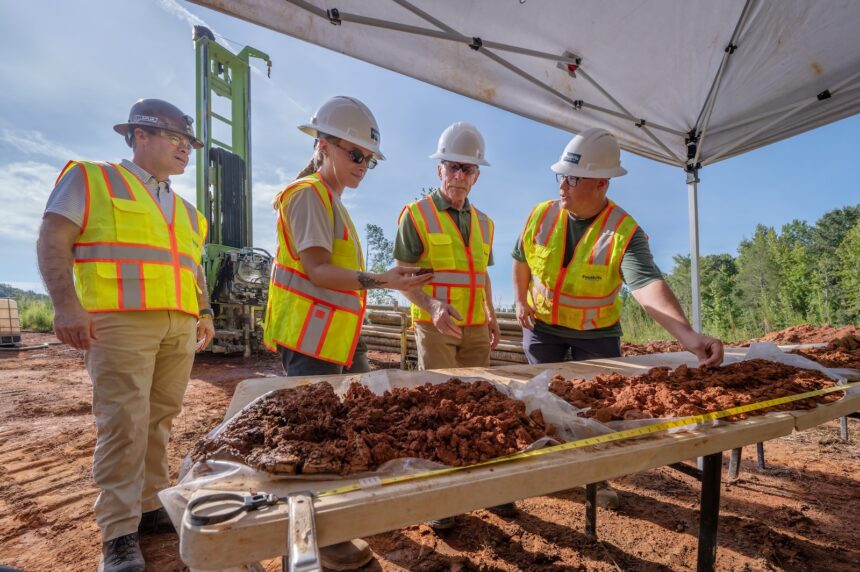
Drill hole 25-DPLC-022 cut 10.2 metres grading 2.02% total rare earth oxides from surface, the company reported June 15. Mineralization occurs in saprolite clays and monazite-bearing sands. The project sits on private land and would require state approvals and potentially federal permits to develop.
Processing options
Monazite from Foothills could potentially be processed at Energy Fuels’ (TSX: EFR; NYSE-A: UUUU) White Mesa mill in Utah or at the Saskatchewan Research Council’s plant in Saskatoon, Swartz said. White Mesa already uses monazite feed, including material from Chemours’ (NYSE: CC) operations in the South. It has produced neodymium-praseodymium oxide commercially and dysprosium and terbium oxides at pilot scale.
Elsewhere in the region, USA Rare Earth (Nasdaq: USAR) has a feasibility study under way at Round Top in Texas. IperionX (ASX: IPX) completed a feasibility study in June for its Titan project in Tennessee. Chemours extracts mineral sands containing rare earths in Florida and Georgia.
Rare Earths Americas shares were 12% weaker at $7.25 at Thursday’s close in New York, valuing the company at about $149 million based on the share count at print time.
“We’ve got a very large package that we’re drilling out, and we see widespread mineralization,” Swartz said. “You start with the proof of concept and then you grow the resource every time.”
Source: www.northernminer.com — article syndicated from the publisher’s feed; all rights remain with the original publisher.


