Ottawa’s five-year extension of mineral exploration tax credits has won praise from Canada’s prospectors association, but British Columbia’s exploration group says the budget misses a key change needed to help discoveries become mines.
Thursday’s federal budget proposes keeping the 15% Mineral Exploration Tax Credit and 30% Critical Mineral Exploration Tax Credit available through March 31, 2032, providing an estimated $956 million (US$684 million) in support over five years. Ottawa also proposes $424.4 million over four years, starting in 2027-28, to renew the Canadian Critical Minerals Strategy.
“Extending both credits for five years responds directly to PDAC’s call for greater long-term certainty and gives explorers more confidence to plan and finance work across multiple field seasons,” Jeff Killeen, senior director of policy and programs at the Prospectors & Developers Association of Canada, told The Northern Miner in e-mailed comments.
Both PDAC and the Association for Mineral Exploration have sought expanded Canadian Exploration Expense eligibility to cover engineering, economic and feasibility studies needed to establish reserves and make mine-development decisions. That remains an unmet industry request, leaving a financing gap between discovery and development, according to AME.
‘Disappointed’
“We are disappointed that Budget 2026 missed an opportunity to take the steps needed to unlock Canada’s critical minerals,” AME president and CEO Todd Stone said in an e-mailed statement. “This budget does not address that gap.”
“This budget includes measures to help early-stage technology companies access capital,” he said. “We need the same level of support for mineral exploration companies.”
The flow-through share system has generated more than two-thirds of early-stage domestic exploration activity over the past decade, according to PDAC’s analysis, Killeen said. The association had sought permanent credits or extensions of at least 10 years.
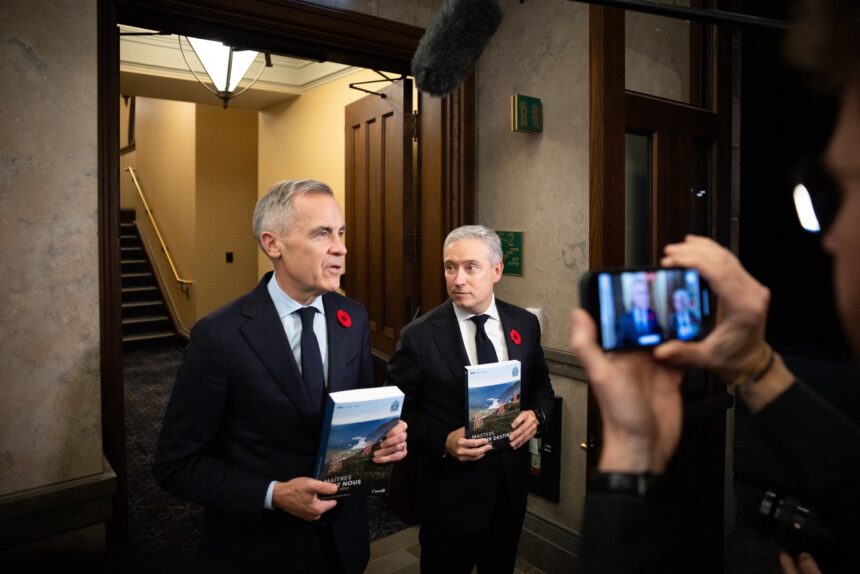
“But for too long, Canada has fallen behind in bringing those minerals from mine to market,” Finance Minister François-Philippe Champagne said in Parliament. “That is why we are focused on increasing Canadian production and processing of our minerals.”
Beyond exploration, the package offers power, infrastructure and financing measures that could help projects move towards construction. Much of the larger funding architecture, however, was announced before budget day.
Windfall funds spending
Ottawa projects a $62.3-billion deficit in 2026-27, up from $39.3 billion last year but about $3 billion below April’s forecast, with annual shortfalls continuing through 2030-31. Federal debt is forecast to reach $1.37 trillion this fiscal year and $1.59 trillion by the end of that period, remaining around 40% of gross domestic product. Annual debt-servicing costs would rise to $85.5 billion from $60.2 billion over the same period, according to the Department of Finance.
Improved economic and fiscal conditions provide $158 billion over five years, almost all absorbed by $152 billion in new spending, RBC economists Cynthia Leach and Salim Zanzana said in a budget analysis. Higher revenues, supported by oil prices and a stronger starting position, account for about 70% of the improvement; lower projected program expenses provide the rest, they said.
The gains from Ottawa’s investment agenda remain uncertain and will take time, while higher day-to-day spending could reduce room for future investments, Leach and Zanzana warned.
Exploration runway
Both credits expire next March 31. The budget would extend them to eligible flow-through share agreements signed by March 31, 2032, and add antimony to the 30% credit for agreements signed after budget day.
Flow-through shares allow companies to pass eligible expenses to investors as tax deductions. The credits offer an additional incentive for individuals financing grassroots exploration in Canada.
The renewed critical minerals strategy would support mining and processing technology, geoscience and research, and targeted funding for priority projects. Ottawa also proposes $34 million over four years, starting in 2027-28, to renew GeoNorth, which provides public geoscience information for northern exploration, infrastructure planning and environmental assessments.
“Public geoscience is fundamental to mineral exploration in Canada,” Killeen said. “PDAC welcomes Budget 2026’s investment in geoscience capacity because it will help attract exploration investment and support the next generation of mineral discoveries.”
Helium producers would receive separate relief. Ottawa proposes treating eligible helium exploration, development and resource-property acquisition expenses like those in conventional oil and gas, effective for spending incurred on or after budget day. The government estimates the change would provide $54 million in tax relief over four years from 2027-28.
Power and processing
For miners and processors seeking reliable electricity, the budget proposes extending the Clean Technology and Clean Electricity investment tax credits to the end of 2040. The clean technology credit’s reduction to 15% would occur in 2040 instead of 2034.
Eligibility for the clean electricity credit would also expand to the highest-voltage transmission lines within each province, for property acquired and available for use on or after budget day. That could help finance infrastructure serving new mines and industrial developments.
Further eligibility details are still pending, and draft legislation to implement the changes wasn’t released with the budget, lawyers at Osler, Hoskin & Harcourt noted.
Ottawa proposes nearly $4 billion over 10 years, starting in 2027-28, for electricity infrastructure, renewable energy and priority power projects. A further $37 million in 2027-28 would support analysis of interprovincial connections and discussions about sharing their costs.
“We’re working with provinces, territories, and Indigenous partners to double Canada’s grid capacity by 2050,” Champagne said. “We will connect provincial grids. We will build thousands of kilometres of transmission lines. We will develop the nuclear energy sector.”
Canadian industrial suppliers could benefit from proposed domestic-content bonuses. The government plans 60 days of consultations on additions of up to 10 percentage points to the clean technology credit and five percentage points to the clean electricity credit. Their scope and conditions remain to be determined.
The budget also reaffirms the Productivity Mega Deduction announced in September. It would permanently allow immediate writeoffs for a broader range of capital assets and increase the deduction rate for Canadian development expenses to 100% from 30% on a declining-balance basis. The government puts the economy-wide fiscal cost at $36 billion over five years.
Mining investors wouldn’t qualify for every new incentive. The proposed Canada Growth Incentive would exempt up to $15 million in capital gains per qualifying individual per business, subject to eligibility conditions, but the tax annex explicitly excludes mining businesses. Utilities, financial services and several other sectors are also excluded.
Approval to construction
Ottawa is
Source: www.northernminer.com — article syndicated from the publisher’s feed; all rights remain with the original publisher.