




Let me get this straight. A sponsored write-up of a junior gold micro-cap, complete with a disclosure that the author holds a long position and might buy more within 72 hours. Spectacular. Nothing says unbiased analysis like the person being paid by the company also holding the bag. Read everything below with that filter firmly engaged.
The facts, because facts are the only thing worth repeating: Blue Jay Gold (JAY.V) has signed Ocean Partners, a UK-based concentrate trader, as a buyer for the “remediation material” — surface rock piles left behind by a previous operator at Skukum Creek, part of the Steller Gold Project south of Whitehorse, Yukon. Clearing the piles is a cleanup obligation the company has to fulfill anyway, and now it gets paid to do it. That part is genuinely sensible. Turning a liability into revenue is the rare instance of arithmetic working in a junior miner’s favor.
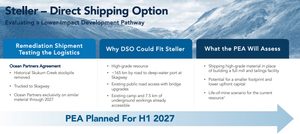
Mechanically, the rock gets trucked to Skagway, Alaska, and loaded onto ships — likely bound for Taiwan, where Ocean Partners recently finished building a warehouse and blending facility. Hence their sudden interest in West Coast mining projects. Payment structure: 90% of estimated value paid shortly after loading, the balance settled after final weights and assays. Standard, reasonable, unexciting. That’s how you know it’s probably legitimate.
Now the speculation portion of the program. Ocean Partners as a potential offtaker has the company evaluating Steller as a direct shipping ore operation — dig up rock, sell it unprocessed, no on-site treatment plant. Think Scottie Resources in BC. If it works, you skip enormous capex, which for a junior miner is the difference between a mine and a memorial plaque. A PEA is supposedly coming in the first half of 2027. Note the word “potential” appearing three separate times in the source material. In junior mining, “potential” is the most expensive word in the English language. PEAs have a long and glorious history of describing mines that will never be built.
Then there’s the financing. Ocean Partners is investing C$3M at C$0.90 per unit — 3.33M units, each one share plus a full warrant at C$1.20, one-year term, expiring early if the stock trades above C$1.25 on a 5-day VWAP. If all warrants get exercised, that’s another C$4M. Insiders taking equity at market-ish prices with real strike premiums is a mildly positive signal — they’re not paying themselves with your dilution at a discount, at least not obviously. But let’s keep perspective: C$3M and a possible C$4M is venture-scale money for a venture-scale gamble. This is not a thesis. It’s a lottery ticket with marginally better odds.
And that’s the entire investment case, laid bare: cleanup revenue with details arriving in 2027, drill results “soon,” a PEA in H1 2027, and a strategic investor whose interest is real but whose checks are small. “The next few months will be full of catalysts” is the single most repeated sentence in junior mining, and it has made approximately nobody financially independent.
Here’s the mathematics that actually matters. If you’d put money into a boring, low-cost index fund instead of every junior miner that ever promised a catalyst-rich future, compound interest would have quietly done the work these press releases only claim to do. A position in Blue Jay belongs in the strictly limited speculation bucket — money you can incinerate without changing your savings rate, your withdrawal plan, or your sleep. If a C$0.90 stock going to zero would bother you, you’ve already made the mistake.
The company may well execute. The offtake is real, the financing is clean, and DSO economics can work. But the person selling you this story is paid by the story. Price your position size accordingly — and remember that for every junior that makes it, a thousand pile of remediation rock stories quietly vanish, warrants unexercised, catalysts unsprung.


