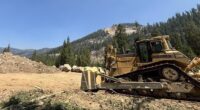
Perpetua Resources Corp. has secured a 36-month, $40 million award from the U.S. Army’s Defense Ordnance Technology Consortium (DOTC) via the Portfolio Acquisition Executive Agile Sustainment & Ammunition program to assess the technical and economic feasibility of producing tungsten concentrate at Idaho’s Stibnite Mining District. The cost-share structure — with Perpetua matching the government’s contribution — is a material detail for investors evaluating capital risk: half the funding burden for a potential resource expansion sits outside the company’s balance sheet.
The award funds three concrete workstreams: drilling to define a potential tungsten mineral resource, collection of material for laboratory and bench-scale metallurgical testing, and permitting and engineering of an exploration decline into areas of known tungsten mineralization. The initial 18-month phase carries an estimated cost of roughly $18 million, split equally. Subsequent phases remain contingent on results and incremental funding approvals — a staged structure that limits downside exposure if early results disappoint, while preserving optionality if they don’t.
The scientific basis for the award rests on Perpetua’s recent exploration at the Hangar Flats deposit, which returned significant tungsten-antimony mineralization. Metallurgical test work will use an existing 550-kilogram composite sample grading 9.2% antimony and 4.2% tungsten — grades that, if representative, would place Stibnite among the higher-grade tungsten sources globally. That caveat matters: composite samples from prior exploration are not a mineral resource, and grade continuity beneath Hangar Flats is precisely what the drilling program must demonstrate.
For context on the broader asset, the currently permitted Hangar Flats pit contains approximately 1.37 million oz of gold and more than 95 million lb of antimony — neither included in the current mine plan or reported mineral reserves. Any conversion of that material into reserves would require permitting, engineering, and economic study, and investors should treat it as potential upside rather than bankable value.
The cumulative funding signal is the more statistically meaningful data point. This award brings total U.S. government support for Perpetua’s critical minerals program to $126 million since 2022, with additional grant proposals pending. Repeated federal cost-share awards across multiple administrations and agencies indicate durable strategic demand for domestic antimony and tungsten supply chains — both designated critical minerals with heavy import dependence. Government backing does not de-risk execution, but it reduces funding requirements and signals a policy tailwind that few junior developers possess.
The rational watch items are straightforward: drill results confirming grade and continuity at Hangar Flats, metallurgical recovery data from bench-scale testing, and progress on decline permitting. Each milestone is verifiable, dated, and tied to defined funding gates — the kind of staged evidence pipeline disciplined investors should track rather than the headline award itself.
Source: https://www.e-mj.com/breaking-news/perpetua-u-s-army-evaluating-tungsten-production-at-stibnite/