




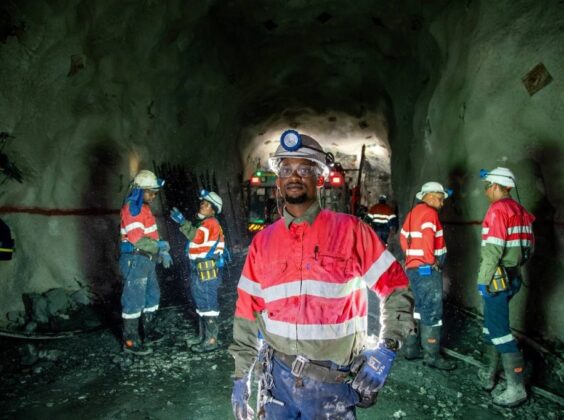
Underground development at Mogalakwena Sandsloot is moving forward, and for once the story isn’t about a cost blowout or a collapsed contractor relationship. Redpath Africa Limited is driving lateral development beneath Anglo American Platinum’s sprawling PGM complex near Mokopane in Limpopo’s Waterberg District. That’s worth paying attention to — not because underground mining is glamorous, but because execution quality in this sector is rare and directly affects the cash flows behind the platinum group metals you might own exposure to.
Here’s what this really means. Anglo is chasing deeper mineral resources beneath an existing open pit — access developed via a decline rather than a vertical shaft. Anyone who’s followed mining capex for more than a decade knows the pattern: open pits deplete, grades fall, and companies face the ugly arithmetic of either going underground at enormous upfront cost or watching volumes fade. This isn’t the first time we’ve seen this circus. What’s different at Sandsloot is that the transition appears to be running on schedule — Phase B is reportedly ahead of its development plan — which, in an industry where “ahead of schedule” usually means “less behind than expected,” is genuinely notable.
Redpath’s scope covers the full package: underground development, raiseboring, mechanised drill-and-blast, ground support, ventilation, and preparation for longhole stoping. In practical terms, bundling these under one contractor reduces the coordination risk that kills so many mining projects. Every additional contractor interface on an underground job is another place where schedule slippage hides and cost overruns breed. Single-point accountability is old-school risk management, and it works.
Eldie Nortier, Redpath’s Contracts Manager, calls this one of the smoothest operations in his 20-plus years of contracting, crediting genuine collaboration between contractor and mine. I’d normally discount that kind of quote as PR filler — contractors saying nice things about clients is like analysts saying nice things about companies they want banking fees from. But there’s substance here worth taking seriously. When a contractor describes the relationship as a business partnership with open issue-resolution and joint action plans, what they’re really describing is reduced contractual friction — fewer variations, fewer disputes, fewer months lost to finger-pointing while the meter runs. On a multi-year underground development, that’s real money.
The mechanisation angle deserves a hard look too. Trackless loading and hauling, mechanised ground-support installation, specialised rigs — this isn’t exotic technology, but it matters. Mechanised development delivers consistent advance rates and, critically, reduces human exposure at the working face. Ground support installed mechanically and immediately is how you prevent the rockfalls that still kill miners on this continent with depressing regularity. Safety performance and productivity aren’t competing goals; they’re the same goal measured different ways. Operations that treat them as a trade-off are the ones that eventually shut down.
Now, the skills development component. Redpath is training South African personnel in development drilling, longhole drilling, remote operation and related specialisations, using specialist trainer-operators. Assessments show the performance gap between South African and expatriate operators narrowing, with local crews posting strong drilling output, and the company has had expatriate electricians accredited to South African competency requirements. Nortier’s point is well taken: importing expertise is a bridge, not a destination.
My take on this is less sentimental than the trade press will make it. Yes, it’s good social policy. But it’s also good business arithmetic. Skilled underground labour is a genuine bottleneck in South African mining — the country has deep mining heritage but a shrinking pool of experienced underground crews as older operations wind down. Any contractor that builds a pipeline of competent local operators isn’t just ticking a B-BBEE box; it’s securing the labour it needs for the next contract. Anglo, meanwhile, secures a workforce that can run the mine long after Redpath’s decline is developed. Both sides have skin in the game, which is exactly why the collaboration rhetoric rings more true here than usual.
The near-term milestone is trial stoping — testing the longhole mining method under actual operating conditions. This is where projects prove themselves or don’t. Development metres are hard enough; stoping is where geology, fragmentation, dilution and recovery all get tested against the mine plan simultaneously. Until trial stoping data is in, any production forecast for the underground operation is a hypothesis, not a fact. I’ve watched too many projects sail through development and stumble at the stoping stage to take scheduling progress as proof of anything. The ventilation infrastructure now being installed is another unglamorous but essential piece — underground production lives or dies on airflow, and retrofitting ventilation is painfully expensive.
Phase B runs to August 2027. Watch the trial stoping results and the transition toward production readiness, not the development metres. Development ahead of schedule is encouraging but doesn’t pay dividends; a stoping method that performs at design dilution and recovery rates does.
For investors, the broader read is straightforward. PGMs have been through the wringer — palladium and rhodium crushed from their peaks, platinum grinding out gains on supply-side discipline. In that environment, the marginal projects that advance on time and on budget are the ones that keep Anglo’s cost curve competitive. Sandsloot isn’t a headline-grabbing discovery; it’s the unsexy work of replacing depleting ounces at reasonable cost. That’s where mining returns actually get made.
Redpath gets a demonstrated capability to point at when bidding the next contract. Anglo gets a development project progressing without drama. And South Africa gets a growing bench of underground specialists. No bubble here, no hype cycle — just capital being deployed into a real asset by people who’ve done it before. In this business, that counts as a rare and bankable combination.


