





Spain is committing €197 million (US$223 million) to a mineral exploration program running 2026 through 2030, covering 100,000 square kilometres of territory. The mandate: identify previously unknown deposits, evaluate critical metals in historical mining waste, and build out the geological dataset available to anyone who eventually stakes ground there. There is no chart to validate here — this is a policy catalyst, not a price catalyst, and the market has not yet been presented with anything to confirm or reject. Treat it accordingly.
The Geological and Mining Institute of Spain (IGME) will run geophysical surveys across western and southern Spain. Airborne work starts within weeks and wraps by June 30. Watch the juniors with existing Spanish ground — if this program translates into staking activity or option agreements, you’ll see it in volume first, not headlines. Price is the truth; the press release is just the setup.
Airborne Surveys Target Potential Mineral Deposits
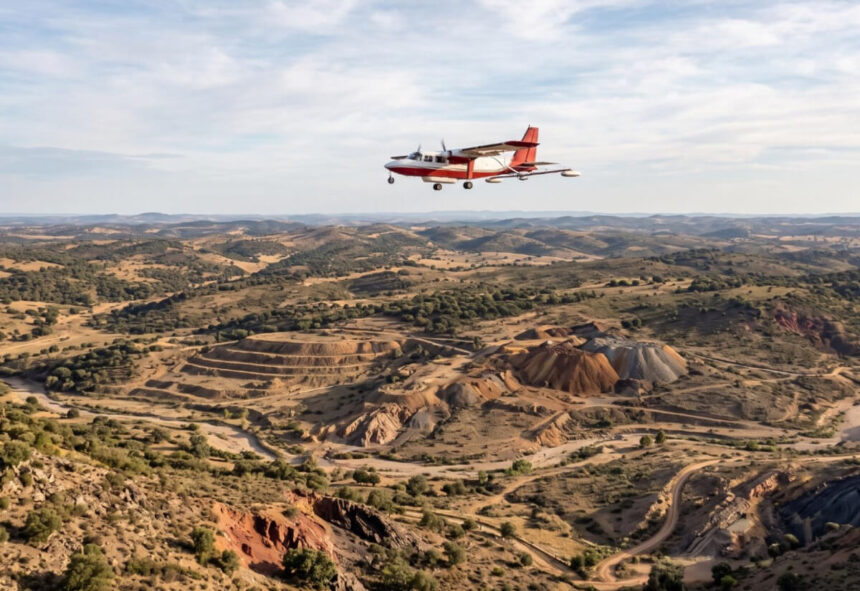
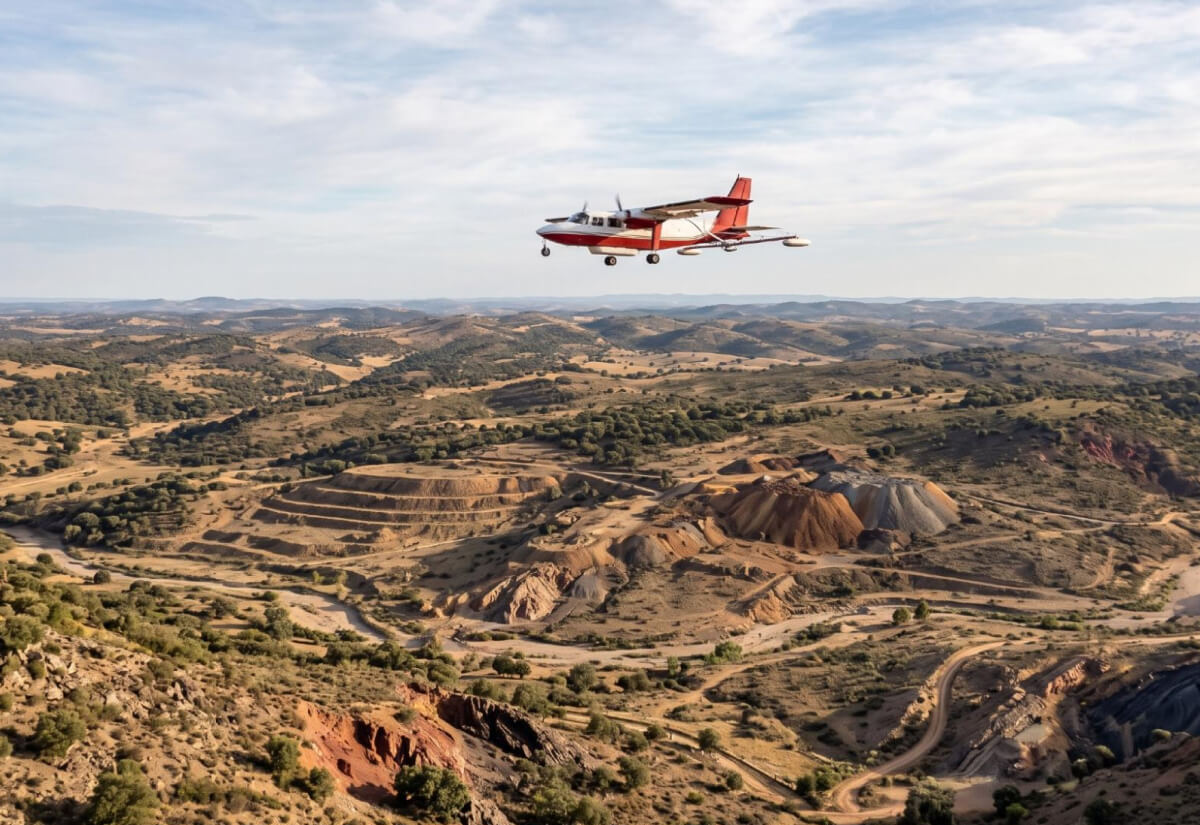
The campaign covers three geological regions: the Central Iberian, Osa-Morena, and South Portuguese zones. Aircraft will fly roughly 100 metres above terrain, collecting magnetic, radiometric, and gravity data on 400-metre line spacing. That’s systematic coverage, not spot-checking — the kind of dataset that surfaces buried structures and anomalies that surface mapping misses entirely.
IGME also plans to apply AI-driven predictive models to flag prospective ground for follow-up fieldwork. Whether that accelerates target generation or just generates noise remains to be seen. The market won’t care about the methodology; it will care about which listed companies hold ground adjacent to whatever anomalies get published.
Copper, Lithium, and Tungsten Exploration Projects
Two initial exploration areas have been defined in Huelva and Salamanca provinces.
The San Silvestre de Guzmán project in Huelva spans 1,583.7 square kilometres within the South Portuguese zone — Iberian Pyrite Belt country, for those who track the geology. Targets are copper-bearing polymetallic sulphide systems with potential germanium, gallium, and indium credits. Existing magnetic data has already flagged anomalies to guide follow-up.
The Morille project in Salamanca covers approximately 4,353 square kilometres in the Central Iberian zone, targeting tungsten, tin, niobium, tantalum, and lithium. The area hosts more than 100 recorded mineral occurrences and historical workings, and IGME’s Peñarroya repository holds historical drill cores that will feed the assessment. Old drill data plus modern interpretation is how efficient exploration budgets get spent.
State-owned Hunosa will provide technical direction for the initial state-reserve areas while research permits are prepared. That permitting timeline is the real variable here. Spain’s mining permitting regime is not known for velocity, and exploration results without a path to permitting are just sunk cost.
Historical Mine Waste to Be Assessed for Valuable Metals
The program includes re-evaluation of four legacy mining waste sites: Santa Bárbara and Elena in Córdoba, and Paquito La Manzana and El Centenillo in Jaén.
The assessment targets antimony, cobalt, copper, nickel, silver, lead, and zinc. Tailings reprocessing plays have a different risk profile than grassroots exploration — the mineralization is already located and characterized. The question is always metallurgy and economics, not geology. Antimony and cobalt sit on EU critical raw materials lists, which is the entire reason this program exists. Policy-driven demand, not market-driven demand — a distinction that matters when the funding cycles turn.
Investment Allocated Across Exploration Activities
The budget structure: roughly €51 million to IGME, national institutions, and universities; €115 million split between Hunosa and private companies; €16 million in government grants; and an anticipated €15 million in related private investment.
Read that carefully. The private contribution is a fraction of the total, and government spending remains subject to annual budget allocations with project-level funding approvals. This is not committed capital — it’s a framework. Multi-year government exploration programs have a history of under-delivery when fiscal priorities shift. Don’t price in the full €197 million; price in what’s actually appropriated in year one.
Geological Records to Support Future Mineral Discoveries
IGME has digitized roughly 2,000 documents from 684 prior exploration projects, with a geological archive of about 30,000 plans, over 7,000 of which are scanned. The institute will also reassess legacy geochemical data, which historically targeted a narrower metal suite than today’s critical minerals list demands.
Archival reprocessing is unglamorous and occasionally decisive. Some of the better deposits in established mining jurisdictions were sitting in government or company files for decades before someone re-ran the data with a different commodity assumption. The 100-plus recorded occurrences around Morille are exactly the kind of dataset that gets re-ranked under current tungsten and lithium pricing.
The Technical Read
There is no price action to analyze here because there is no trade yet. The actionable structure emerges in one of two ways.
First: juniors with contiguous ground to the San Silvestre de Guzmán and Morille areas. If this program generates published anomalies and subsequent permit applications, ground packages in the South Portuguese and Central Iberian zones become optionable assets. Watch for volume spikes on low-float Spanish-focused explorers — that’s where the program leaks into price. Any move without volume behind it is noise, and I’d treat a gap up on thin tape as a fade candidate, not a breakout.
Second: the service and geophysics providers. Airborne survey contractors, labs, and drilling companies with Iberian exposure get paid regardless of whether the exploration succeeds. That’s the lower-beta way to express the thesis, and it doesn’t require guessing which anomaly turns into a deposit — a bet most explorers themselves lose.
The commodity backdrop does the heavy lifting. Copper, tungsten, and lithium have all shown structural supply deficits in longer-timeframe analysis, and European jurisdictions trade at a permitting-risk discount that programs like this are explicitly designed to compress. If Spain delivers even a fraction of its stated timeline, jurisdiction re-rating follows — and jurisdiction re-rating is a rising tide for every listed company holding ground in the survey areas.
But confirmation is everything. A government press release is a hypothesis. Staking activity, permit filings, and — eventually — drill intercepts are the evidence. Until then, this is a watchlist item, not a position. Map the Spanish-focused juniors now, note their baselines, and let price and volume tell you which ones the market has decided matter. The chart will confirm the thesis long before the drill core does, and it will lie to you less often.
Source: https://www.miningfeeds.com/spain-targets-mineral-deposits-with-us223-million-exploration-plan/


