




So Alex Metals (ALX.V) wrapped up its first full Alaskan exploration season, and we’re supposed to be impressed that it spent money it raised earlier this year. Fascinating. A junior miner drilled holes and now awaits lab results. Groundbreaking stuff—literally, I suppose.
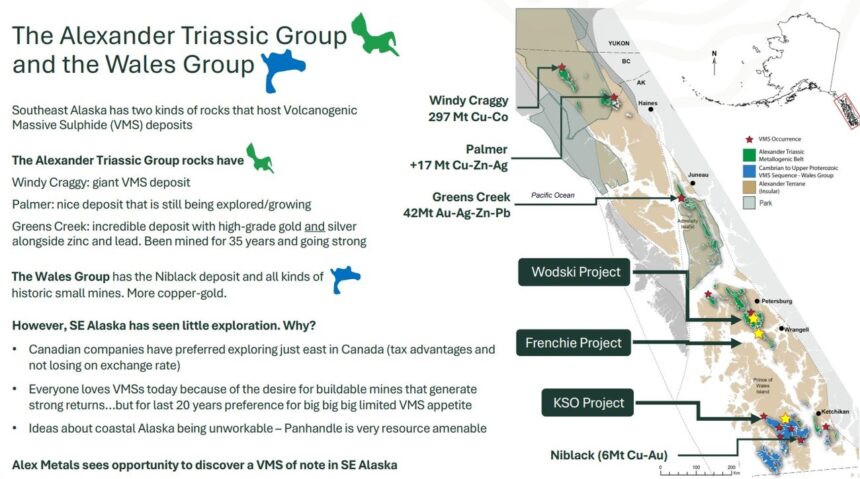
Here’s what actually happened, stripped of the promotional gloss: three properties (Wodski, Frenchi, KSO), four targets tested across two of them, over 6,000 meters of drilling total. KSO got 3,058 meters across 16 holes and three targets. Wodski got 3,138 meters in 13 holes. Frenchi, the property they didn’t bother drilling, got mapping, sampling, and geophysical surveys instead. And the punchline: assays are pending. Everything else is noise.
Let’s do the arithmetic that junior mining enthusiasts conveniently skip. Drilling costs in remote Alaska run well into the hundreds of dollars per meter once you factor in mobilization, helicopters, and everything else that makes Alaska delightfully expensive. That 6,000 meters likely consumed a seven-figure chunk of the capital raised earlier this year—capital that, for the shareholders who bought in, is now sitting in the ground as rock core until assays say otherwise. Until those assays arrive, your investment thesis is “trust me.”
And that’s the entire game with explorers: pre-discovery, the company’s value is a function of cash in the treasury minus burn rate, plus whatever narrative the market will pay for. No revenue. No resource. No cash flow to discount. The only exit ramps are a discovery, a buyout, or the eternal junior mining classic—another raise that dilutes you while management keeps collecting salaries.
Could this work out? Sure. A discovery on a decent target can re-rate a junior dramatically, and 6,000 meters is a real program, not a token one. But understand what you own: a lottery ticket with a geology department attached. This is not an investment, it’s a speculation, and the correct sizing is money you’d shrug at losing entirely—which the author’s own disclosure of a “small long position” implicitly admits. When the person writing the bullish note only risks pocket change, take the hint.
Compare the alternative that requires zero assays: a broad index fund compounding at market returns with a 0.03% expense ratio, versus this, which charges you dilution, discovery risk, and jurisdiction risk in exchange for a pending lab report. The math isn’t close. It never is.
The author will “keep an eye out” for assay results. Adorable. I’ll be over here watching my net worth grow without needing a geologist.
Source: https://www.caesarsreport.com/blog/alex-metals-wrapped-up-its-6000-meter-drill-program-in-alaska/


