




Let me get one thing straight before the cheerleading starts: the author owns this stock and the company sponsors his website. Keep that in your mental spreadsheet the entire time you read his enthusiasm, because “the stars are aligning” from a paid promoter is not analysis, it’s marketing with extra steps.
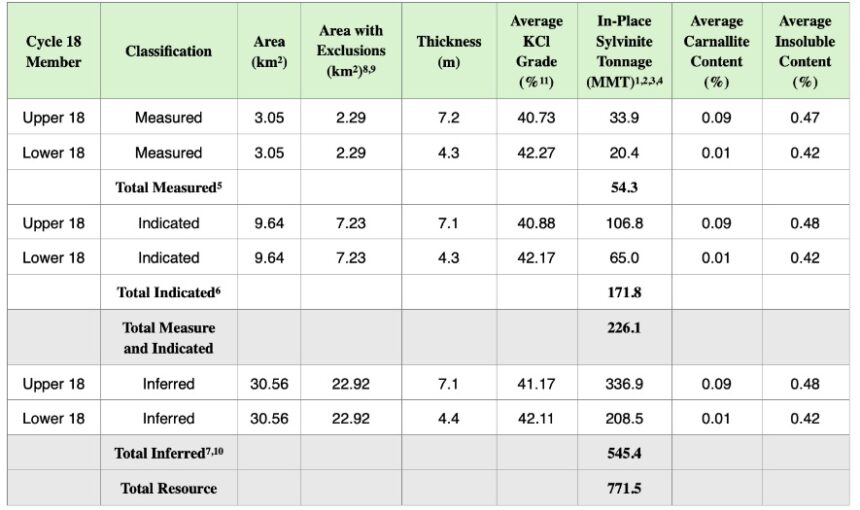
Now, the actual news. Sage Potash (SAGE.V) released its resource update on the Sage Plain project, and the numbers are genuinely solid. Total resources now exceed 770 million tonnes across all categories, with 226 million tonnes in measured and indicated. The grade is remarkably consistent — 41.3-41.5% KCl across all three categories. For context, that’s a high-grade potash deposit by any standard, and grade consistency is what actually matters in mining economics, not the big scary total tonnage headline that promoters love to wave around.
The methodology here deserves a nod instead of an eye roll, which is rare for me. The measured resource uses a 0-750 meter radius of influence; the indicated resource runs 750-2000 meters. That’s reasonably tight drilling control for an M&I base. Most junior miners would love to have this problem.
But here’s the part the press release hopes you skim past: this entire resource is built on two holes. Two. The mineralization consistency supports the interpretation, and if you accept that bedded potash of this character tends to be continuous, the extrapolation is defensible. But a pre-feasibility study will demand far more than two data points, and anyone sizing a position off today’s headline without understanding that is doing exactly the kind of lazy thinking that turns portfolios into charitable donations to the market.
The next steps: additional engineering on solution mining, optimizing mine and plant throughput, continued environmental baseline work, all feeding into a pre-feasibility study to update the project economics. Management is guiding toward a substantial production increase from the 300,000 tonnes per year used in the 2025 Preliminary Economic Assessment. Great story. Note that a PEA is, by definition, the most optimistic preliminary sketch in the mining disclosure hierarchy, and pre-feasibility studies have a long, decorated history of arriving with numbers smaller than the ones management previewed. Until independent consultants sign off, “substantial increase” is a hope, not a fact.
The strategic angle has merit — a high-grade domestic potash resource is genuinely valuable in a market where the US imports most of its supply. That’s a real structural argument, not hype. But strategic value doesn’t pay for capex; engineered economics do, and those are still pending.
If you must gamble on junior miners, size it like the lottery ticket it is — a rounding error in a portfolio otherwise built on low-cost index funds doing the actual wealth-building work. A resource update on two holes is a data point, not a thesis.
The market will price today’s headline by Friday. The pre-feasibility study is where the real math happens — and real math doesn’t care about your excitement.
Source: https://www.caesarsreport.com/blog/sage-potash-releases-strong-resource-update/
