




Let me save you the suspense: Canterra Minerals (CTM.V) delivered a resource update at Lundberg, and the numbers are actually worth reading—unlike 95% of junior mining press releases that mistake adjectives for data.
The headline figures: tonnage at Lundberg jumped 55%, contained copper-equivalent metal rose 34%. Yes, the CuEq growth is smaller than the tonnage growth, and that’s because strong copper prices mathematically compress the copper-equivalent calculation. If that surprises you, you have no business reading resource tables—stick to your savings account. Impressively, 97% of the ~26 million tonnes sits in the indicated category with barely any inferred tonnage. After only ~4,800 meters of drilling since acquisition, that’s a competent piece of work, not the usual smoke-and-mirrors exercise of padding inferred ounces and hoping nobody checks.
What’s actually in the ground: roughly 210 million pounds of copper, 750M+ pounds of zinc, over 300 million pounds of lead, 4.2 million ounces of silver, and a token 51,000 ounces of gold at a grade of 0.06 g/t. Anyone pitching this as a “gold story” should be escorted from the room. It’s a base metals deposit, full stop. Zinc at 1.31% matters because zinc is on Canada’s official critical minerals list, which means government money potentially flows toward it—policy arbitrage is still arbitrage.
Now, the part most retail investors will skip and then complain about later: recovery rates. Only about 66% of the silver is recoverable and payable (part of it reports to the zinc concentrate and gets penalized), and just 23% of the gold. So the “4.2 million ounces of silver” headline is really ~2.8 million ounces you’d ever see paid for, and gold is basically a rounding error at ~12,000 payable ounces. If you read a resource table without checking recoveries, you’re not investing—you’re collecting press releases. The good news: the copper-equivalent grade of 0.87% already bakes these penalties in, so the number itself isn’t lying to you.
The math that actually matters: pit-constrained strip ratio of 3.16:1, which is genuinely decent. Using the consultants’ parameters—US$3.60/t mining cost, US$3/t waste, US$18/t processing, US$2.40/t G&A—your all-in cost is $3.60 + (3.16 × $3) + $18 + $2.40 = $33.48 per tonne. Against a net recoverable and payable NSR of $82.25/t, that’s roughly US$49/t of margin at current assumptions. Before anyone starts spreadsheeting their early retirement around this: there is no economic study yet. This is arithmetic on disclosed parameters, not a promise. The >$120/t NSR blocks near surface suggest the first years of a potential mine could run fatter margins as the strip ratio starts lower, but “could” is doing a lot of work in that sentence, as it always does in junior mining.
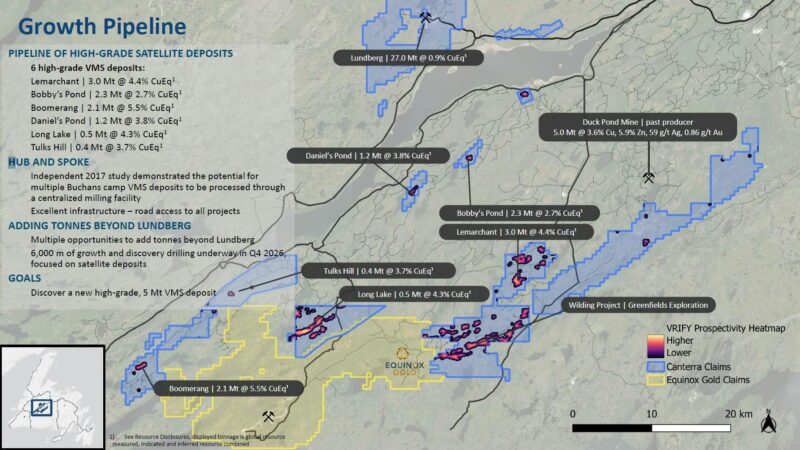
The Two Level zone is the more interesting exploration angle: only 870,000 tonnes in a maiden inferred resource—comically small on its own—but at nearly twice Lundberg’s average grade, sitting right against the pit outline. Feeding higher-grade material into a mill fed by a 0.87% CuEq deposit is how marginal projects become viable ones. Meanwhile, drilling is underway at Lemarchant, which carries a 2018 historical resource of 3 million tonnes at 4.4% CuEq. Historical, people. Pre-2019 standards, unverified. Treating that number as gospel is how people lose money in this sector.
The company has about C$3.0 million in the treasury—enough for the current program, and not one dollar more. Expect a flow-through financing soon, at a discount to whatever the share price is that day, because dilution is the permanent tax on junior mining shareholders. If you hold this, your real return will be whatever the deposits deliver minus the steady drip of shares printed to keep the drills turning.
One more thing: the author discloses that Canterra sponsors his website while holding no position. At least it’s disclosed. But understand the incentive structure before you internalize anyone’s enthusiasm—sponsored coverage is marketing with footnotes. The path to financial independence doesn’t run through a C$3 million treasury junior with no economic study. If you insist on speculating here, size it as what it is: lottery money from your speculative bucket, not your index portfolio. Every dollar in this is a dollar not compounding at market returns, and the math on that trade is brutally unforgiving.


