




Let me get this straight. A junior miner starts drilling two targets with no pre-determined meter count, and this is apparently news. Fine. Let’s do the math anyway, since nobody else seems inclined to.
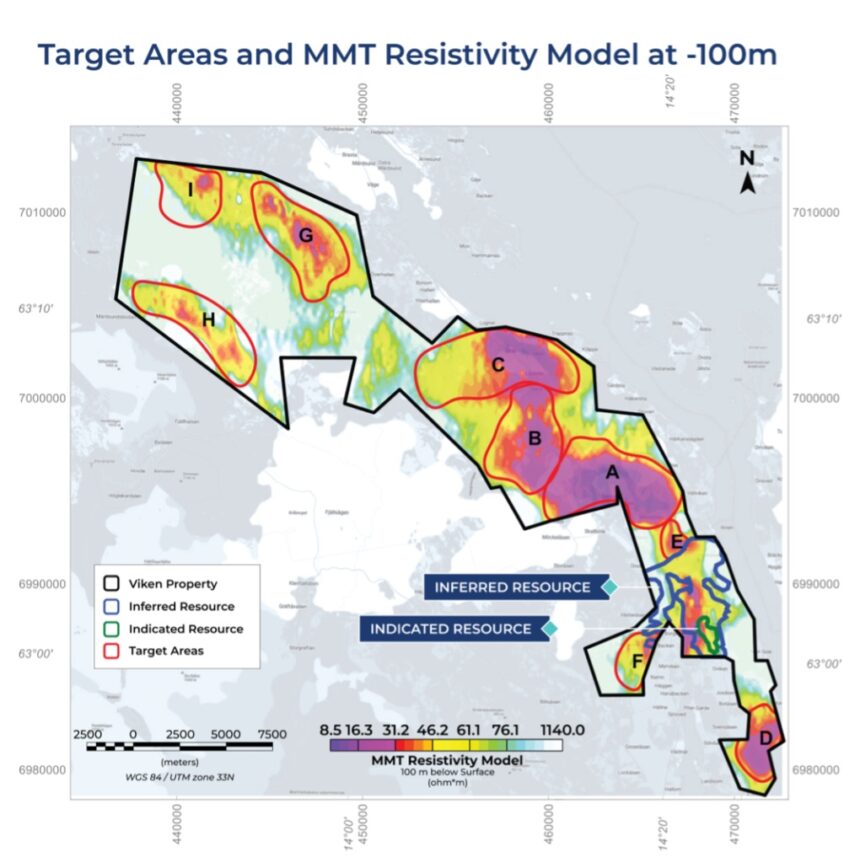
District Metals (DMX.V) has commenced diamond drilling on Target Areas A and B at its Viken uranium-critical minerals project in Sweden. These are two large conductive anomalies picked up in the 2025 airborne survey. The 2008 program poked around the periphery and called it a day, which is exactly the level of rigor you’d expect from a 2008 exploration budget. This new campaign is part of a 5,000–7,000 meter program across the alum shale properties budgeted for the year. No fixed meter allocation for A and B. Translation: the market gets zero certainty on how seriously management takes these targets until the meters actually get spent. Watch the drill logs, not the press releases.
The targets sit 1.7 and 7.5 km north and northwest of the Viken Energy Metals deposit. Here’s the part that matters: the conductive signatures on A and B are stronger than those over the Viken deposit itself. Now, before anyone starts mentally spending a second multi-billion-tonne resource, let’s review what “stronger conductivity” actually proves. Almost nothing, on its own. Conductive anomalies in alum shale are an indication of shale thickness and character, not a resource. The Viken deposit itself runs 4.8 billion tonnes — 456 Mt indicated, 4.3 billion tonnes inferred — hosting 1.7 billion pounds of uranium. That’s the number the anomalies are being compared against, not a second deposit you can already book.
And notice the composition of that existing resource: roughly 90% of the tonnage is inferred. In junior mining, inferred means “geologically plausible, economically hypothetical.” Anyone valuing this company on the headline 4.8 billion tonnes has failed junior mining investing before even starting. The market cap that matters is the one attached to ounces and pounds that can survive a feasibility study, permitting (uranium, in Sweden, post-referendum-ban era — good luck), and metallurgy.
Also, per the usual disclosure: the author holds a small long position and District sponsors the website. Small position plus sponsorship means the promotional incentive is real and the financial exposure is modest. Read accordingly. That’s not cynicism; that’s incentive analysis, the cheapest risk management tool available and, mysteriously, the one retail investors use least.
Is there a legitimate speculative case here? Sure. If Targets A and B return mineralization comparable to Viken, the district-scale optionality is real, and you’re paying a junior-miner option price for it. That’s the correct framing: an option, sized accordingly, in the “money you can incinerate without crying” bucket. If you’ve allocated more to this than to your low-cost index funds, your portfolio’s risk management is being conducted by a storyline about conductivity maps. No amount of drilling fixes a savings-rate problem, and no uranium discovery compounds like 30 years of VOO and staying out of your own way.
A stronger conductive anomaly than a 4.8-billion-tonne deposit is a reason to drill, not a reason to buy. One of those is a scientific process. The other is how juniors finance their drill programs — with your money.
Source: https://www.caesarsreport.com/blog/district-metals-starts-drilling-at-viken/


