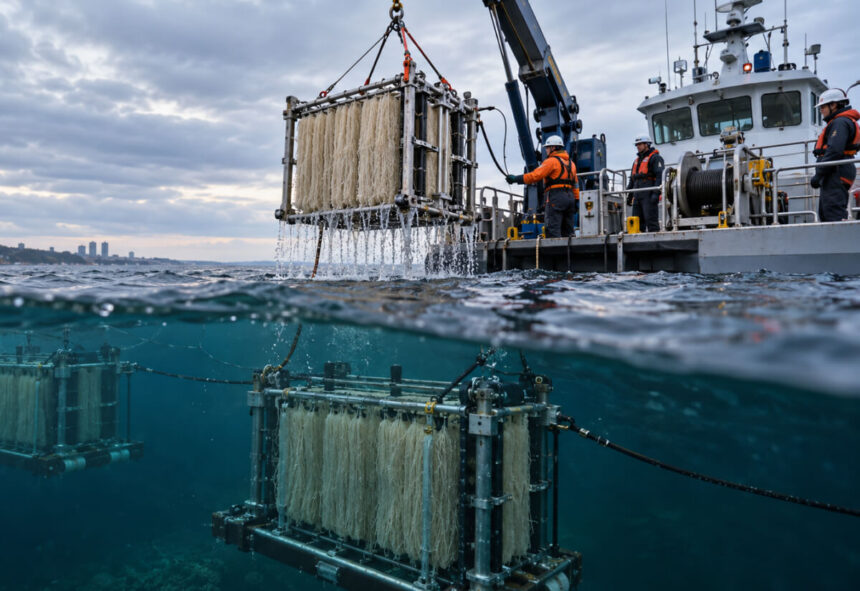

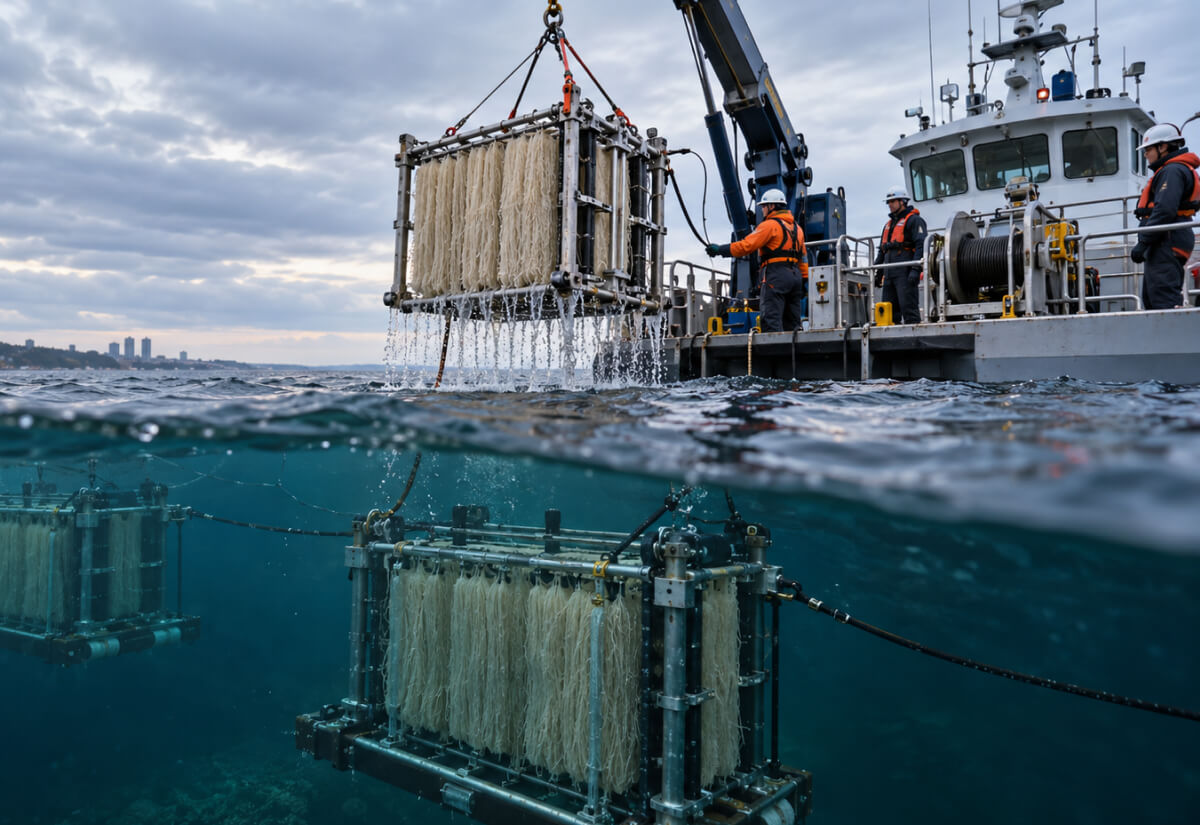
SuperCritical Materials Corp. has announced a research partnership with the University of Michigan to work on the physical systems required to collect uranium from seawater at commercial scale. Strip away the press-release framing and what you have is an early-stage development story with no revenue, no production, and no price action to validate any of it yet. That matters. News is noise until the tape confirms it, and in this case the tape is still printing on a story stock, not a cash-flow story.
The company’s licensed adsorbent captures dissolved uranium as seawater flows across the material. After a defined exposure period, the adsorbent is retrieved and processed to strip the uranium. Scaling that concept means building equipment that can deploy, hold, and recover large volumes of material repeatedly — without mechanical failure and without operating costs that destroy the economics. That is an engineering problem before it is a market problem, and engineering problems don’t show up on a chart until the market decides to price them in.
University researchers will study the mechanical forces imposed during packing, deployment, ocean exposure, and retrieval. Their findings feed directly into prototype design and determine which packing configurations survive repeated cycling. Translation: this is pre-pilot work. Nothing here has been tested in open water. Nothing here has been validated at volume. Any trader positioning ahead of results is trading anticipation, and anticipation is where retail gets harvested.
Tank Trials Will Simulate Offshore Forces
Testing will run through the Aaron Friedman Marine Hydrodynamics Laboratory, whose tanks can reproduce waves, currents, and other marine conditions in a controlled environment. Researchers will measure how prototype systems respond to offshore loads before anything touches a real deployment site.
Dr. Maha Haji leads the university side. She is an assistant professor of mechanical engineering and directs the Symbiotic Engineering and Analysis Laboratory, bringing hydrodynamics, offshore design, and experimental testing capability to SuperCritical’s program. Credible academic partners are a legitimate quality signal for a development-stage company — but credibility in a lab does not equal a buy signal on a screen. Price is the truth, and the truth hasn’t spoken yet.
The work sequence is straightforward: measure the adsorbent’s mechanical properties, assess packing formats, build prototypes, run hydrodynamic trials, and iterate. The output is intended to support a later open-water pilot. Each stage is a binary catalyst. Each stage can validate the thesis or kill it. From a risk-management standpoint, that means event risk — and event risk demands position sizing discipline, not conviction narratives.
The core engineering question is dependable cycling at industrial volume. A viable installation must move large quantities of adsorbent into position, hold the material exposed for the required interval, and retrieve it efficiently — repeatedly, in a punishing saltwater environment. If any link in that chain fails, the entire cost model collapses. There is no partial credit in industrial process economics.
Seawater Resource Draws Nuclear Fuel Interest
SuperCritical is running this through a nearshore development program targeting industrial capacity and competitive production costs, positioning itself within the American nuclear fuel supply chain as the U.S. works to expand domestic supply and reduce import dependence. That policy tailwind is real, and it’s part of why uranium equities have held bid interest. But policy tailwinds are sentiment drivers, not technical confirmations. Sector beta can carry a speculative name higher on narrative alone — right up until it doesn’t. Names that run on theme and not on fundamentals tend to retrace the entire move when the theme cools.
The resource itself is a numbers game: uranium exists in seawater at extremely low concentrations, but ocean volume yields an estimated 4.5 billion tons. The geological inventory is not the constraint. Extraction economics are. A resource nobody can profitably recover is a resource priced at zero until proven otherwise. The burden of proof sits entirely with the process engineering, not with the ocean.
Alexander Canon Bryan, SuperCritical’s president and CEO, has framed efficient, repeated deployment, exposure, and retrieval of the adsorbent at industrial scale as the focus of the current program. Success in the Michigan trials would generate the engineering dataset required for offshore trials and a subsequent feasibility assessment. Note the structure: lab trials, then offshore trials, then feasibility. That is at least three validation gates before commercialization is even discussable. Discounted cash flows at this stage are fiction. Trade the catalysts, not the projection spreadsheets.
The partnership pairs a uranium-selective material with the equipment research needed to deploy it at sea. Results will define design parameters, operating limits, and preferred configurations before an offshore pilot is committed. The phased structure has a practical benefit: it surfaces constraints early, letting engineers adjust handling methods and prototype geometry before equipment faces uncontrolled marine conditions. From a capital-markets perspective, phased de-risking is the correct structure — each completed gate reduces the probability-weighted risk premium the market applies to the equity.
How to actually trade this: treat every announcement in this sequence as a potential volatility event. A partnership headline like this one can gap a microcap higher on thin volume — and gaps on low relative volume in development-stage names are historically poor entries. This setup lacks confirmation until you see a gap-and-hold pattern: a break above the pre-announcement range that consolidates above it with expanding volume on the retest. If price fills the gap within days and volume dries up, you’re looking at a liquidity event for early holders, not a trend. That’s the classic profile of a headline pop — a trap for chasers.
The cleanest tell to watch is the response after each trial milestone. Positive lab results that produce a higher low above prior resistance, confirmed by rising volume and a MACD crossover on the daily, would be the first legitimate structural signal this story has legs. Positive news that produces a fade into the announcement-day open would tell you the market has already priced the anticipation and smart money is distributing. Watch the reaction, not the headline. The headline is known by everyone simultaneously; the reaction is where the information actually lives.
Risk parameters are non-negotiable here. Development-stage uranium names with no production carry binary outcomes on every trial. If you must take the position, define the invalidation level before entry — typically the low of the breakout base — and respect it without exception. No thesis, however compelling, overrides a broken support level. Price is the truth; everything else is commentary.
The engineering roadmap is coherent and the academic partnership adds genuine technical weight. But coherence on a roadmap and confirmation on a chart are two different things, and only one of them pays. Let the tape validate before the narrative does.