




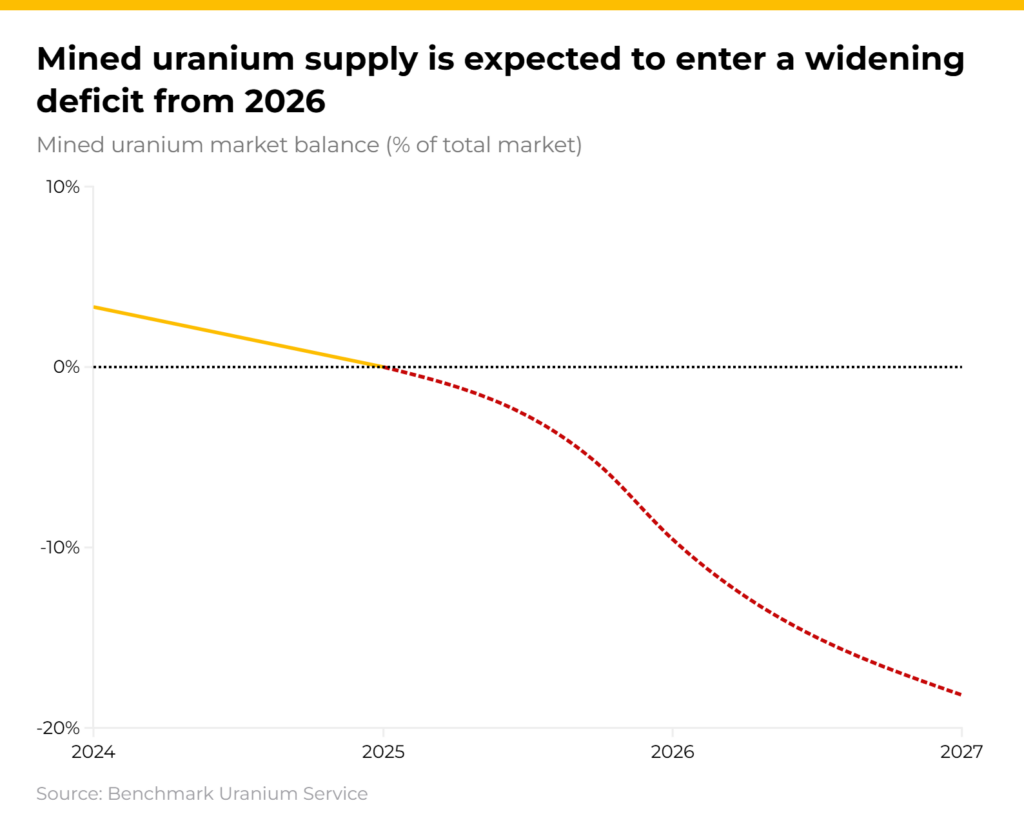
The uranium market is slipping into a structural deficit as surging nuclear demand outpaces the development of new mines.
Global uranium exploration and development spending exceeded $1.78 billion in 2023 and 2024, up about 46% from the previous two years, according to a new report jointly published by the OECD Nuclear Energy Agency (NEA) and International Atomic Energy Agency (IAEA).
Production is responding, rising about 20% over the same period to more than 116,000 tonnes uranium (tU). Output reached 61,924 tU in 2024 alone, the highest annual level since 2016.
Still, Benchmark Mineral Intelligence sees the market already in a marginal deficit in 2026, with the shortfall forecast to widen to 18% of demand by 2027. Nuclear reactor construction, rising electricity consumption and the rapid expansion of power-hungry data centres are adding demand just as the industry confronts the long timelines required to develop new mines.
“The uranium market is moving decisively beyond the post-Fukushima period of subdued market and price environment,” Tony Alderson, Benchmark’s uranium research manager, told MINING.COM. “Demand is being strengthened by renewed interest in nuclear power, including SMRs and advanced reactor technologies, as well as growing requirements from AI hyperscalers.”
“However, the focus on future reactor capacity risks overlooking the scale of mined uranium supply that will be needed to support this growth,” Alderson, said.
The challenge is less about whether enough uranium exists underground than whether miners can extract it quickly enough. Identified global uranium resources recoverable for less than $260 per kgU ($100 per lb. U3O8) exceed 8.1 million tU, up 2.1% from the previous edition of the NEA-IAEA report. That would be sufficient to meet even its highest projected demand through 2050.
Reactor buildout
The urgency comes from the scale of nuclear expansion expected over the next quarter-century.
There were 418 commercial nuclear reactors operating worldwide as of Jan. 1, 2025, with 378 gigawatts electric (GWe) of net generating capacity requiring about 64,500 tU annually, according to the NEA and IAEA. Another 23 reactors totalling 19.7 GWe were in suspended operation.
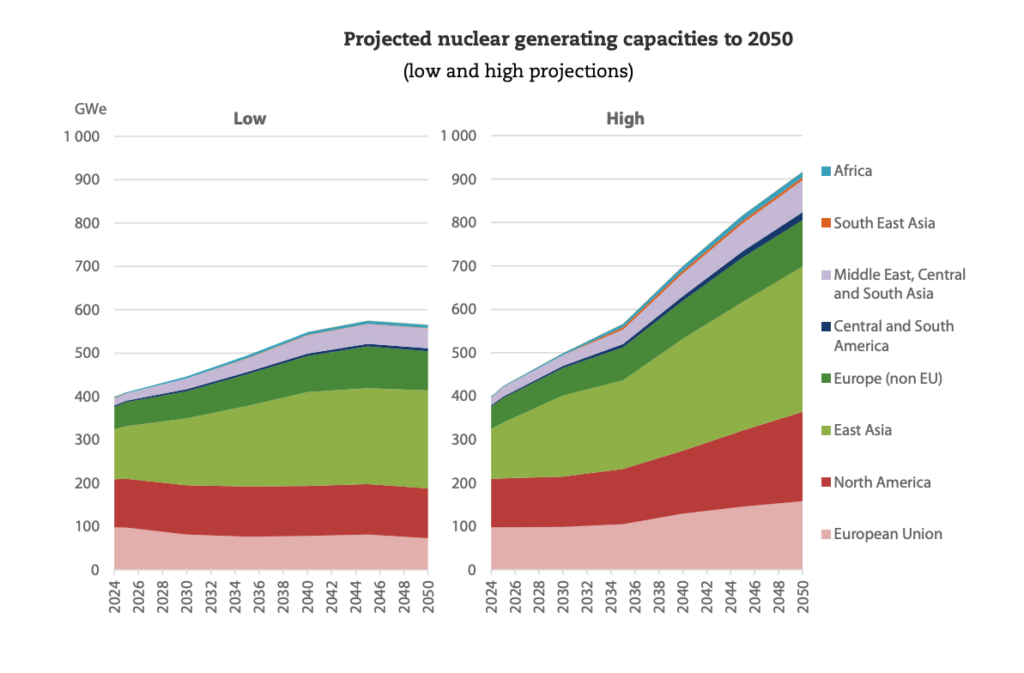
Global nuclear capacity is projected to expand substantially through 2050 as countries seek to meet rising electricity consumption, bolster energy security and pursue environmental goals. Depending on the pace of growth, annual uranium requirements could rise to between about 84,800 tU and 143,900 tU by mid-century.
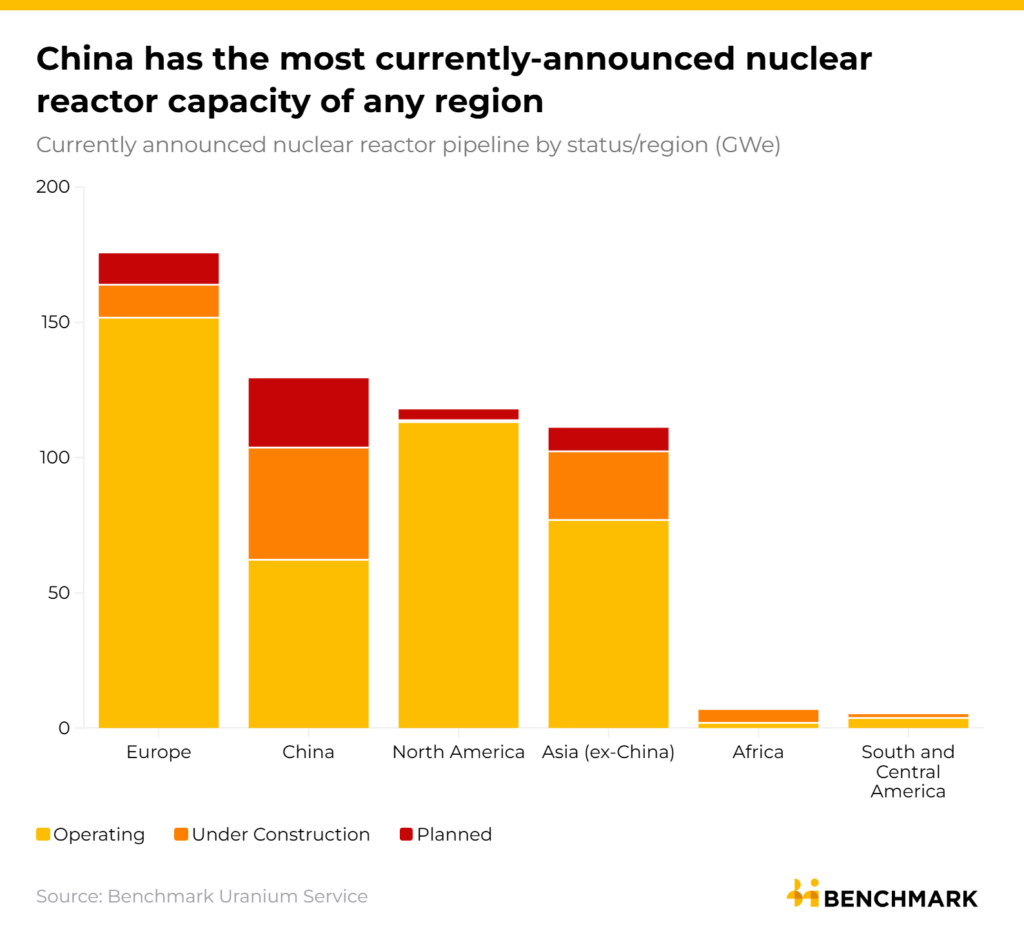
China is expected to be a major driver. Its roughly 68 GWe of existing nuclear capacity is set to expand rapidly, with 42 GWe under construction and another 26 GWe planned, according to Benchmark. More than 30 GWe is under construction or planned elsewhere in Asia, while Europe has more than 20 GWe in the pipeline.
The buildout comes as data-centre development adds another source of electricity demand. Artificial intelligence and cloud-computing operators require large volumes of reliable, around-the-clock power, strengthening interest in nuclear generation.
SMRs could eventually broaden the market further by offering smaller, replicable reactor designs that may be easier to deploy. Their near-term contribution to uranium consumption remains limited, however. Benchmark tracks 73 SMRs that are expected to require less than 2,000 tU annually.
The shift marks a reversal from the years following Japan’s 2011 Fukushima disaster, when reactor shutdowns erased uranium demand faster than miners could reduce supply. Low prices between 2014 and 2021 subsequently caused producers to scale back operations and discouraged investment in new mines.
Mine bottleneck
The supply response is now strengthening, but much of the additional uranium has come from existing operations rather than new projects.
The increase in 2023 and 2024 was driven mainly by restarting idled capacity and expanding existing mines, particularly in Canada, according to the NEA-IAEA report. Several new projects received regulatory approvals and moved closer to development, but none began producing during the period.
Exploration activity has also accelerated while drilling specifically aimed at project development has remained relatively stagnant. That disconnect could become increasingly important because turning a uranium discovery into an operating mine typically takes 15 to 20 years.
Resource abundance therefore does not automatically translate into secure supplies. Sustained investment is needed to identify deposits, secure permits, finance construction and bring projects into production before demand arrives.
“The challenge is not limited to uranium mining,” Alderson said. “The wider nuclear fuel cycle is also facing notable constraints, from conversion and fabrication capacity.”
“With long project lead times, policy hurdles and supply-chain concentration adding to the uncertainty, substantial investment is required across the fuel cycle — and it needs to happen soon if supply is to keep pace with demand.”
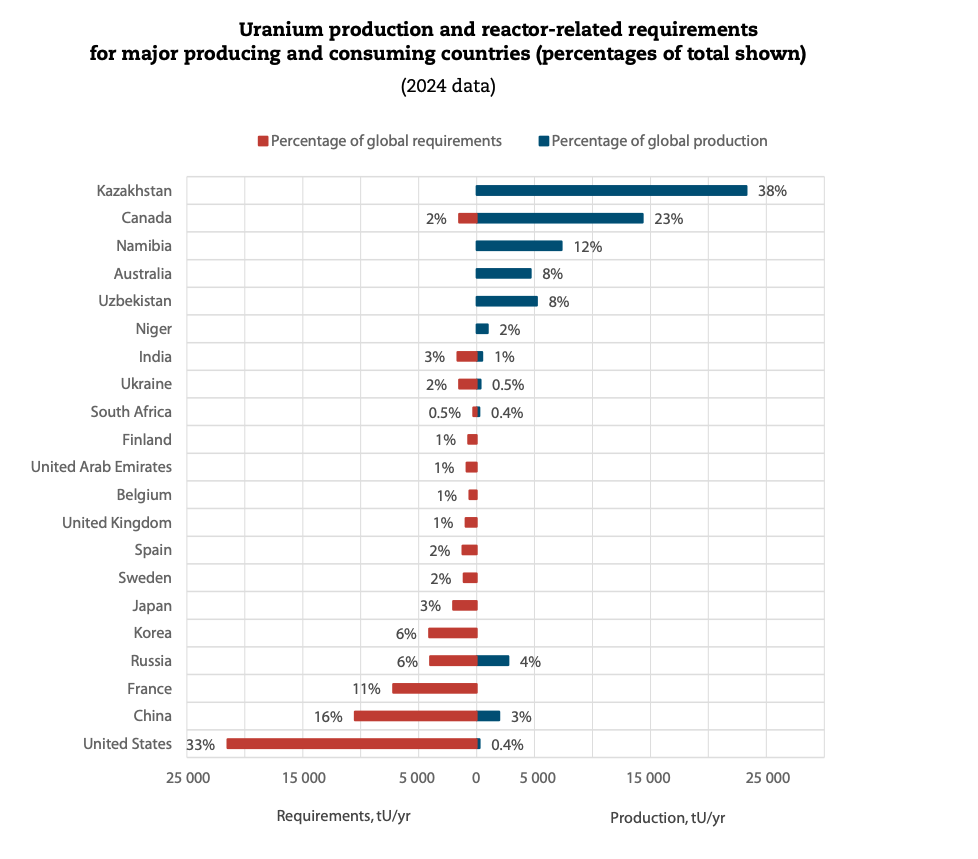
Kazakhstan is particularly important to the near-term outlook because it accounts for about 39% of global mined uranium. Benchmark expects its production growth to remain constrained by tight sulphuric acid supplies, shortages of skilled labour and a record of downward revisions to output guidance.
Sulphuric acid is critical to Kazakhstan’s in-situ recovery operations, which use solutions injected underground to extract uranium. Supply issues involving the chemical also briefly halted production at Cigar Lake in Canada, one of North America’s most important uranium mines, in July.
Namibia offers another source of growth. The country has become the world’s third-largest uranium producer following substantial Chinese investment, and Benchmark expects its output to continue expanding through 2030.
Those gains may not arrive quickly enough to prevent near-term tightness. Benchmark estimates new uranium supply can take about a decade to reach the market, while the NEA and IAEA put typical mine-development lead times at 15 to 20 years when exploration, permitting and development are considered.
The agencies conclude that adequate and sustained uranium prices, backed by long-term contracting, will be critical to maintaining exploration, supporting final investment decisions and encouraging better extraction and processing technologies.
That leaves the uranium industry facing a timing problem. The world has identified enough uranium to cover projected requirements through 2050, and miners have begun spending and producing more. But the expansion of nuclear generation is already underway, while the development pipeline required to turn resources into dependable mine supply remains slow.
“Higher uranium prices are sending a clear signal that the market requires new supply,” Alderson said. “Whilst interest in nuclear power and advanced reactor technologies is accelerating, the development of mines and fuel-cycle capacity are not happening at the same speed as demand growth.”
“Without immediate investment, the industry risks a deepening structural deficit and a more volatile price environment,” he warned.
Source: https://www.mining.com/charts-uranium-miners-race-to-catch-surging-nuclear-demand/