Price is the truth, and right now the truth in the rare earth complex is telling us the market has repriced ex-China supply. Brazil’s reserve base — roughly 21 million metric tons per IEA data, second only to China — is the fundamental backdrop, but fundamentals don’t move charts. Capital flows do. And the capital flow data here is unambiguous.
The application count is the cleanest proxy for speculative accumulation in the sector. The National Mining Agency holds 2,758 rare earth projects under review. For context: between 1975 and 2020, Brazil logged just over 250 filings. Between 2023 and 2024 alone, filings climbed by 1,662. That is a vertical — a forty-five-year base followed by a two-year breakout in project activity. In market terms, this is what a volume expansion after a prolonged basing pattern looks like. When Australian, Canadian, and U.S.-listed juniors posted outsized gains over the past year, the move was validated by that same surge in participation. This is not drift. This is rotation, and rotation of this magnitude rarely resolves in a retest of the old base.
The Ionic Clay Trade: Why the Market Is Paying Up
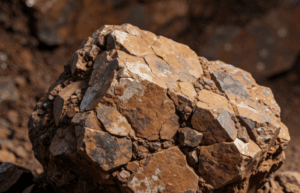
Geology matters here because it changes the cost curve, and the cost curve changes which projects survive contact with reality. Roughly 73 percent of Brazil’s rare earth resources sit in ionic clay formations — deposits that carry meaningful concentrations of dysprosium and terbium, the heavy rare earths embedded in high-temperature permanent magnets. Weathering has already done much of the comminution work, so processing intensity drops relative to hard rock hosts. Lower capex intensity, lower opex per kilogram of contained magnetic rare earth oxide. When the market prices exploration-stage names, it is really pricing the spread between their assumed position on the cost curve and incumbent Chinese production. That spread widened sharply after the export restriction episode, and equities re-rated accordingly.
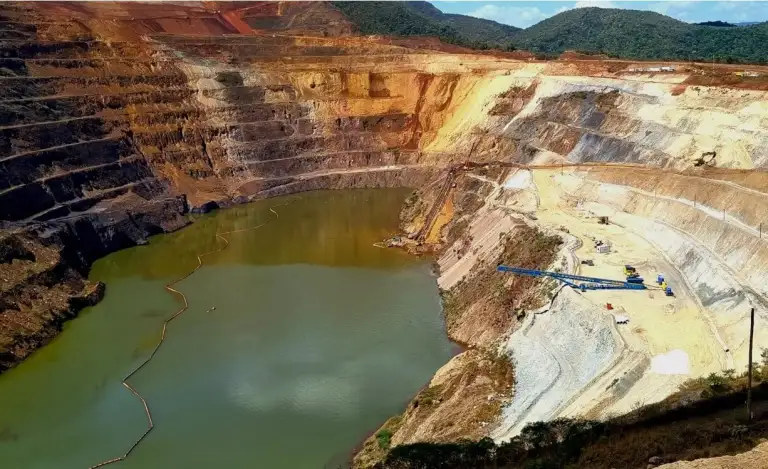
The flagship chart to watch is Meteoric Resources’ Caldeira deposit in Minas Gerais — the largest known ionic clay rare earth deposit in the world, targeting magnetic rare earth output for electric mobility and renewables manufacturing. Development-stage names like this are where the sector’s beta lives. If the broader ex-China thesis holds, Caldeira-adjacent equities should hold above their breakout levels on pullbacks. If they give back the entire range on light volume, that tells you the bid was momentum capital, not strategic capital — and momentum capital exits faster than it arrives.
The Catalyst Was Validated by Price Action
China controls north of 90 percent of global refining capacity and roughly 95 percent of permanent magnet manufacturing. Those numbers have been public for a decade. What changed the chart was the export restriction event during the tariff dispute with the U.S., which disrupted electronics supply chains. Note the sequence: the restriction came first, the sector repriced second. That is textbook catalyst-and-confirmation. Buyers did not front-run a headline and fade it — they responded after the disruption materialized, which is why the subsequent equity moves carried volume behind them rather than printing as exhaustion spikes.
The clearest institutional confirmation came in April, when USA Rare Earths acquired Serra Verde’s Goiás operation for $2.8 billion. Serra Verde is the only active rare earth producer in Brazil and one of the few operations outside Asia producing all four major magnetic rare earth elements — neodymium, praseodymium, dysprosium, and terbium — at commercial scale. A $2.8 billion transaction is not retail speculation; it is a strategic bid establishing a floor under in-country asset valuations. Comparable-stage projects now have a marked-to-market reference point, and that reference point was set at a premium. Expect juniors with ionic clay exposure to trade against that comp.
The Gap in the Thesis: Processing Is the Bottleneck, Not the Resource
Here is where the narrative and the numbers diverge, and this is the part most coverage skips. Brazil exports the overwhelming majority of its mineral output in raw or partially processed form. Domestic refining capacity is minimal. Magnet manufacturing is effectively nonexistent. Owning the resource without the midstream is a commodity producer with a concentrate discount baked into every tonne shipped — the market pays for separation and metallization, not for ore in the ground.
Building separation plants, chemical processing infrastructure, and magnet production requires heavy capital, technical depth, and sustained policy support — none of which materializes on the timeline of a quarterly report. Until that midstream is funded and constructed, ex-Chinese supply chains remain structurally dependent on the very processing capacity they are trying to bypass. India, Vietnam, Sweden, and Norway are chasing the same gap. Brazil’s edge is reserve scale and low-cost mining conditions, but low-cost extraction without domestic refining is a margin-capped business model, not a supply chain solution.
How to Trade It
Structure over story. The sector has had its catalyst, its institutional bid, and its expansion in participation — three of the four ingredients of a durable uptrend. The fourth is follow-through, and that is what to monitor from here. Watch for these signals:
- Breakout retention: Development-stage names with ionic clay exposure should hold above prior resistance on pullbacks. Failures on declining volume signal a bull trap, and there are plenty of exploration-stage charts in this space that fit that description.
- Volume on retests: Healthy consolidation shows contracting volume into support and expansion on recovery. Heavy volume breakdowns through support are exits, not entries.
- RSI behavior on the leaders: If the flagship names register lower RSI highs while price makes marginal new highs, that is bearish divergence — the market running out of buyers at the top of the range before the midstream buildout can justify valuations.
- M&A as confirmation: Further strategic transactions at or above the Serra Verde multiple validate the comp. Bid erosion on comparable deals is an early warning.
The risk case is straightforward: the sector is priced for a supply chain that does not exist yet. Refining and magnet capacity in Brazil remains aspirational, and aspirational capacity does not produce dysprosium. If execution slips — permitting delays, capex overruns, offtake failures — the development-stage cohort will retrace hard regardless of how good the geology is. Divergence between narrative and delivery eventually resolves toward delivery.
The probability-weighted view: reserve scale and the Serra Verde comp give Brazilian rare earth equities a structural bid, but the tradable risk lives in the gap between extraction-stage charts and processing-stage cash flows. Position for the projects with validated metallurgy and funded milestones. Skip the ones whose charts only work when the news cycle is cooperative. Price is the truth, and right now price is rewarding Brazil — the question is whether the infrastructure arrives before the momentum does.
Source: https://www.miningfeeds.com/brazil-emerging-as-rare-earth-powerhouse-amid-shift-from-china/