
Image source: https://pixabay.com/photos/mine-gold-mine-gold-mining-gold-5523376/
Ecuador signed an agreement with CMOC Group Limited to develop the Cangrejos Gold-Copper Project, positioned to become the country’s first large-scale open-pit gold mine. Odin Mining Ecuador, a purpose-built subsidiary, will handle construction and operations. Capex exceeds US$1.7 billion, with construction slated to begin before the end of 2027.
Strip out the press release language and this is what matters: a major capital commitment in a jurisdiction with a mixed track record, at a point in the gold cycle where every developer and producer has been re-rated higher. Price is the truth — and gold’s price structure has given projects like this a window that did not exist eighteen months ago. Whether CMOC deploys that capital efficiently is a separate question from whether the metal tailwind persists through a multi-year build. Those are two different trades on two different timelines.
The Resource — What the Numbers Actually Say
Cangrejos hosts an estimated 11+ million ounces of gold, roughly 1.4 billion pounds of copper, and over 14 million ounces of silver. On paper, that’s a Tier-1 scale asset. But resource estimates are inputs, not signals. The market only pays for ounces that convert to production, and conversion requires permitting, financing, construction, and commissioning — each a failure point with its own probability distribution.
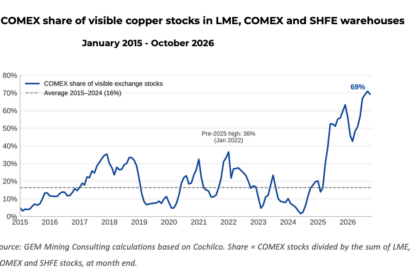
The gold-copper-silver mix is a hedge embedded in the geology. When gold consolidates, copper exposure can carry the economics, and vice versa. From a portfolio construction standpoint, that revenue diversification lowers single-commodity risk — provided both metals hold their respective uptrends. Right now, copper’s longer-term structure is constructive but choppier than gold’s, which has been printing a clean higher-high, higher-low sequence. Anybody modeling Cangrejos cash flows should run scenarios across both, not assume the 2024–2025 tape continues uninterrupted for 26 years. It won’t.
Economics Over a 26-Year Horizon
Mine life is projected at approximately 26 years. The Ecuadorian government takes 50% of the project’s value, with projected state revenue of US$4.39 billion over the life of mine. Advance royalties tied to milestones deliver tens of millions before first production.
A 50% government take is a material haircut to equity returns — not a dealbreaker at current metal prices, but the margin of safety narrows if gold retraces meaningfully. That’s the risk nobody in the announcement mentions: the economics were likely modeled at spot or better. Treat any discounted cash flow coming out of this project with skepticism unless the price deck is disclosed. Long-dated projects priced off cyclical highs have a way of disappointing exactly when sentiment is most bullish — a classic pattern that shows up in the charts as developers failing to hold gains on “positive” news. No volume follow-through on a headline = distribution, not accumulation.
The employment angle — 1,200+ direct jobs plus indirect employment in transport, maintenance, and supply — is politically relevant, not tradeable. The 35% rise in Ecuadorian mining exports between 2024 and 2025 tells you the sector’s macro contribution is growing, which improves the odds of continued government support. Regulatory continuity is a real variable for jurisdiction-risk discounts, and rising export dependence cuts both ways: it incentivizes cooperation, but it also incentivizes fiscal raiding when budgets tighten.
Energy Infrastructure — An Overlooked Variable
CMOC plans to build dedicated power generation rather than tap Ecuador’s national grid, which has faced reliability problems. From an operational standpoint, this is the correct engineering decision. From a capital allocation standpoint, it adds capex to an already US$1.7 billion budget — watch for cost escalation revisions during construction, because those tend to hit developer equities harder than the underlying commodity move.
Energy independence de-risks production continuity, which matters for any model projecting mill throughput decades out. Grid-dependent mining operations in jurisdictions with unstable power supply carry an unpriced risk premium that dedicated generation partially removes.
Geographic Risk — El Oro Province
The project sits in El Oro Province near the Ecuador-Peru border, a region with documented illegal mining activity and organized crime presence, including groups such as Los Lobos. This is not background noise. Security costs, workforce retention, and equipment protection are real line items in jurisdictions with informal mining economies, and formal operations expanding into these areas since 2019 have had mixed results.
From a risk-management perspective, this raises the operational beta of the project. Any disruption event — an attack on infrastructure, a labor incident, an escalation with illegal miners — will reprice the story faster than any geology update. Security incidents are binary catalysts: they gap prices and don’t give you time to exit at your level. Size positions accordingly if you have exposure to this theme through juniors or suppliers.
Environmental Overhang
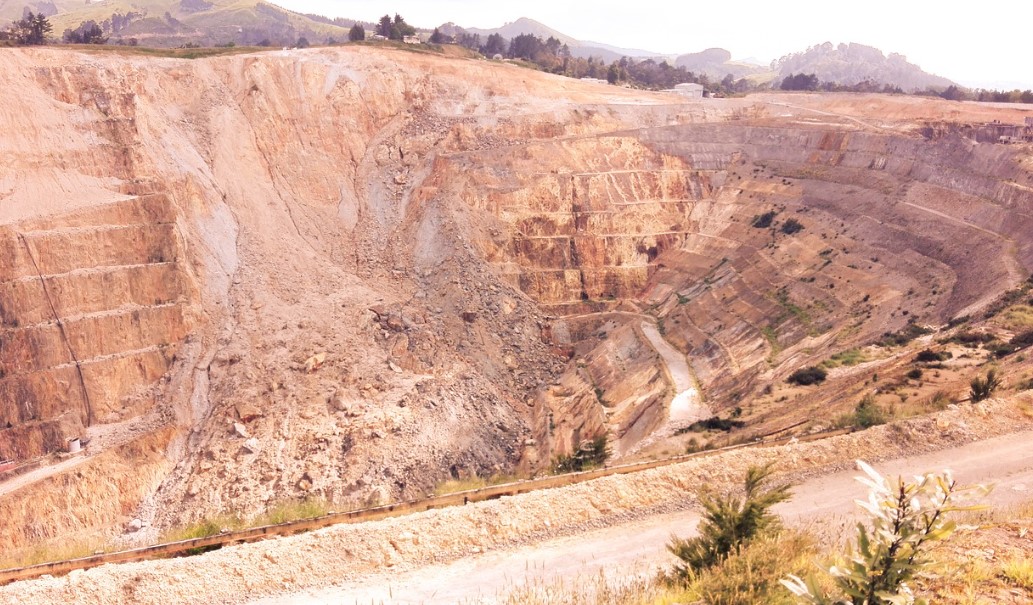
Open-pit development at this scale in an agricultural region guarantees opposition. Waste disposal — millions of tons of tailings and waste rock — is the central technical and social risk, with direct implications for water sources and farmland. Expect permitting challenges, legal delays, and potential social-license disruptions over the 26-year operating life.
For traders, environmental conflict is not a moral question — it’s a schedule risk. Every delay pushes first production right, pushes the NPV discount deeper, and extends the period during which the equity carries development risk without revenue. A slipped timeline is a sellable event regardless of the commodity backdrop.
The Macro Setup This Rides On
Zoom out. This deal is a function of gold’s trend, not the other way around. Gold has been in a confirmed uptrend with consistent volume on advances and lighter participation on pullbacks — textbook accumulation structure. Central bank buying, real-rate dynamics, and geopolitical hedging demand have kept bid depth under the metal. As long as that structure holds, capital will keep flowing into development-stage projects at economics that would have been unfinanceable in 2022.
But recognize the risk asymmetry at cycle highs. When consensus is fully positioned and every jurisdiction is announcing flagship projects, marginal capital enters the market last. If gold breaks key support — watch the major moving averages and the prior consolidation shelf — the financing window for projects like Cangrejos narrows fast. CMOC locking in this agreement now is rational execution against a favorable tape. It doesn’t mean the tape stays favorable through 2027 construction start, let alone first production.
What to Watch
Track three things: construction milestones versus the pre-2027 start date, capex revisions (any upward revision above initial guidance is a negative signal for equity holders of exposed names), and the gold and copper trend structures themselves. If copper’s uptrend confirms with clean volume while gold holds its structure, Cangrejos economics improve in real time. If either metal breaks down, the whole jurisdictional narrative gets repriced with it.
Neither headline enthusiasm nor environmental objections move the needle. Milestone completion, capital discipline, and the metal trends do. The setup is legitimate but unproven — and unproven setups demand confirmation, not conviction.