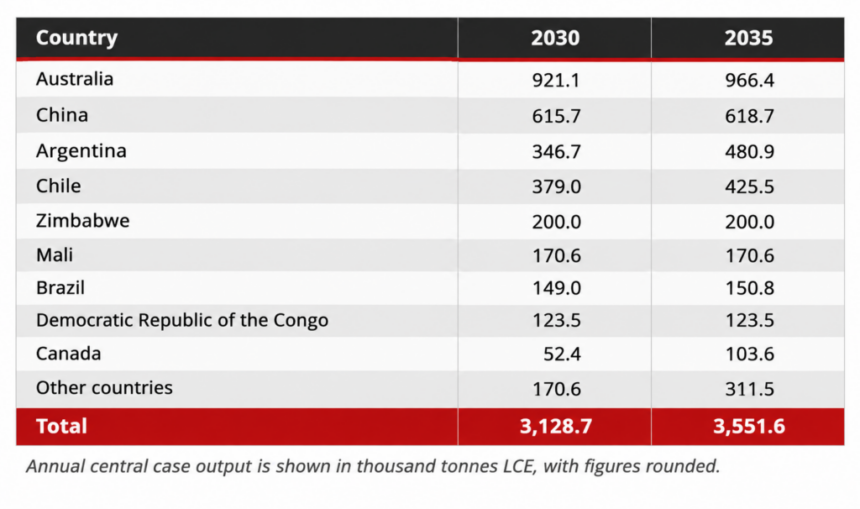
Argentina could overtake Chile as South America’s top lithium producer by 2035, even as global supply climbs to 3.55 million tonnes of lithium carbonate equivalent (LCE), a new study shows.
GEM Mining Consulting’s forecast puts Argentina’s output at 481,000 tonnes LCE by 2035, ahead of Chile’s 426,000 tonnes. Australia would remain the world’s largest producer at about 966,000 tonnes, followed by China at 619,000 tonnes.
The projections draw on 150 operating mines, expansions and development projects across 27 countries. They point to a changing competitive landscape as emerging producers gain ground on established suppliers, although financing constraints and construction delays could alter the rankings.
The findings also highlight the growing importance of project execution in securing future lithium supplies. For buyers and investors, the distinction between announced capacity and reliable commercial production could determine which suppliers can meet long-term commitments.
Conditional lead
Argentina’s projected advantage over Chile depends heavily on a single two-stage development, the Pozuelos–Pastos Grandes project, expected to contribute 90,000 tonnes LCE annually.
Without that project, Argentina’s expected output would fall to about 391,000 tonnes in 2035, leaving it behind its western neighbour.
Chile, meanwhile, is expected to increase production from about 361,000 tonnes in 2026 to 426,000 tonnes in 2035. Despite that growth, its share of modelled global supply would decline from roughly 18% to 12%.
The loss of market share reflects expanding production in competing jurisdictions, including Argentina, Mali, Brazil and Canada, rather than an outright contraction in Chilean output.
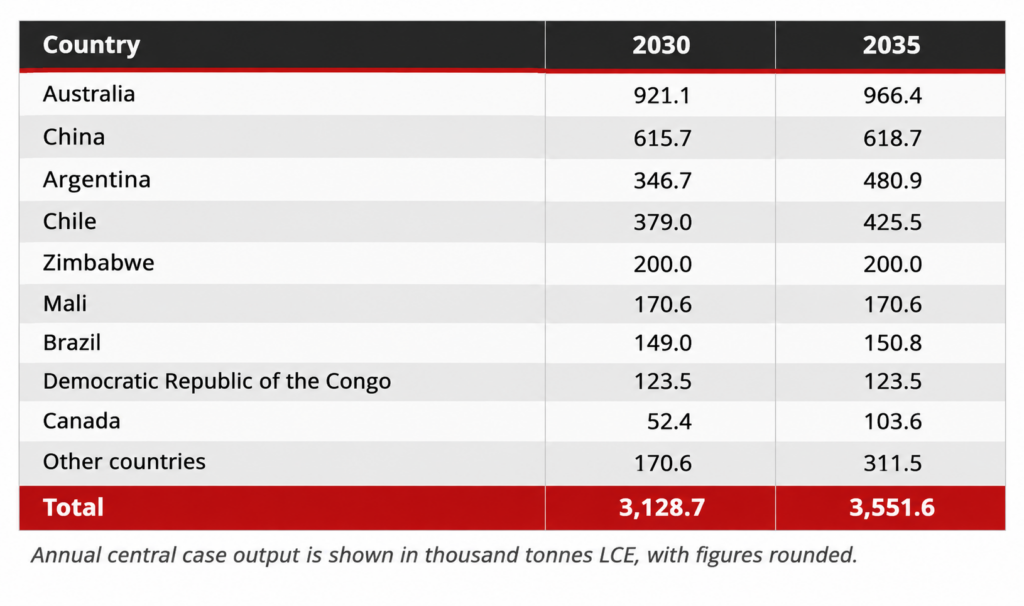
The study’s central scenario forecasts global lithium supply reaching 3.13 million tonnes LCE in 2030 before rising to 3.55 million tonnes five years later.
Supply risks
GEM’s alternative scenarios illustrate how project execution and operating performance could substantially alter the supply outlook.
Under a constrained development scenario with weaker operating results, global production would reach just 2.63 million tonnes LCE by 2035. Faster project delivery, by contrast, could lift output to 4.03 million tonnes.
The study also examined the consequences of a weaker lithium market. A scenario delaying new developments by two years and reducing production from existing operations by 10% beginning in 2027 would cut projected 2030 supply by approximately 529,000 tonnes, or 17%, compared with the central case.
Those differences underscore the risks of treating announced project capacity as guaranteed future supply, particularly when development schedules depend on financing and successful commissioning.
GEM recommends that lithium buyers and investors link contracted volumes to verifiable milestones, including secured financing, commissioning and sustained recovery performance.
The consultancy also advises companies to look beyond mine locations when diversifying supply chains, accounting for processing capacity and transportation routes.
Source: https://www.mining.com/argentina-could-claim-chiles-south-american-lithium-crown-by-2035/