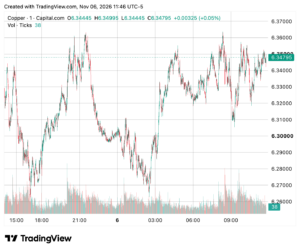
Copper could fall further as Democratic Party gains in the United States midterm elections weaken expectations for import tariffs and raise doubts about projected demand from data centres, TD Securities says.
Three-month copper futures on the London Metal Exchange declined to about $13,779 per tonne, or $6.25 per lb., by late afternoon Friday in London, their lowest level since July, data show. The metal has retreated from September’s intraday peak of almost $6.80 per lb. as traders reassess demand and the incentive to accumulate U.S. stockpiles.
“We continue to expect the red metal to face further downside from here,” TD Securities managing director and global head of commodity strategy Bart Melek said in a note published Thursday.
The risk is that copper loses some of the support from U.S. stockpiling before expected growth in data-centre consumption materializes. Mine disruptions and tight supplies outside the U.S. could nevertheless limit the decline, Fitch Group’s BMI research and data unit says.
Stockpiling risk
Democratic gains could increase resistance to power-hungry data centres, a source of expected copper demand growth, TD says. Affordability concerns ahead of the 2028 presidential vote could also reduce the appetite for aggressive copper tariffs, it says.
“With many states slated for significant AI data center development turning blue, and opposition to new construction potentially growing, AI-driven copper demand could fall meaningfully short of current projections,” Melek wrote. “At the same time, many traders believe aggressive copper tariffs are now less likely with the Democratic Party controlling the U.S. Congress, and affordability the Achilles’ heel for the governing party heading into 2028.”
U.S. copper inventories total about 1.6 million tonnes, TD estimates. Reduced stockpiling incentives and the disappearance of profitable price differences between American and overseas markets could halt additional inflows for a significant period. Slower imports would not necessarily mean an equivalent decline in industrial consumption.
“As such, another $500 per tonne drift lower would not be a major surprise,” Melek wrote. Based on Thursday’s closing copper price of $13,843 per tonne in London, that would represent a drop of about 3.6%.
BMI also sees tariff policy as the immediate catalyst, although it expects mine constraints and electrification demand to cushion any correction. It expects copper to average $13,500 per tonne this year and $12,900 in 2027.
“U.S. tariff uncertainty remains the clearest near-term catalyst for copper, in our view,” BMI said in a report published Thursday.
Possible duties
Washington’s July 2025 copper proclamation outlined possible refined copper duties of 15% from January 2027, rising to 30% in 2028, subject to a subsequent presidential determination. While Democratic gains could increase political pressure over the decision, the proclamation leaves it with the president — and the proposed levies remain unenacted. Separate 50% duties on certain semi-finished copper products and copper-intensive derivative products took effect in August 2025.
Anticipation has nevertheless redirected trade. Higher Comex prices relative to London encouraged shipments into American warehouses before potential tariffs, reducing metal available elsewhere. Comex inventories rose about 62% from January through Wednesday, BMI reported, with those warehouses holding about 70% of global exchange copper stocks on Oct. 30.
The dislocation overlays a concentrated supply chain. Chile supplied 68% of U.S. refined copper imports during 2021–24, followed by Canada at 16%, U.S. Geological Survey data show. China produced an estimated 14 million tonnes of refined copper in 2025, nearly half the global total.
Metal scramble
Chinese buyers are paying more to secure immediately available metal. The Yangshan import premium exceeded $200 a tonne on Wednesday, its highest since records began in 2017, BMI reported. Yet Melek argues that even China’s scramble for supplies has proved insufficient to prevent prices slipping below $14,000.
A tariff retreat would probably slow American imports before prompting substantial re-exports, BMI says, because shipping metal back overseas requires prices to cover freight and handling.
Supply remains a counterweight. BMI cut its 2026 mine production growth forecast to 1.1% from 2.4%, citing Chilean weakness and constraints at Freeport-McMoRan’s (NYSE: FCX) Grasberg operation in Indonesia and Ivanhoe Mines’ (TSX: IVN; US-OTC: IVPAF) Kamoa-Kakula complex in the Democratic Republic of Congo.
Source: www.northernminer.com — article syndicated from the publisher’s feed; all rights remain with the original publisher.