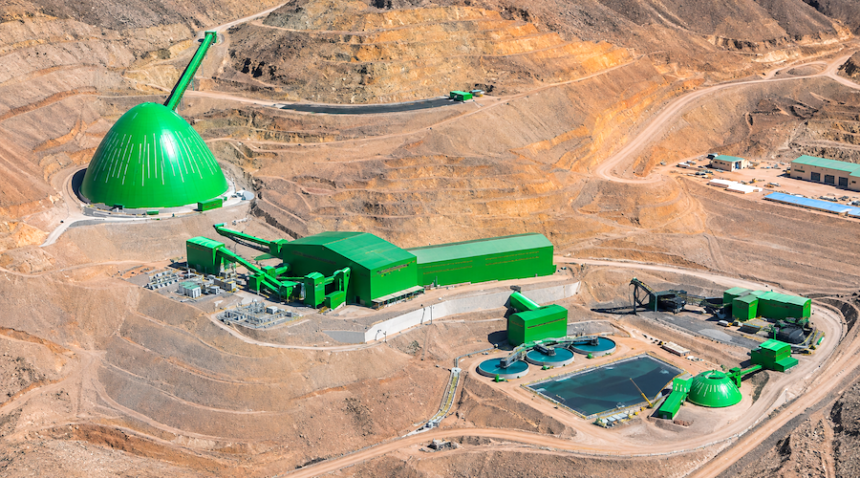
Lundin Mining (TSX: LUN) has lowered its annual copper production forecast for the second time since August as snowmelt continues to disrupt its Caserones mine in Chile, despite stronger-than-expected quarterly cash flow.
The miner cut Caserones’ target to 105,000–115,000 tonnes from 120,000–130,000 tonnes, reducing company-wide guidance to 285,000–310,000 tonnes from 300,000–325,000 tonnes. The mine began the year targeting 130,000–140,000 tonnes before an August reduction.
“Importantly, these are deferred tonnes rather than lost production, and we expect to see a recovery in operational performance through 2027,” president and CEO Jack Lundin said in the company’s quarterly results, released Wednesday.
Reaching the midpoint of the reduced forecast requires about 78,000 tonnes in the fourth quarter, a 25% increase from the third, BMO Capital Markets analyst Matthew Murphy said Thursday. That puts pressure on Caserones to recover while Candelaria maintains strong grades and Chapada delivers steady output, as Lundin approaches a major investment decision at Vicuña.
Lundin shares traded 10% weaker at C$28.48 Thursday morning in Toronto, giving the company a market value of about C$24.3 billion.
Storm disruption
Power outages caused by severe winter storms halted Caserones for about 30 days during the third quarter, including time needed to thaw flotation equipment and restart mills. Subsequent snowmelt has reduced haulage rates and restricted ore deliveries into the fourth quarter.
The mine is about 125 km southeast of Copiapó in Chile’s Atacama region.
Company-wide copper production reached 62,610 tonnes in the three months to Sept. 30, matching BMO’s forecast but missing the 68,000-tonne consensus estimate, Murphy said. Gold output of 36,763 oz. exceeded his estimate and roughly matched consensus.
Caserones’ annual cash cost guidance remains $2.15–$2.35 per lb., following an increase in August. Consolidated guidance remains $1.95–$2.15 per lb.
Candelaria’s copper production rose 13% from the second quarter, while Chapada in Brazil recorded its highest quarterly copper and gold output of the year.
Cash-flow cushion
Free cash flow reached $312 million (C$436 million), exceeding BMO’s $14-million forecast and consensus of $219 million. Capital spending was lower than expected, while a $61-million working-capital release boosted operating cash flow, Murphy said.
Desjardins analyst Bryce Adams described the results as mixed, with lower operating costs and stronger realized copper prices helping offset weaker sales volumes. Adjusted earnings of 32¢ a share exceeded his 28¢ forecast, but the reduced annual copper production range fell below his estimate of 314,000 tonnes. He maintained a buy rating and C$45 target.
Adjusted earnings before interest, taxes, depreciation and amortization of $648 million also exceeded forecasts. However, that measure excluded $58 million in Caserones fixed overhead costs that BMO had included in its estimate, he said.
Lundin ended September with net cash of $237 million. It also lowered annual capital spending guidance by $50 million to $980 million, including a $20-million reduction in sustaining spending at Caserones.
Vicuña decision
Lundin is targeting a year-end investment decision at Vicuña, its equal partnership with BHP (ASX, LSE, NYSE: BHP). The project combines the Josemaría and Filo del Sol copper-gold deposits along the Argentina-Chile border.
The venture has secured a provincial agreement with San Juan and approval for a high-voltage powerline connecting the project to Argentina’s grid. Engineering, financing arrangements and an updated first-stage capital estimate remain part of the work towards sanctioning.
At Chapada, construction of an additional ball mill is about 15% complete, with commissioning targeted for late 2027.
The Vicuña investment decision, project optimization and capital-cost update are the key upcoming events for Lundin’s shares, Murphy said. BMO maintained an outperform rating and C$49 target.
Source: www.northernminer.com — article syndicated from the publisher’s feed; all rights remain with the original publisher.