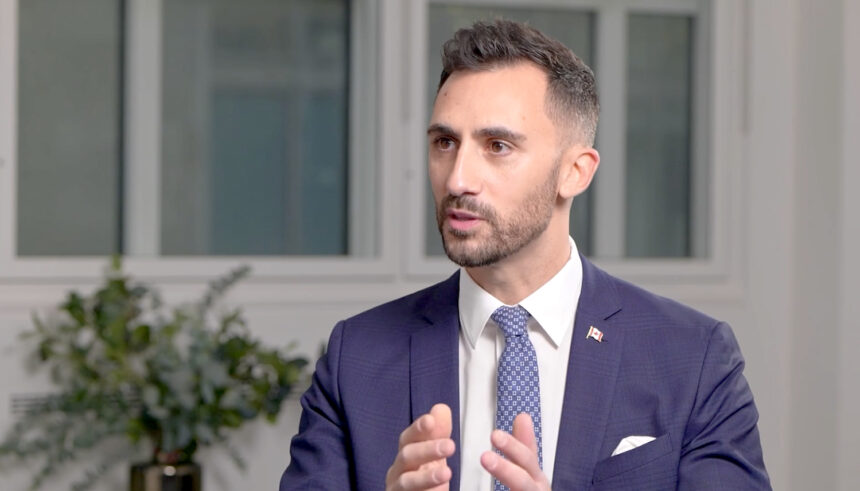
Canada shouldn’t expect the United States to lift tariffs simply because Democrats won control of Congress, Ontario Energy and Mines Minister Stephen Lecce said.
Speaking two days after the U.S. midterm elections, Lecce said the outcome could strengthen Prime Minister Mark Carney’s negotiating position. Still, protectionism runs through both major U.S. political parties, which will leave Canadian exporters exposed even after President Donald Trump leaves office, he cautioned.
“I’m just not convinced it materially changes our fundamental reality on the ground,” Lecce said of the U.S. midterm election results in a lunchtime speech Thursday to the Empire Club of Toronto. “The change of the composition of Congress doesn’t change the policy position of America vis-a-vis tariffs.”
Lecce’s remarks underscore the gap between securing a trade agreement and eliminating tariffs. For Canadian metals producers, a trade deal may offer greater certainty without removing the tariffs that raise the cost of selling into the U.S. market.
Lame-duck Trump
Democrats won both the House of Representatives and Senate in Tuesday’s elections, giving them power to challenge Trump’s agenda when the new Congress convenes in January. The results leave the Republican president facing an opposition-controlled Congress for his final two years in office.
While U.S. political analysts pointed to voter frustration over high prices, the Iran war and government corruption as key factors behind Tuesday’s outcome, Lecce insists trade friction with Canada figured prominently in the campaign.
“Tariffs were on the ballot,” he said. “We stayed in our lane, but it’s clear that Canada was on the ballot.”
New momentum
Negotiations between the neighbours and trading partners have been showing fresh momentum. Carney said Tuesday that Washington had dropped demands affecting Canada’s ability to negotiate agreements with other countries. Trump, meanwhile, said a deal was close, Reuters reported.
Carney’s recent comments on the state of talks are “a good signal,” Lecce said. The Democrats’ win Tuesday “perhaps will enable a better hand for Prime Minister Carney and the national government to land a deal.”
Ontario Premier Doug Ford should get credit for pressing Carney to reject an earlier agreement that would have entrenched tariffs, Lecce added.
Recounting a conversation between the two leaders, Lecce said Ford told Carney this summer: “’Do not sign a bad deal that will lock us and create the precedent of acceptance of tariffs in perpetuity. No deal is materially better than a ‘good’ deal.”
Ford also made it clear to Carney that Ontario would oppose the deal publicly, according to Lecce.
Wider dispute
Ottawa suspended negotiations with the U.S. in August. Washington subsequently imposed 50% tariffs on $27.6 billion of Canadian goods, prompting Canadian countermeasures.
The dispute extends beyond those measures. According to Canada’s Trade Commissioner Service, U.S. sectoral tariffs on covered steel, aluminum and copper products range from 15% to 50%, subject to product and content rules. Certain other tariffs apply even when Canadian goods qualify for preferential treatment under the continental trade agreement.
The bilateral talks are unfolding alongside negotiations over the Canada–United States–Mexico Agreement, or CUSMA. The pact replaced the North American Free Trade Agreement in July 2020, following renegotiation during Trump’s first presidency.
Washington declined to extend CUSMA in its current form at the July 1 review. That triggered annual reviews rather than immediate expiry: the agreement’s existing term runs to 2036, and the three countries can jointly approve another 16-year term.
Canada has explicitly linked those discussions to relief from sectoral tariffs on steel, aluminum, autos and lumber. Preserving CUSMA and resolving the tariff dispute therefore remain connected negotiating objectives.
Diversification
Even as efforts advance to rebuild the American relationship, Canada and Ontario should continue to deepen ties with other nations, Lecce argued.
“We should strengthen that relationship [with the U.S.], get it back on track, but be very vigorous in diversification,” he said. Ontario’s goal is “to make sure we are less exposed, less shocked by that vulnerability when conservatively, well over 75% of our trade is going to one nation.”
Even so, “it doesn’t mean that we can’t hope for some return to what I’d call just normal, respectful civil dialog with the most foundational relationship on earth, which is the United States.”
Source: www.northernminer.com — article syndicated from the publisher’s feed; all rights remain with the original publisher.