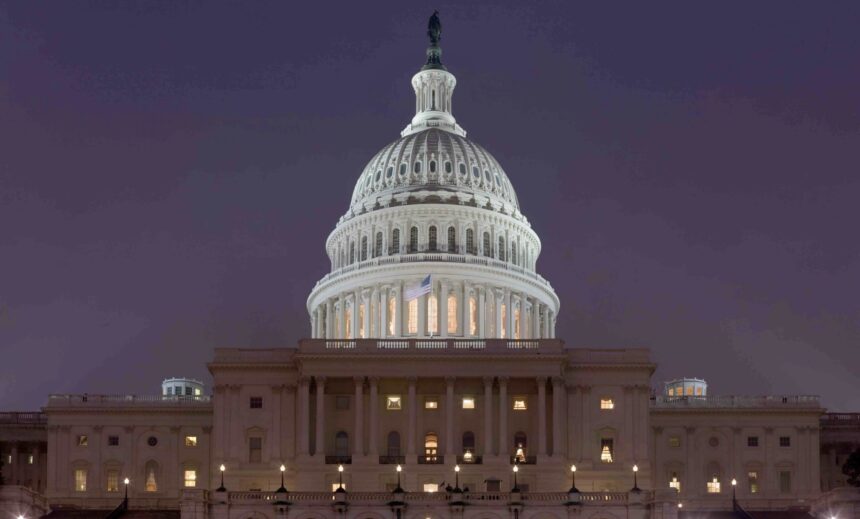
Democrats’ capture of Congress could put U.S. mining investments under closer scrutiny and sustain demand for gold as political stalemate complicates business planning, according to analysts and policy specialists.
Federal support for projects could face tougher examination without necessarily slowing environmental approvals, while uncertainty over trade and economic policy could encourage investors to buy precious metals, CPM Group managing partner Jeffrey Christian and Aaron Mintzes, deputy policy director and counsel at environmental group Earthworks, told The Northern Miner.
“We expect inflation to remain high and problematic, and do not expect any reductions in government spending to reduce inflationary pressures,” Christian said in emailed answers. “The inflationary pressures are coming from a much broader array of developments.”
The comments sharpen the distinction between scrutiny of Washington’s financial backing for mining companies and changes to the rules governing project development. Democrats’ victory gives them greater influence over spending and oversight, but leaves President Donald Trump with executive powers and a veto over legislation. For developers, the question is whether federal support will remain dependable as lawmakers examine how recipients were chosen.
Markets surge
Mining shares outpaced a broad stock market rally on Wednesday following the election. The S&P/TSX Global Mining Index gained 5.1%, while the S&P/TSX Global Gold Index surged 8.7% as bullion rebounded.
Canada’s S&P/TSX Composite advanced 2.3% and the junior-heavy S&P/TSX Venture Composite added 2.5%. In New York, the Dow Jones Industrial Average jumped 3%, or 1,569 points, while the S&P 500 gained 1.6% and the Nasdaq Composite rose 1.4%.
The election has already triggered a rotation across commodities as investors weigh slower U.S. data centre construction and a possible easing of Middle East tensions, BMO Capital Markets said Thursday in a note.
Gold rebounded above $4,100 per oz. as the dollar and Treasury yields fell, accompanied by sharp gains in silver and platinum group metals. Copper and tin, which are exposed to artificial intelligence infrastructure spending, underperformed, while zinc, nickel and aluminum proved more resilient, the bank said.
Crude oil fell below $95 a barrel for the first time since the summer, from more than $110 a week earlier, BMO said.
Funding focus
Government investments in mining companies are likely to become an oversight priority, Mintzes said. But he questioned whether Democratic control would itself delay projects.
“Slowing projects, probably not,” he said in emailed answers. “After all, Congress is debating the permitting legislation that prevents slowing projects.”
Senator Martin Heinrich and Representative Jared Huffman, the senior Democrats on the Senate energy and House natural resources committees, sought a watchdog investigation in August into government investments in private mining companies.
Their request asked the Government Accountability Office to examine financial safeguards and potential conflicts when federal agencies act as both investors and regulators. It also questioned how agencies assess project economics before committing taxpayer funds.
Christian argued that greater scrutiny could delay financing for projects whose economics do not justify federal support. He did not identify individual projects or provide supporting economic assessments in his response.
Permitting divide
Mintzes sees room for a permitting agreement when the new Congress takes office, but favours retaining electricity transmission measures while changing the mining provisions.
Both parties face pressure from Indigenous groups and communities to oppose the existing Senate package, he said. Earthworks has criticized the bill’s proposed restrictions on legal challenges and changes to environmental safeguards.
The Bipartisan American Affordability and Jobs Act would strengthen review deadlines, restrict agencies’ ability to revoke permits and narrow the window for litigation. Republican senators Shelley Moore Capito and Mike Lee joined Democrats Sheldon Whitehouse and Heinrich in sponsoring the proposed legislation before the election.
Huffman argued before the election that Democrats should seek a better agreement once they had greater negotiating power. His objections included protections for communities and wildlife, as well as assurances that renewable energy projects would receive fair treatment.
“Folding our hand now or in the lame duck makes no sense,” he said in a September statement outlining his objections.
Wood Mackenzie offered a more optimistic assessment after the election, identifying permitting reform as the likeliest area for bipartisan agreement because both parties face pressure to lower electricity costs.
The Senate has scheduled a procedural vote for Nov. 9 on advancing the legislation serving as the vehicle for the permitting package.
Gold protection
For precious metals, Christian sees political stalemate adding to existing economic and geopolitical risks rather than resolving them.
Those pressures are likely to stimulate renewed investor buying of gold and silver, he said. CPM sees the metals’ recent price declines as at or near a bottom.
His assessment does not depend on the weaker dollar and falling interest rates that helped explain gold’s initial post-election rally.
“We do not see a weaker dollar in the near term,” Christian said. “We expect interest rates to remain ‘high’ and possibly increase until recessionary conditions are more clearly emerging.”
BMO also cautioned against assuming an immediate change in the economic outlook. The election had not prompted changes to its baseline growth, inflation or interest-rate forecasts, chief U.S. economist Scott Anderson said during a webcast from London on Wednesday.
Democrats would have limited ability to reverse existing legislation without presidential cooperation, he said.
Data centre risks
Christian sees a more direct demand risk for copper and silver if increased scrutiny slows data centre construction. Regulation would be only one constraint.
“Financing also will be a constraint to future data center developments, as will energy availability, water, and an absence of local buy-in,” he said.
Physical shortages are cushioning copper against those demand concerns. Chinese smelters are moderating production as processing margins turn negative, tightening an already constrained spot market, BMO said Thursday, citing CRU estimates. The Shanghai futures market is showing its steepest backwardation since 2022, with nearby metal commanding
Source: www.northernminer.com — article syndicated from the publisher’s feed; all rights remain with the original publisher.