Washington is backing California’s critical minerals push with loans, price guarantees and equity, but developers still face a hurdle federal support can’t remove: state environmental approval.
The state hosts the country’s only active commercial-scale rare earth mining and processing operation at MP Materials’ (NYSE: MP) Mountain Pass, while developers around the Salton Sea are trying to turn lithium-rich geothermal brines into battery materials. A rival project’s environmental review was sent back for revisions in August, two months after BHE Renewables and TerraLithium reported a technical breakthrough.
“California is a water-constrained state, and that makes it very difficult to approve projects like this,” Federico Gay, principal analyst for lithium at Benchmark Mineral Intelligence in London, told The Northern Miner in an October interview. “But the California Energy Commission and the government seem to be focused on supporting projects like this—more in words than in money, but potentially money will follow.”
The setback came on Aug. 11, when California’s Court of Appeal ruled that an Imperial County environmental review of privately held Controlled Thermal Resources’ Hell’s Kitchen project didn’t establish that its claimed 50-year water supply would be available or fully address air quality impacts. The county must address those gaps under the California Environmental Quality Act.
Midterms
Tuesday’s Democratic election victory adds uncertainty to federal support. The party’s capture of Congress raises the prospect of closer scrutiny of Washington’s mining investments and gives Democrats greater influence over negotiations to accelerate federal permitting.
Permitting mines in California requires navigating local land-use rules and state laws, including the California Environmental Quality Act and the Surface Mining and Reclamation Act. The latter requires reclamation plans, annual inspections and financial assurances for restoring mine sites.
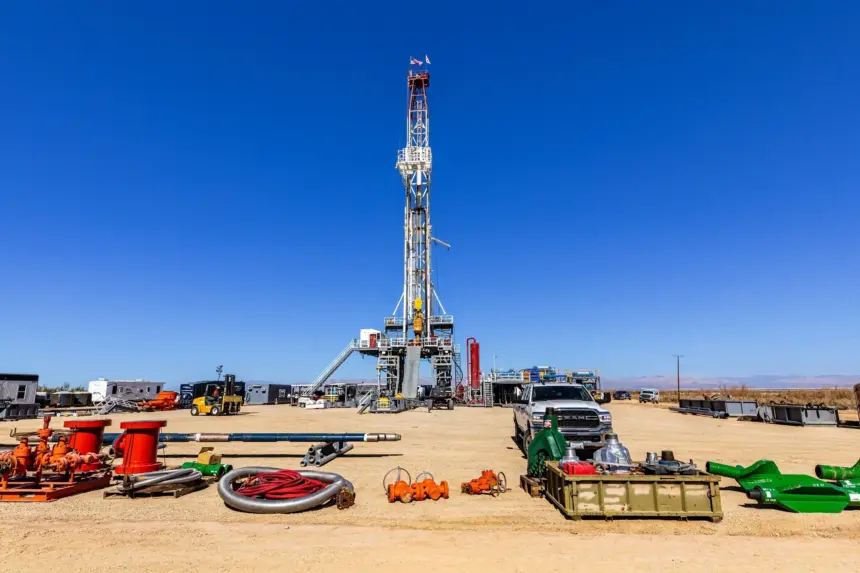
Controlled Thermal Resources broke ground on its $1.85-billion (C$2.5-billion) Hell’s Kitchen project in Imperial Valley in 2024. The project, about 200 km east of San Diego, would use heat from geothermal brine to generate electricity and extract lithium before reinjecting the brine underground.
The company targets 50 megawatts of power by 2028 and annual lithium carbonate output of 25,000 tonnes by 2029, rising to 100,000 tonnes at full capacity. Controlled Thermal hasn’t said whether regulatory delays will change those timelines. It has signed supply agreements with General Motors (NYSE: GM) and Stellantis (NYSE: STLA).
The company announced an agreement in March with special purpose acquisition company Plum Acquisition Corp. IV (Nasdaq: PLMK). The merger is expected to close in the fourth quarter, with Controlled Thermal listing on Nasdaq under the symbol CTRH.
Warren Buffett
BHE Renewables, controlled by the Warren Buffett-formed Berkshire Hathaway (NYSE: BRK.A, BRK.B), operates 10 geothermal power plants in Imperial Valley. It plans to add lithium extraction to its existing infrastructure through a joint venture formed in 2024 with TerraLithium, a unit of Occidental Petroleum (NYSE: OXY).
The partners announced in June that they had produced lithium chloride from geothermal brine at BHE’s Calipatria plant and then manufactured battery-grade lithium carbonate.
The tests are a step towards commercial production, though BHE hasn’t announced a start date. Recovering lithium from its existing geothermal plants could yield about 90,000 tonnes of lithium carbonate equivalent annually, the company estimates. It hasn’t provided a water-use estimate.
“Capital requirements are quite high, and the processing side of things has several technological and technical difficulties that make it very difficult,” Gay said. “But the potential is massive.”
A 2023 Lawrence Berkeley National Laboratory study estimated 4.1 million tonnes of lithium carbonate equivalent in the well-characterized portion of the Salton Sea geothermal reservoir, rising to 18 million tonnes across its probable extent.
Hell’s Kitchen could reach commercial production in the early 2030s, followed by BHE in the mid-2030s, Gay said.
Federal backing
In the Mojave Desert, Washington is acting as customer, lender and investor in MP Materials’ Mountain Pass operation.
Under a July 2025 agreement, the U.S. Department of Defense established a 10-year price floor of $110 per kg for MP’s neodymium-praseodymium products. A separate 10-year agreement covers purchases of magnets from MP’s planned 10X plant.
The department bought $400 million of convertible preferred stock and a warrant that, if converted and exercised, would give it about 15% of MP’s common shares and make it the company’s largest shareholder. It also provided a $150-million loan to expand heavy rare earth separation.
MP produced 840 tonnes of neodymium-praseodymium in the second quarter, 41% more than a year earlier despite an extended planned shutdown in April. Sales exceeded 1,000 tonnes for a second consecutive quarter, the company said in its quarterly results.
The company reached mechanical completion of its first heavy rare earth separation circuit at Mountain Pass in May. Its dysprosium-terbium circuit, designed to produce 200 tonnes annually of the two heavy rare earths used in high-performance magnets, is being commissioned.
MP’s Independence campus in Fort Worth, Texas, manufactures magnets. The company began shipping magnets to General Motors for qualification in the second quarter, with commercial shipments targeted by year-end, executives said on its earnings call.
Gold projects
In the eastern Mojave, Equinox Gold (TSX, NYSE-A: EQX) is advancing stage two of its Castle Mountain mine, the Bureau of Land Management’s first mining project to receive full coverage under FAST-41.
A 2021 feasibility study projected average production of 218,000 oz. gold annually over 14 years, followed by residual heap leaching. Stage one heap leaching operated from November 2020 to August 2024.
FAST-41 coordinates environmental reviews and permitting timetables. The federal dashboard estimates completion of Castle Mountain’s environmental review and permitting by April 30, 2027.
“We’re in the final stages of permitting at the federal level,” Etienne Morin, Equinox’s chief capital markets officer, told The Northern Miner.
Equinox’s South Railroad project across the border in Nevada completed its federal environmental review and permitting under FAST-41 in August.
“It’s been very helpful for South Railroad, and we’re hoping that it’s going to be the same thing for Castle,” Morin said.
State permits are also required for stage two, though they will be extensions of existing operating permits, he said.
Equinox is continuing to extend the life of its Mesquite gold mine, 320 km south of Castle Mountain. The mine is expected to produce 70,000 to 80,000 oz. this year.
“It’s the gift that ke
Source: www.northernminer.com — article syndicated from the publisher’s feed; all rights remain with the original publisher.