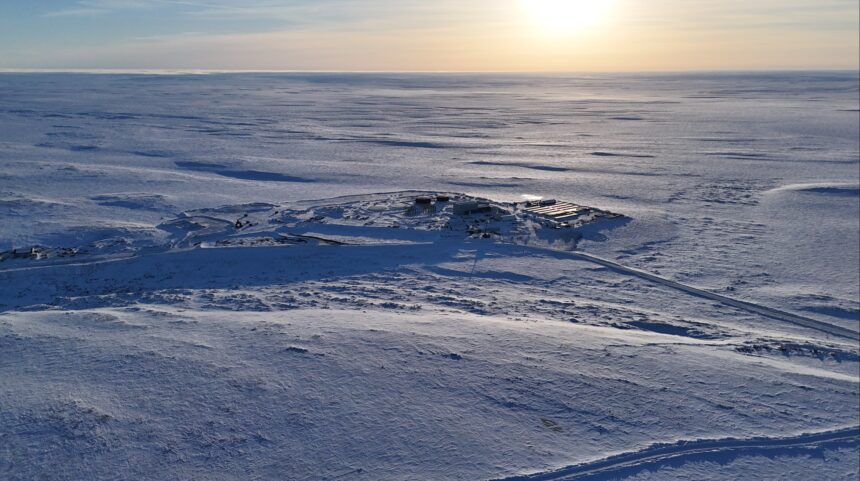
B2Gold (TSX: BTO; NYSE-A: BTG) cut its annual cost forecast and said repairs and upgrades at the fire-damaged crushing circuit of its Goose mine in Nunavut cleared a key production bottleneck.
Vancouver-based B2Gold lowered its 2026 all-in sustaining cost guidance to $2,230–$2,410 (C$3,122–C$3,374) an oz. from $2,370–$2,550, a reduction of about 6% at the midpoint. The annual production target remains unchanged at 820,000–920,000 oz., the company said late Wednesday in its third-quarter report.
“Goose execution continues to derisk,” Jefferies mining analyst Fahad Tariq said Wednesday in a note. With about 73% of the company’s 2026 output target already achieved as of Sept. 30, “we see limited risk to achieving production guidance, while lower [cost] guidance is encouraging.”
The improved outlook rests on B2Gold’s other mines, leaving Goose as the main test of its operational recovery. The Nunavut operation needs about 74,000 oz. in the fourth quarter, up 86% from the third, just to reach the bottom of its annual production range. Its repaired crusher must now deliver through the Arctic winter.
B2Gold’s adjusted third-quarter earnings of 14¢ a share exceeded the 12¢ consensus cited by Jefferies and National Bank Financial. The miner produced 193,321 oz. gold in the period, generating $48 million in quarterly free cash flow following the completion of its prepaid gold sales contracts in June.
Shares of B2Gold rose 0.8% to C$7.21 Thursday morning in Toronto, valuing the company at about C$9.5 billion ($6.8 billion). The stock has traded between C$5.02 and C$8.60 in the past year.
Goose struggles
Since first gold was poured in June 2025, Goose “has struggled to maintain mill throughput, mostly due to crusher issues,” BMO Capital Markets analyst Brian Quast wrote in an Oct. 5 site-visit report.
The April fire compounded those difficulties, forcing B2Gold to rely on mobile crushing equipment while repairing the permanent plant. During the recent analyst visit, the mobile crusher was being enclosed to support more consistent operation through the Nunavut winter.
Goose produced 39,973 oz. gold in the third quarter, up from about 12,900 oz. in the previous period, but the site’s all-in sustaining costs remained elevated at $4,816 an ounce. National Bank Financial analyst Don DeMarco attributed the high figure partly to gold sales lagging production, alongside spending on fire repairs, mobile crushing and deferred work.
B2Gold continues to expect to produce 170,000–200,000 oz. at Goose this year, it said Wednesday. The Nunavut mine needs roughly 74,000 oz. in the fourth quarter to reach the bottom of that range, making sustained operation of the repaired circuit critical, DeMarco said.
Other operations
The lower group cost outlook comes from B2Gold’s other operations. Strong year-to-date production at Masbate in the Philippines and Otjikoto in Namibia, together with lower royalties at Fekola in Mali, supported the reduction. Goose’s cost guidance is unchanged at $2,670–$2,970 an oz., with results expected near the upper end.
As a result, execution at Goose remains “the main near-term cost watchpoint,” Tariq wrote.
Beyond Goose, B2Gold’s Fekola Regional operation offers another source of growth. Waste stripping began in October following receipt of the Menankoto exploitation permit. First ore at the Fekola plant is expected early next year, subject to completion of a toll-milling agreement.
“Successful delivery of the year-end Goose ramp and first regional ore at Fekola should increasingly shift attention toward the company’s higher production and improved cash-flow profile beyond the current transition year,” DeMarco said.
Source: www.northernminer.com — article syndicated from the publisher’s feed; all rights remain with the original publisher.