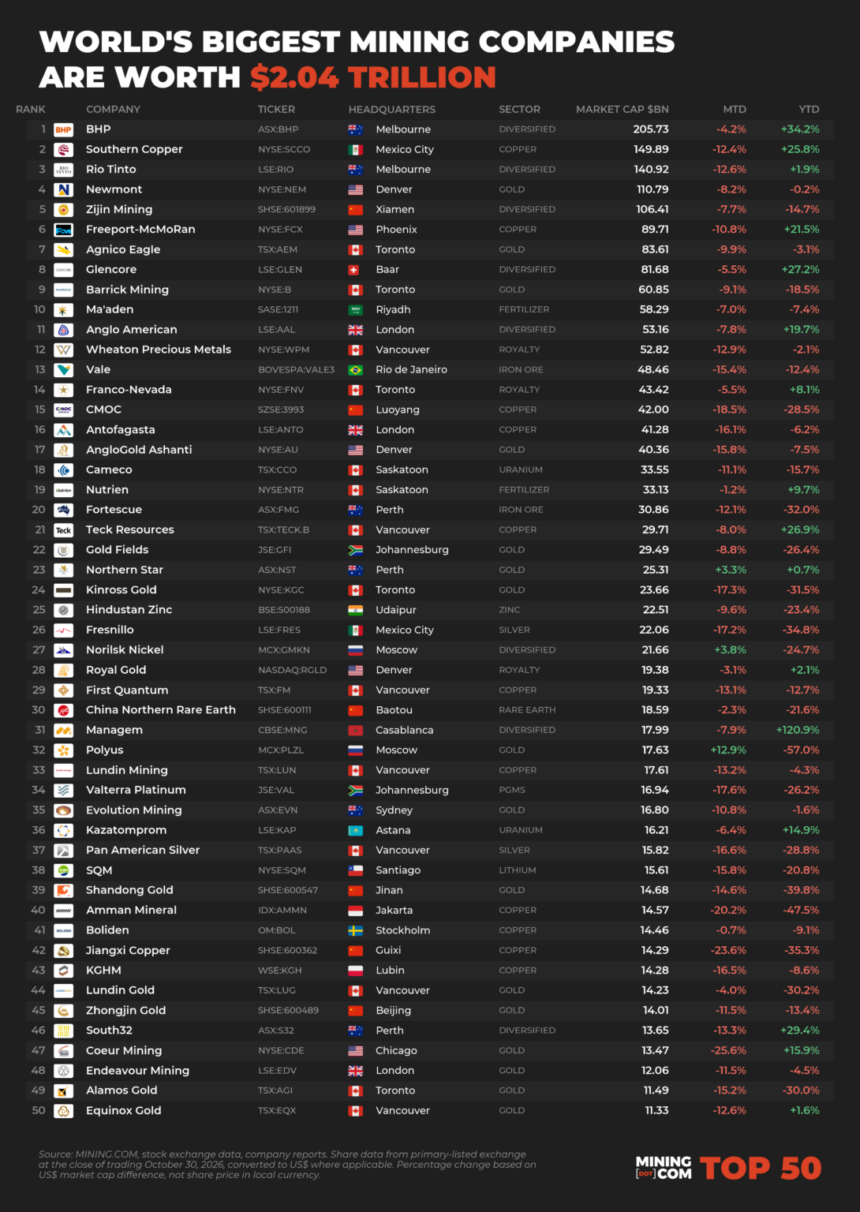
After a record-breaking start, world’s 50 most valuable mining stocks trade near one-year lows after losing 26% since the February peak.
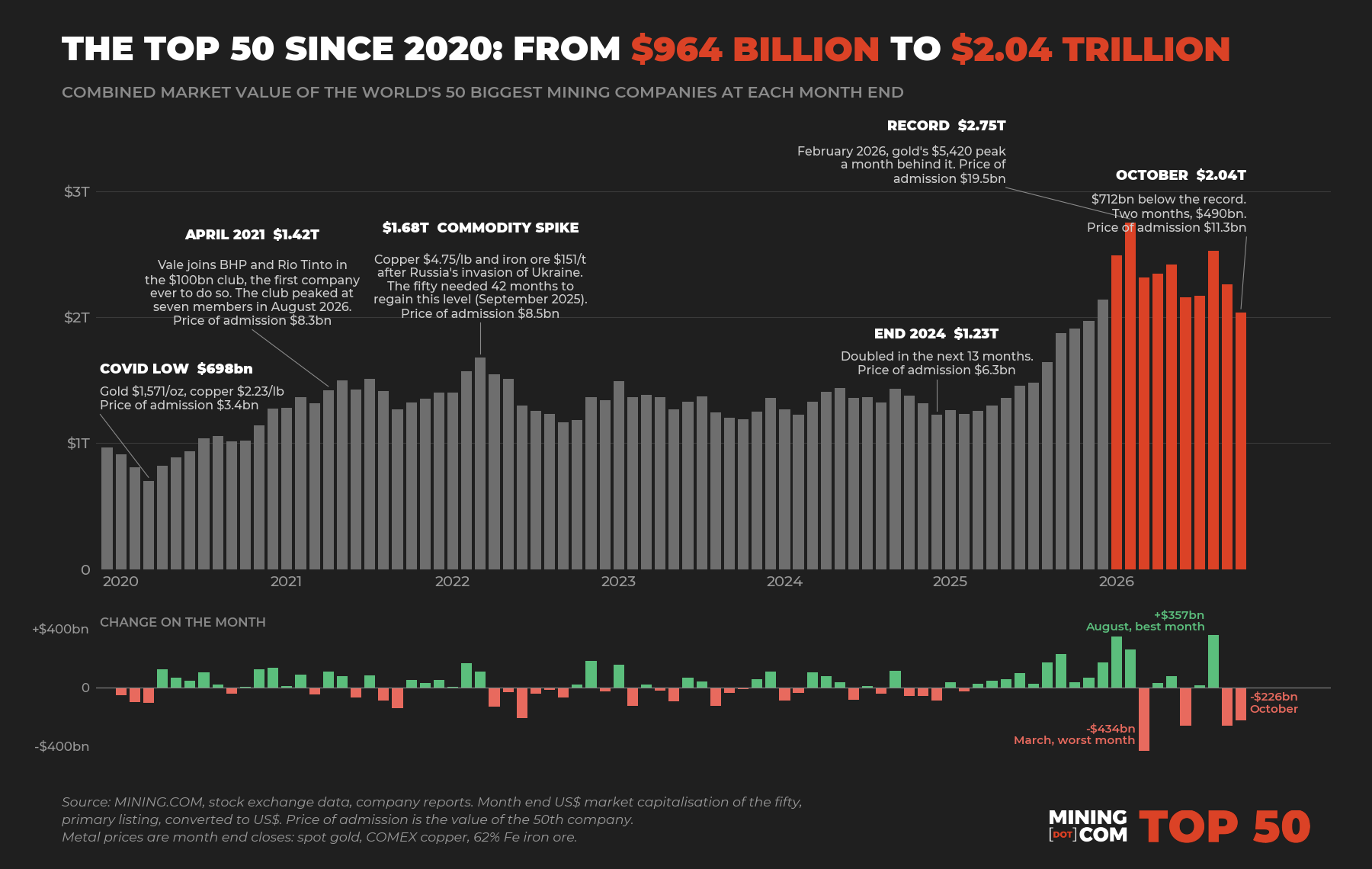
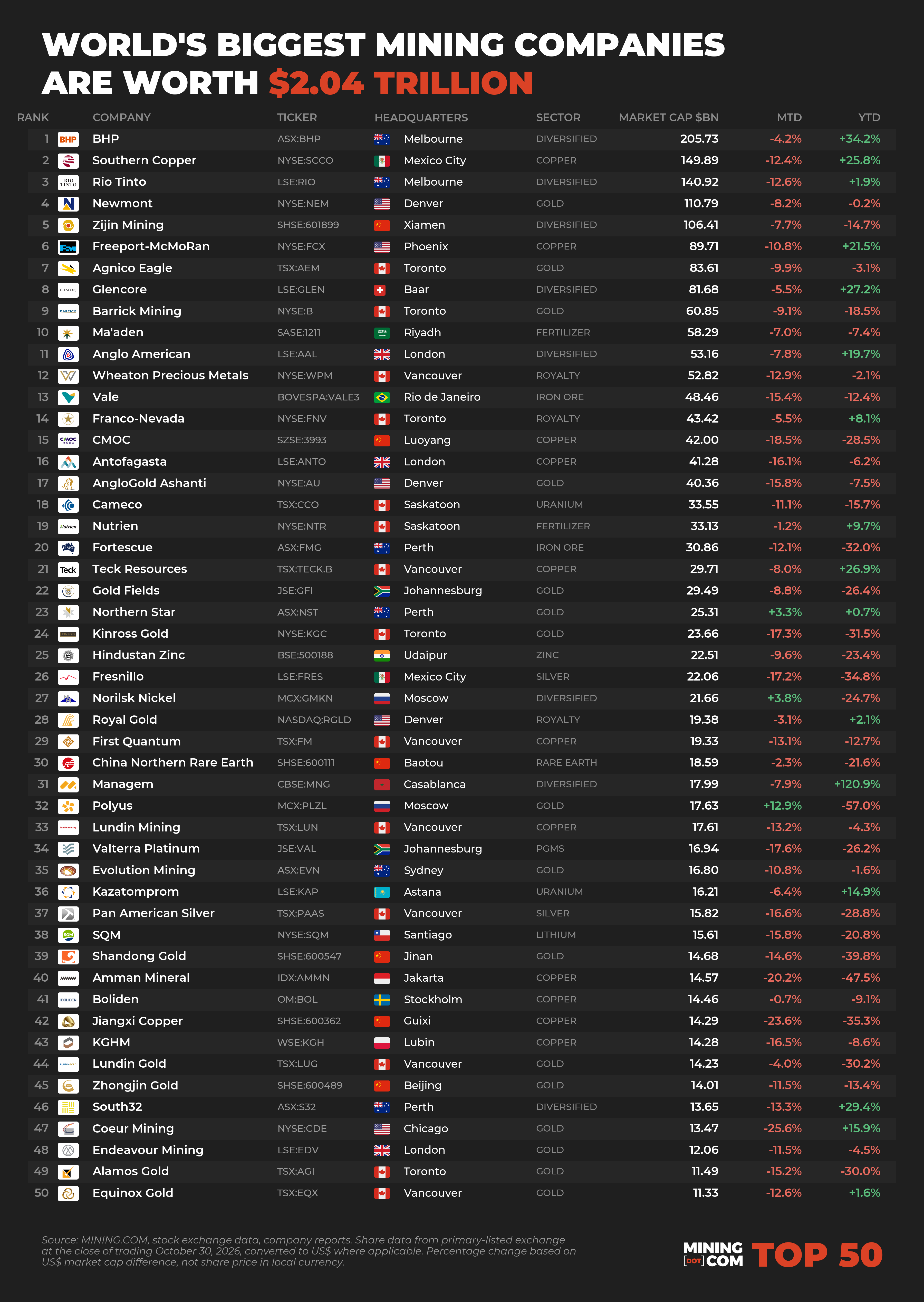
October took $226 billion off the MINING.COM TOP 50, a 10% decline on top of September’s $264 billion loss. Two months have erased nearly half a trillion dollars and the fifty are now worth $108 billion less than at the end of 2025, the first time this year the ranking has been in the red. From the $2.75 trillion record set at the end of February the fall is $712 billion, or 26%, and the ranking is the smallest it has been since November last year.
Hotter US inflation data hardened bets on another Federal Reserve rate hike, oil prices climbed on the Middle East conflict, and a rout in technology stocks in the final week of the month forced funds to sell metals to cover losses elsewhere.
Gold’s worst October since 2008, silver back below $50
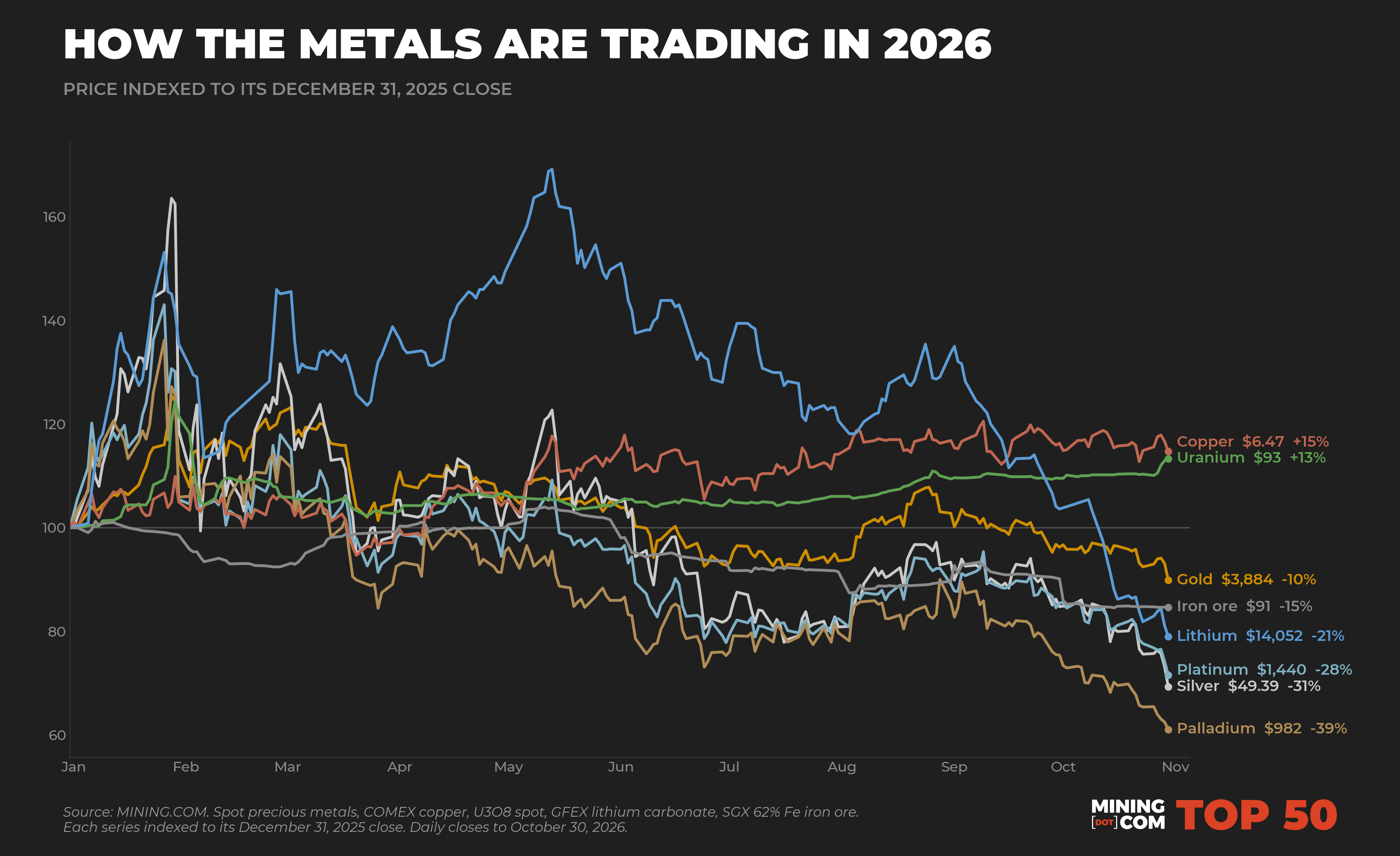
Gold ended the month at $3,884 an ounce, down 6.6% and the first month-end close below $4,000 since September last year. Bullion slid under $4,000 a week before the close and then fell to a one-year low on the last trading day, with gold and silver producers down as much as 8% in a single session. The metal is now 10% lower in 2026, its worst October since 2008.
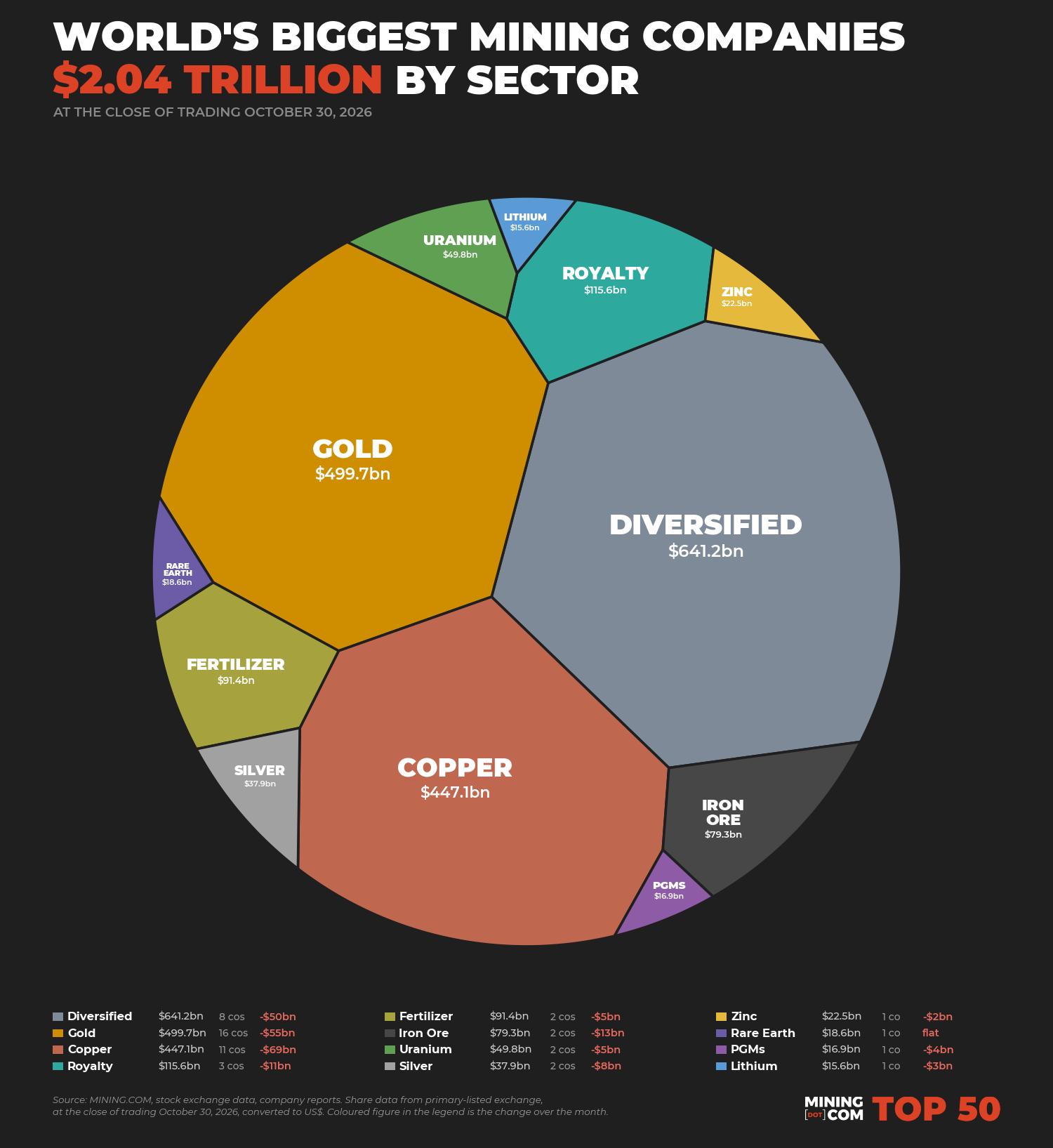
The sixteen gold miners in the ranking gave up $55 billion, or 9.9%, and are worth $500 billion between them. Newmont lost 8.2% despite beating profit estimates for the third quarter and putting a $4.8 billion price on taking Red Chris underground, and is now fractionally lower for the year. Agnico Eagle fell 9.9% and Barrick 9.1%, so the three largest gold miners are now all in the red for 2026, a year that began with gold on its way to $5,400. Kinross, down 17.3%, and AngloGold Ashanti, down 15.8%, fared worst among the majors, Kinross also reporting two contractor deaths at Bald Mountain in Nevada.
Silver had its worst month of the year. The metal fell 18.2% to $49.39, below $50 for the first time since October 2025 and 58% beneath the $116.58 it reached in late January.
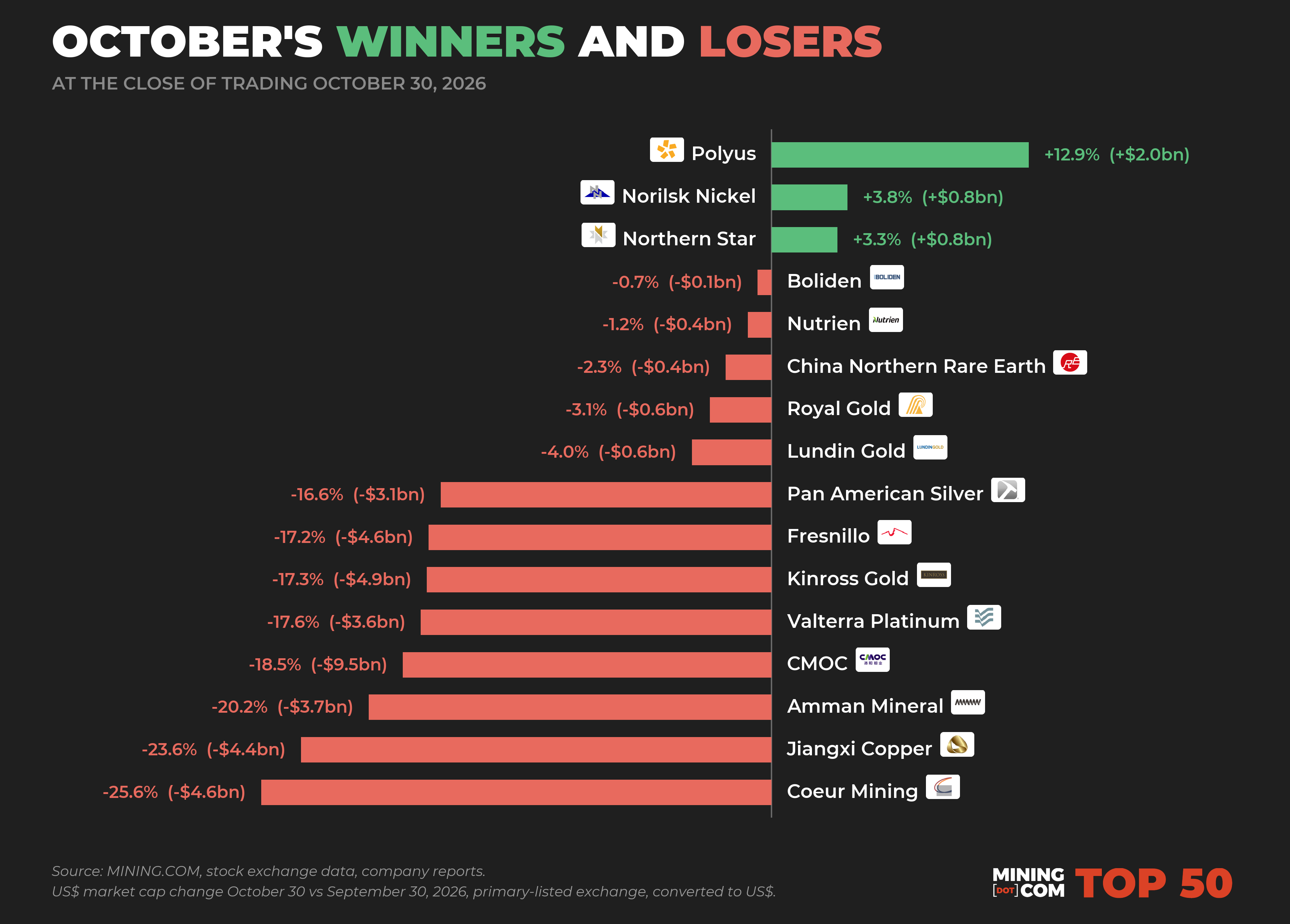
Deutsche Bank had warned at the start of the month that rising inventories and softer industrial demand could flip last year’s shortage into a surplus by 2027. Coeur Mining, down 25.6%, was the worst performer in the fifty, with Fresnillo losing 17.2% and Pan American Silver 16.6%. Platinum fell 16% and palladium 19%, and Valterra Platinum dropped 17.6%.
October winners on a technicality
Russia’s miners went against the tide in October, but the rouble flattered both. Polyus is still down 57% for the year after its July decision to suspend dividends until 2030 sent the stock down 26% in a single session, and Norilsk Nickel, which skipped full-year payouts from 2022 to 2025 and only resumed with a token interim dividend in August, is 25% lower in 2026 while palladium, its main metal, fell 19% in October alone.
Northern Star, up 3.3%, was the only company in the ranking to add value in its own currency, but that is courtesy of Gold Fields’ A$38.7 billion ($27 billion) approach for the Perth miner, rejected as highly opportunistic in late September.
The South African company’s bid still hangs over the stock with activist Elliott Investment Management building a 6.2% stake to press the board into talks. Gold Fields chief executive Mike Fraser played down a higher offer in mid-October, saying Northern Star must first show it is open to a deal. Gold Fields fell 8.8% in the month and is 26% lower for the year, one rank above its target, which is one of only three gold miners in the fifty still ahead for 2026.
Equinox Gold also had a little help from M&A, and returns at number 50 despite a 12.6% fall, helped by a 34% jump in third-quarter output after the Orla merger, and because MMG, the company it displaces, lost a fifth of its value with the rest of the Chinese copper mid-tier.
Copper stocks fall without the metal
The copper price itself barely moved in October at $6.47 a pound, 1.4% below where it started but still up 15% for the year. Rising LME inventories took it to a five-week low mid-month, yet Chinese import premiums held near a 13-year high and the World Bank lifted its 2027 forecast by 18% to $13,000 a tonne on the same grid and data centre demand that has carried the metal all year.
That was not enough to keep sentiment for producers of the bellwether metal strong. The eleven in the ranking lost $69 billion, a 13.3% fall and the largest of any sector in dollars.
BHP missed quarterly copper estimates after the fatal accident and weather stoppages at Escondida, though it averted a supervisors’ strike at the world’s largest copper mine. Antofagasta lost 16.1% after a weaker 2027 production outlook and higher cost guidance sent the shares down 6% in a day, even as the Centinela strike ended. Anglo American reported a 5% drop in copper output from Chile’s winter storms, and China’s antitrust regulator demanded copper concentrate supply commitments as its price for approving the Anglo Teck merger.
Southern Copper lost 12.4% and $21 billion in a month when its only news was a $680 million expansion study at Cuajone. Freeport-McMoRan fell 10.8% to $89.7 billion and out of the $100 billion club despite beating third-quarter profit estimates as Grasberg recovers from last year’s mud rush.
Teck, down 8%, had a fivefold jump in quarterly profit on record copper prices and still could not hold its ground. Further down the mid-tier was hit harder: Jiangxi Copper fell 23.6%, Amman Mineral 20.2%, CMOC 18.5%, KGHM 16.5% and First Quantum 13.1%. Copper equities are now priced for a metal well below where it trades, a gap the ranking has been tracking since the summer.
Iron ore in retreat, lithium slump cuts ranks to one
Iron ore slid 6% to $91 a tonne and spent the last days of the month below $90, a level UBS says puts up to 170 million tonnes of supply under water. Vale fell 15.4% after third-quarter core profit tumbled 20% and output missed forecasts, a fortnight after its chief executive argued that soaring energy and freight costs had pushed 10% of global supply into losses. Fortescue lost 12.1% as its standoff with China’s state buyer cut quarterly sales 8% below shipments, while Rio Tinto, down 12.6% and $20 billion, reached its own multiyear deal with the same buyer and lifted Pilbara sales in the third quarter.
Lithium carbonate fell another 24% to 93,600 yuan ($14,050) a tonne, hitting a ten-month low early in the month on a China-EU deal to curb hybrid exports. SQM, the ranking’s only lithium producer, lost 15.8% and Albemarle sits 53rd at $10.7 billion. Rio Tinto chose the moment to commit a further $1.4 billion to lithium in Argentina. Uranium was the only metal to rise, up 3.5% to $92.55 a pound, but Cameco still fell 11.1%.
Not rushing for the exits
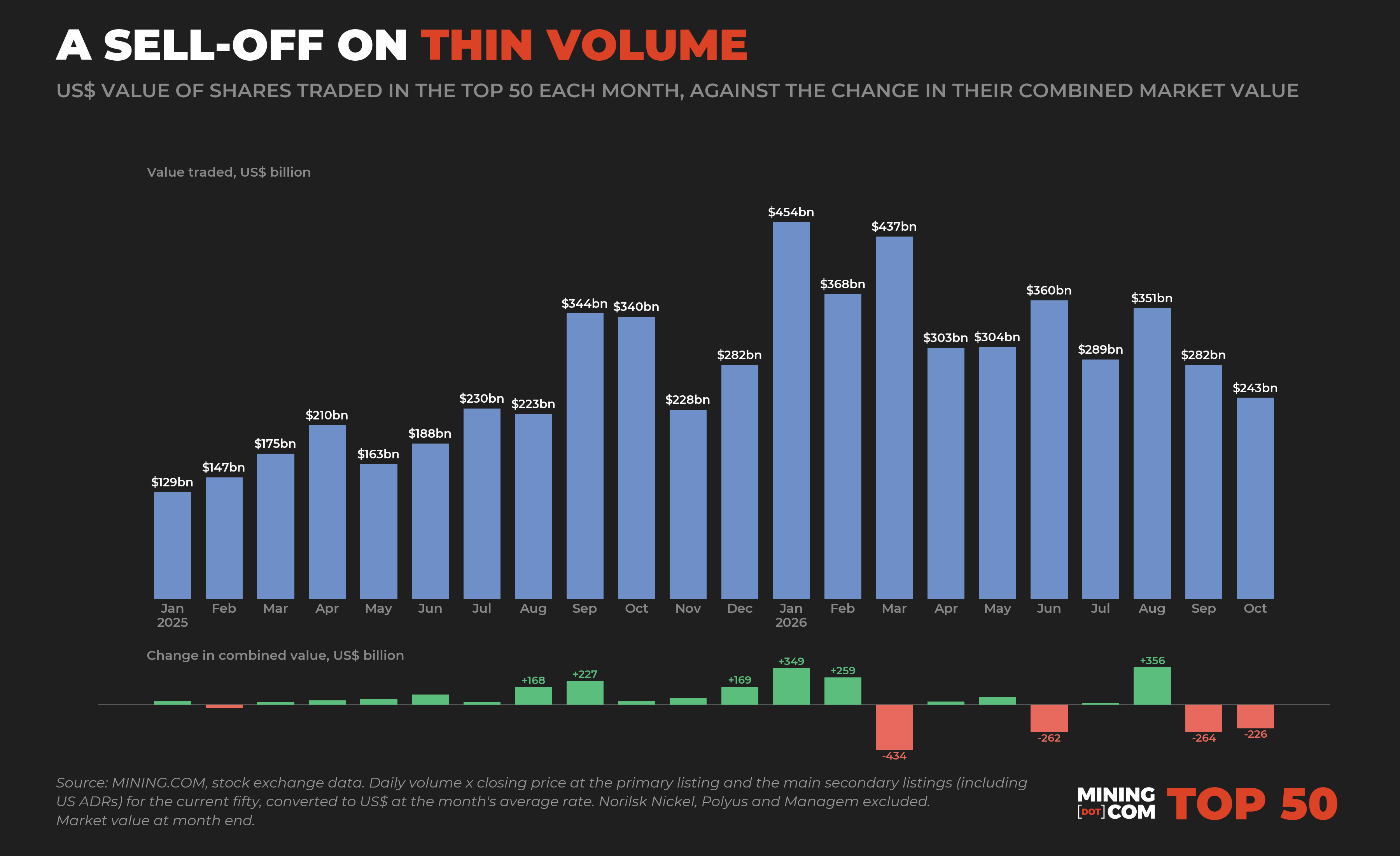
Shares in the fifty worth $243 billion changed hands in October, the lowest monthly turnover since November last year and barely half the $454 billion traded in January, when the ranking was setting records. Chinese markets were shut for the first week of the month, which trimmed trading in the six Chinese companies, but the picture is the same everywhere else.
Measured against the value of the companies, 12% of the ranking turned over in October against 18% in January and 19% in March, when the first leg down came on heavy selling. The $490 billion lost over the past two months has come with buyers standing aside rather than holders selling in size, which is a different kind of correction from the one in March. For scale, Nvidia alone traded $501 billion in October, twice the fifty combined.
Price of admission falls to $11.3 billion
The fiftieth company is worth $11.33 billion, the lowest cut-off since August 2025 and $8 billion below the $19.5 billion it took to make the ranking in February. MMG missed the cut by $75 million.
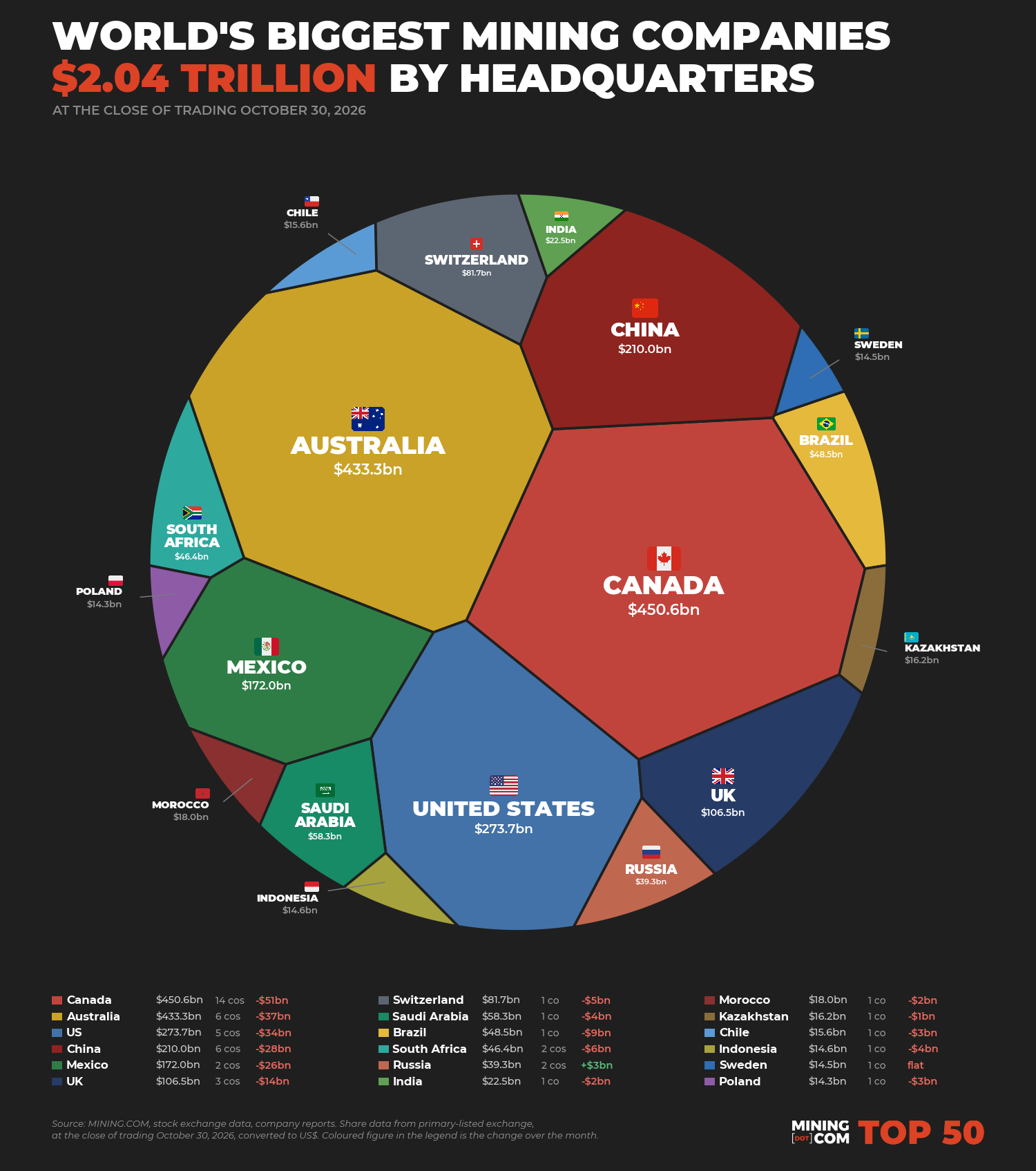
Canada remains the most valuable mining address at $451 billion, having lost $51 billion in the month, ahead of Australia at $433 billion and the United States at $274 billion. China’s six companies lost 11.6% between them and are worth $210 billion. Mexico, home to Southern Copper and Fresnillo, lost 13.1%.
METHODOLOGY

Source: MINING.COM, stock exchange data, company reports. Share data from primary-listed exchange at the close of trading October 30, 2026, converted to US$ where applicable. Percentage change based on US$ market cap difference, not share price change in local currency.

As with any ranking, criteria for inclusion are contentious. We decided to exclude unlisted and state-owned enterprises at the outset due to a lack of information. That, of course, excludes giants like Chile's Codelco, Uzbekistan's Navoi Mining, which owns the world's largest gold mine and is in the process of readying an IPO, Eurochem, a major potash firm, and a number of entities in China and developing countries around the world.

Another consideration is diversified companies such as Anglo American with separately listed majority-owned subsidiaries. Anglo has interests in platinum (Valterra), and in the past diamonds (De Beers) and iron ore (Kumba), but the listed subsidiaries are excluded when consolidated on the parent's books. The same principle sees Hindustan Zinc enter the ranking in place of the slimmed-down Vedanta following the Indian group's demerger. Where mining arms are separately listed like Grupo Mexico's Southern Copper or Penoles' Fresnillo, those are added to the ranking and not the holding company.

Each company is assigned a single sector, and judgment calls abound. Vale appears under iron ore rather than diversified: the Brazilian company's fortunes remain overwhelmingly tied to the steelmaking ingredient, and its plans to separately list its base metals unit in Toronto (copper and nickel assets responsible for roughly a quarter of revenue) only sharpen the distinction. Rio Tinto, by contrast, stays diversified: iron ore may pay the bills, but the breadth of the portfolio, from aluminium and copper to lithium and titanium, is the company's defining feature. As a general rule we classify a company as diversified if no single commodity brings in more than 1.5 times the revenue of its next biggest earner, but as always there are exceptions.

Where the numbers are too close to call, history can settle it. Fresnillo now earns roughly as much from gold as from silver, but the Mexico City-based company is the world's largest primary silver producer and has been mining the metal at its namesake district in Zacatecas since the 1550s, so it stays under silver. Pan American Silver, where gold has come to dominate the revenue mix following the Yamana and MAG deals, keeps its silver classification on the same grounds. The company itself chose to keep the moniker after all.

Royalty and streaming companies Franco-Nevada, Royal Gold, Wheaton Precious Metals and Triple Flag are included on the basis of their deep involvement and funding role in the industry, but pure smelting and refining companies, as well as steelmakers with large mining assets, are excluded. Conglomerates and trading houses like Japan's sōgō shōsha are also excluded, which means well-known names like Marubeni, Mitsui, Sumitomo, Itochu and Mitsubishi, with their prominent stakes in mines and mining companies, do not qualify either.

Vedanta Aluminium, despite being India's largest producer of the metal, is excluded as a smelter without captive mining, and Sumitomo Metal Mining and JX Advanced Metals do not make the ranking on the same test, with smelting and refining the vast majority of their business despite attributable primary production in the hundreds of thousands of tonnes. On the flipside, rare earth miners are included. Rare earth specialists tend to aim for vertical integration (and companies like MP Materials are far along) and the refining, metalization and ultimately magnet making divisions are where the income and margins lie.

While earlier rankings included coal miners, the monthly series covers mined metals and minerals only. We exclude coal companies based on the fact that many derive most of their revenue from utilities, power generation and transport rather than mining, and, as with the steelmakers, their inclusion would crowd out the industry the ranking is meant to capture. That means no Coal India, despite the Kolkata company's standing as the world's largest coal producer. For comparability, previous rankings have been recalculated on the same basis.

Head office refers to a company's operational base where applicable (BHP and Rio Tinto both appear under Melbourne), but Antofagasta is the exception that proves the rule: we place the copper miner in London, where it has been listed since the late 1800s, rather than Chile where it mines.

Norilsk Nickel and Polyus, thanks to captive investors on the MCX, maintain their standing in the ranking despite sanctions and trading restrictions, and are valued on Moscow Exchange pricing converted to US dollars.

Please let us know of any errors, omissions, deletions or additions to the ranking, or suggest a different methodology: email Frik Els at fels@mining.com with Top 50 in the subject line.