Researchers have strengthened evidence that Roman miners used water to extract gold from Spain’s eastern Pyrenees, dating a long-suspected mining complex where an estimated 2 million cubic metres of earth were displaced, enough to fill about 800 Olympic-sized swimming pools.
The findings date sediments preserved in a reservoir at Les Guilleteres d’All, an archaeological site in Catalonia’s Cerdanya Valley. The workings left behind artificial ravines, trenches and a semicircular excavation about 300 metres wide.
Earlier surveys had identified remains of a water-management network that channelled water through gold-bearing sediments. Researchers from the University of A Coruña and the Autonomous University of Barcelona used sediment dating to establish a firmer Roman chronology for the infrastructure.
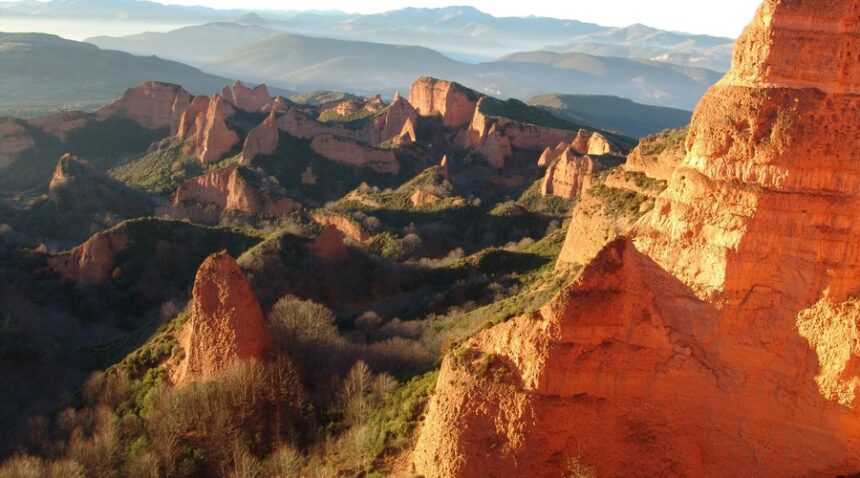
Roman hydraulic mining is already well documented at sites such as Las Médulas in northwestern Spain. The advance at Les Guilleteres is evidence of when the system was used, rather than the discovery of an unfamiliar mining technique.
Spain’s ancient mining districts continue to attract explorers. In the country’s south, Pan Global Resources (TSXV: PGZ; US-OTC: PGZFF) is pursuing copper discoveries in the Iberian Pyrite Belt, where its La Romana deposit remained concealed beneath younger rocks despite thousands of years of mining in the region.
Dating the mines
The study, published in the journal Land on Sept. 19, 2025, addresses a longstanding question about the mining complex: its distinctive terrain suggested Roman engineering, but researchers lacked firm dating evidence.
The findings do not establish whether commercially recoverable gold remains at Les Guilleteres. The research dates ancient mining infrastructure rather than assessing the site’s potential for modern production.
Excavations conducted between 2010 and 2022 uncovered part of a reservoir supported by a dam built from large stone blocks. An excavated section measured about 4.5 metres across and 1.5 metres deep, although the reservoir’s full extent remains largely unknown. The structure stored and regulated water needed to wash gold-bearing material from the surrounding deposits.
Sediment accumulated inside the reservoir during its final stages of use or after its abandonment, preserving evidence that could help date the infrastructure.
Quartz analysis
Researchers analysed two sediment samples using optically stimulated luminescence, a dating technique that measures signals stored in mineral grains, particularly quartz, after their last exposure to sunlight.
The study summarizes the results as placing sediment accumulation broadly between the second and fourth centuries AD, consistent with Roman occupation of the region. Drawing on the archaeological context as well as the dating results, the authors favour abandonment in the late second or early third century.
However, the dates do not establish when gold extraction began or precisely when operations ceased. They provide evidence for the infrastructure’s chronology rather than a complete operating history.
The scale of the operation nevertheless points to substantial engineering capabilities, although the researchers describe the workings as smaller than other Roman gold mines.
Hydraulic extraction relied on controlled water flows to break down sediment and recover gold particles. The process transformed the landscape, leaving excavation fronts and artificial channels still visible today.
Roman connections
The findings could also help explain the economic importance of Iulia Libica, a Roman settlement near the mines that corresponds to present-day Llívia.
The settlement was the only documented Roman city in this part of the Pyrenees, and researchers suggest it may have helped administer the region’s natural resources.
Ancient literary accounts had already pointed to local gold production, including a reference by the poet Martial associated with Iulia Libica.
Archaeological discoveries provide additional context. At El Castellot de Bolvir, researchers identified a metalworking workshop, while excavations at a nearby Roman cemetery uncovered a gold bracelet weighing about 23 grams.
Although these discoveries do not establish a direct connection to Les Guilleteres, they suggest that precious metals and metalworking formed part of the region’s ancient economy.
Researchers also identified a possible chronological relationship between the decline of mining and changes at Iulia Libica. Parts of the settlement appear to have been abandoned during roughly the same period as the hydraulic infrastructure.
The evidence does not establish whether the mine’s closure contributed to the settlement’s decline or whether broader economic and political changes affected both.
Further archaeological work could clarify how the mining network operated, when extraction began and whether gold production was administered through Iulia Libica.
Related: Spain hunts hidden metals with €197M plan
Source: www.northernminer.com — article syndicated from the publisher’s feed; all rights remain with the original publisher.