





Soaring diesel prices have started to impact mining, rising production and transportation costs and influencing the pricing of metals around the globe, as the commodity market adjusts to tariffs and inflation.
Disruptions in the Strait of Hormuz have affected the transportation of liquefied natural gas (LNG) and other energy shipments, raising prices globally. The mining industry is impacted by this as fuel is essential to power up production and transport metals from the mine site to global markets.
Copper producers Antofagasta (LON: ANTO) and Capstone Copper (TSX: CS) have reported rising operating expenses, while gold miners Barrick Mining (NYSE: B) (TSX: ABX), Kinross Gold (TSX: K; NYSE: KGC) and Monument Mining (TSX-V: MMY) have relied on stronger bullion prices to protect margins.
Barrick’s gold production cost rose 17% between 2025 and 2026 in part because of higher fuel costs. With gold reaching record high prices, the company was still able to lift attributable adjusted EBITDA 51% year-on-year to $2.55 billion in Q2 2026.
A similar phenomenon affected Ivanhoe Mines, as even with an 18¢/lb diesel cost increase, its Kamoa-Kakula copper mine generated $385 million of Q2 EBITDA, helped by stronger copper prices and smelter economics.
“Despite elevated global diesel prices during the quarter, the impact on our operating costs has been well contained,” Ivanhoes Mines founder and co-chairman Robert Friedland said in the 2026 Q2 results release. “Our world-class smelter at Kamoa-Kakula provides a natural hedge while flows through the Strait of Hormuz remain constrained.”
The results highlight a growing divide between miners with sufficient commodity-price gains or valuable by-products to absorb higher fuel bills and those more exposed to energy costs.
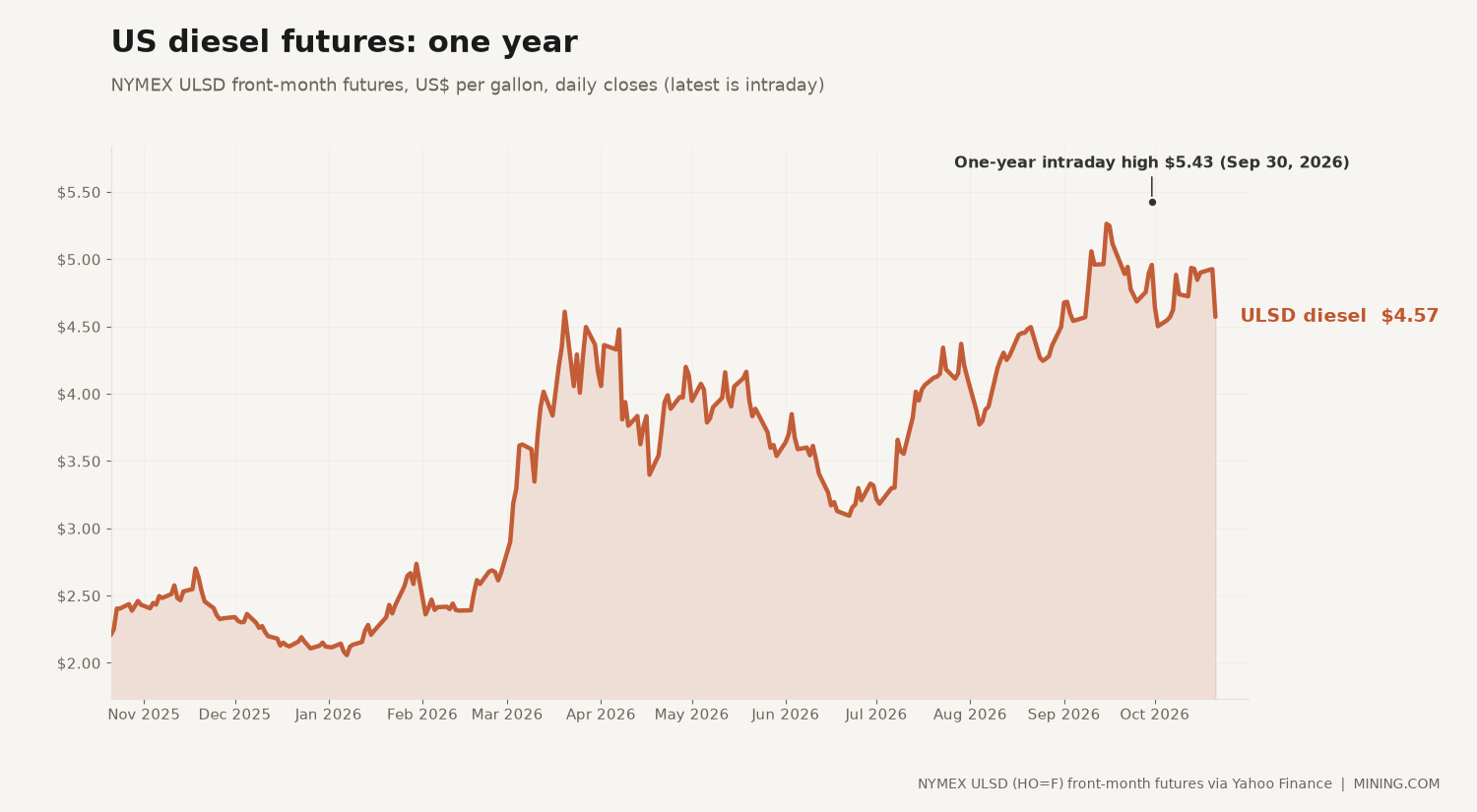
In March 2026, TD Cowen analysts warned that surging energy prices threatened to impact historic margin expansions, adding more pressures on cost guidance, similar to the impact seen in 2022 with the Russia-Ukraine invasion. They estimated that there would be a 15% increase in AISC year-on-year along with 22% higher all-in costs.
With interest rates rising and supply concerns easing, metals prices are also starting to fall and the industry might need to brace for impact.
Copper cost squeeze
Antofagasta increased its full-year cash cost guidance almost $0.3 to between $2.60 and $2.70 per pound, from $2.40 to $2.60, citing higher global diesel prices.
Capstone reported a 15% year-on-year increase in second-quarter C1 cash costs to $2.82/lb,partly driven by higher diesel and sulphuric acid expenses. The sharpest increase came at its Mantos Blancos copper mine, where C1 costs surged 88% to $3.93/lb, including about 34¢/lb attributable to higher mining costs mainly from diesel.
At its Mantoverde copper-gold mine, stronger gold by-products helped to decrease C1 costs by 16% even with diesel prices adding 23¢/lb to the bill.
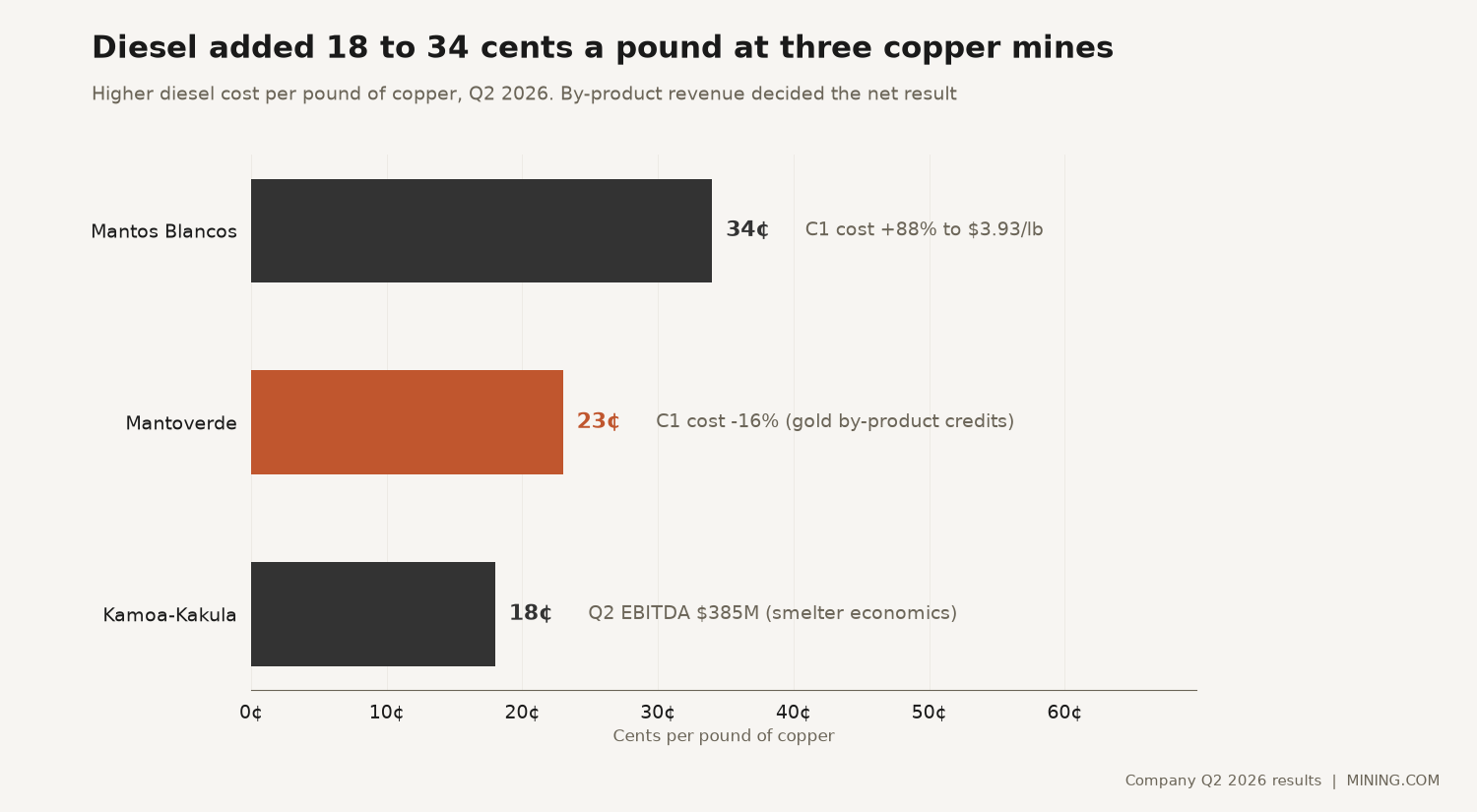
Ivanhoe also benefited from additional revenue at its Kamoa-Kakula complex in the Democratic Republic of Congo. Despite an 18¢-per-lb. increase in diesel costs, the operation generated $385 million in second-quarter EBITDA, supported by stronger copper prices and smelter economics.
Friedland said sulphuric acid sales covered the smelter’s operating costs during the quarter, providing another buffer against energy inflation.
The contrasting results illustrate how diversified revenue streams can offset rising energy bills, leaving producers without significant by-product credits more vulnerable to a downturn in copper prices.
Gold’s margin cushion
Gold producers have faced similar pressures, although record bullion prices have provided greater protection against rising operating expenses.
A World Gold Council (WGC) report on 2026 Q1 released in August pointed out that even with an exceptional quarter for gold miners, the Hormuz closure became a concern.
The impact depended on where they were located. WGC said that while diesel prices increased 54% in the US, in Australia it had almost doubled prices.
While some junior Australian mining operations had to suspend activities because of fuel constraints, larger companies didn’t share that same story.
According to the WGC, record gold prices generated unprecedented margins and cash flows in 2026 Q1, even with the conflict in the Middle East making production cost more expensive, the surge in the average gold price far exceeded the increase in costs. The council warned that the industry’s resilience may be tested following the pullback in gold prices from their January peak.
Kinross (TSX: G) (NYSE: KGC), which has operations in North America, Latin America and Africa reported that its production cost of sales in 2026 Q2 had a 25% increase to $1352 from $1080, due to higher fuel costs. Their margin still increased 42% in the second quarter of this year, to $3,131 compared with the Q2 2025 margin of $2,204.
The price of gold and oil have historically had a mixed correlation but have risen together in periods of inflation and times of geopolitical conflict/instability, the TD March 2026 report said, resulting in disruptions to oil supply and a flight to safety.
Monument experienced an even sharper cost increase at its Selinsing gold operation in Malaysia. Its production costs rose more than 50%, from $814 to $1,243 per ounce, with diesel adding 57¢ per tonne mined.
Yet Monument’s gross margin increased 69% to $109.7 million from $65.1 million in 2025, demonstrating how higher gold prices have outweighed inflationary pressures.
Newmont (NYSE: NEM) also flagged its exposure to rising oil prices in its latest report, despite keeping production costs relatively low so far. The gold miner estimates that every $10-per-barrel increase in oil prices would add $110 million, or $21 per oz., to production costs. Newmont expects both output and costs to rise in 2027.
Gold Miners: Despite energy inflation and lower gold prices, they still have world-class margins. Producers continue to PRINT cash at current gold prices. Nice chart from Red Cloud
pic.twitter.com/kmY9Qx1vbb
— Oliver Groß (@minenergybiz) October 2, 2026

Fuel costs are also reshaping the competitive landscape for bulk commodities, where transportation accounts for a substantial share of expenses.
Rio Tinto (ASX, LON: RIO) recently said that it was taking advantage of being close to the Asian market to increase their iron ore shipments to the region as it would use less fuel than competitors in Latin America and Africa.
While iron ore and lower-margin commodities are much more exposed to the cost squeeze than gold or copper, this could be a possibility for those markets to focus more on close markets than global distribution while they try to manage fuel cost and supply.
Larger companies were safe from that first hit, but there were still concerns over how the disruption would impact future quarters.
The next margin test
Higher gold and copper prices have so far helped miners absorb rising fuel costs, but that protection could weaken as metal prices retreat.
With no clear timeline for the resumption of normal oil shipments through the Strait of Hormuz, prolonged fuel inflation threatens to put further pressure on operating margins, particularly for producers with limited exposure to higher-value commodities.
For TD analysts, companies could begin to evaluate fuel hedges to protect margins, particularly if moving through a heavier capital stripping phase or new construction project.
Upcoming third-quarter and full-year results will offer a clearer picture of the financial impact, revealing whether miners can contain rising expenses before they begin to outweigh gains from stronger commodity prices.
Source: https://www.mining.com/diesel-price-surge-putting-mining-profits-to-test/


