Volta Metals (CSE: VLTA) has more than doubled the indicated rare earth resource at its Springer deposit in Ontario, placing the project among North America’s five largest by measured and indicated resource tonnage as it advances toward an economic assessment in 2027.
The updated mineral resource estimate increased indicated resources by 116% to 122.4 million tonnes grading 0.59% total rare earth oxides (TREO). A further 197.5 million tonnes grading 0.53% TREO are classified as inferred. The independently prepared estimate also includes the project’s first gallium resource assessment.
“We believe Springer is shaping up as one of the few large, road-accessible sources of magnet rare earths, and potentially gallium, in North America, at a time when the market is paying a premium for supply from outside China,” Volta president and CEO Kerem Usenmez said in a statement.
The expansion comes as Western governments seek to reduce their dependence on China, which dominates global rare earth processing and gallium production. Both commodities are strategically important, with rare earths used in permanent magnets for electric vehicles and wind turbines, while gallium is essential to certain semiconductor technologies.
High-grade expansion
Springer’s indicated high-grade core grew 140% to 27.6 million tonnes grading 1% TREO, with an estimated net metal revenue of C$384 ($272) per tonne, equivalent to C$10.6 billion ($7.5 billion) in gross in-situ metal value.
The inferred high-grade core increased ninefold to 26.7 million tonnes grading 0.94% TREO, with an estimated net metal revenue of C$333 per tonne ($236), or C$8.9 billion ($6.3 billion) in gross in-situ value. The zone remains open for expansion.
The deposit also contains an estimated 4,427 tonnes of in-situ gallium within its indicated resource, including a higher-grade zone of 14.8 million tonnes averaging 56 grams per tonne.
Gallium could provide an additional revenue stream, although Volta has yet to establish whether the metal can be economically recovered. The company is conducting metallurgical studies to assess recovery methods and potential commercial viability.
Magnet rare earths — neodymium, praseodymium, dysprosium and terbium — account for about 22.4% of the indicated resource’s total rare earth oxide content, a proportion Volta says is among the highest in North America.
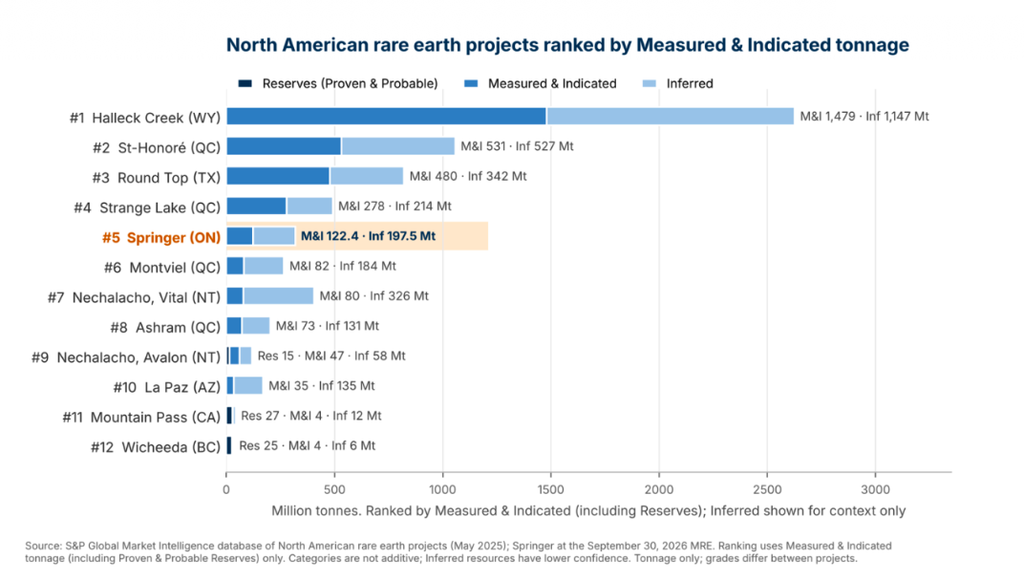
Springer ranks fifth among North American rare earth projects by combined measured and indicated resource tonnage, according to S&P Global Market Intelligence data cited by the company.
However, the ranking measures resource size rather than economic potential and does not account for differences in grade, metallurgy, development costs or project maturity.
Development outlook
Located about 70 km east of Sudbury, Springer benefits from direct highway access, on-site power and nearby natural gas and rail infrastructure. The deposit’s low strip ratio could also support future mine development, although the project’s economics remain untested.
Volta plans additional drilling to expand and refine the resource while advancing metallurgical work on rare earth and gallium recovery.
The company is targeting a preliminary economic assessment (PEA) in the first half of 2027, which would provide an initial evaluation of potential mining costs, processing requirements and project economics.
Source: https://www.mining.com/volta-doubles-springer-rare-earths-eyes-2027-study/