



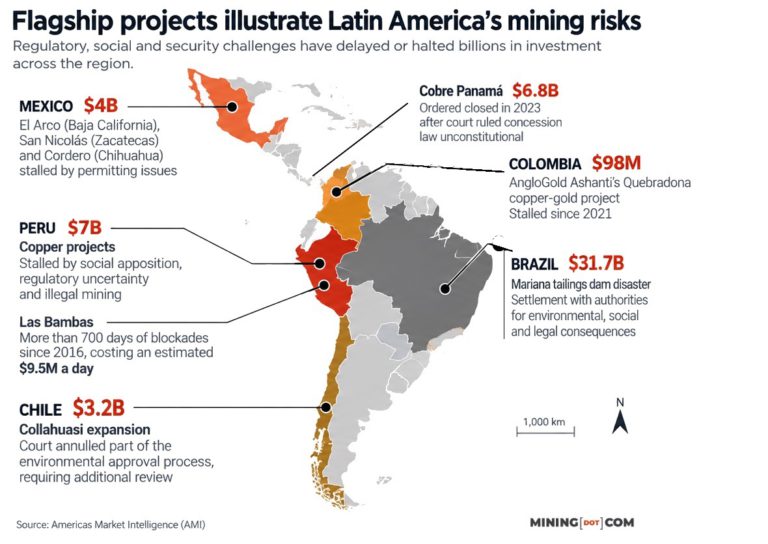
Above-ground risks have cost or stalled more than $54 billion in Latin American mining since 2018, highlighting how permitting, community conflict and security can determine whether the region’s mineral wealth becomes producing mines.
Americas Market Intelligence (AMI) estimates about $38 billion stems from write-offs, legal settlements, fines and other documented losses, while another $16 billion represents capital frozen in delayed or halted projects. The latter includes about $7 billion in Peruvian copper projects and $4 billion across three projects stalled by permitting problems in Mexico, Sebastián Pérez-Ferreiro, co-director of AMI’s mining and risk practice, said during a webinar Thursday.
“The figure is broadly consistent with the scale of disruption we see across Latin America, although we have not independently verified AMI’s calculation,” Juan Carlos Guajardo, executive director of Chile-based Plusmining Consulting, told MINING.COM. “It is important to distinguish losses already incurred from capital tied up in delayed projects.”
Geopolitical mining specialists Eduardo Zamanillo and Marta Rivera also cautioned against treating the $54-billion estimate as a measure of the region’s overall investment appeal. Latin American countries differ substantially in the maturity of their mining industries, infrastructure, institutions, security and regulatory trajectories, they said.
“We see a region entering a potentially important new mining cycle rather than one becoming uniformly less attractive,” Zamanillo and Rivera told MINING.COM.
The distinction matters as Latin America seeks investment to expand copper, gold, lithium and other mineral production. The Mining Conflicts Observatory, a non-profit tracking extractive projects, currently lists 284 conflicts involving 301 projects across the region, according to AMI.
Guajardo cautioned that the cumulative $54-billion figure does not by itself show that risk is rising each year. What has changed is the weight investors assign to those risks when assessing whether projects can be built economically and on schedule.
Juan Ignacio Guzmán, CEO of GEM Mining Consulting, said delays can matter more than direct legal or security expenses because they push cash flows further into the future and can erode a project’s value.
Execution certainty
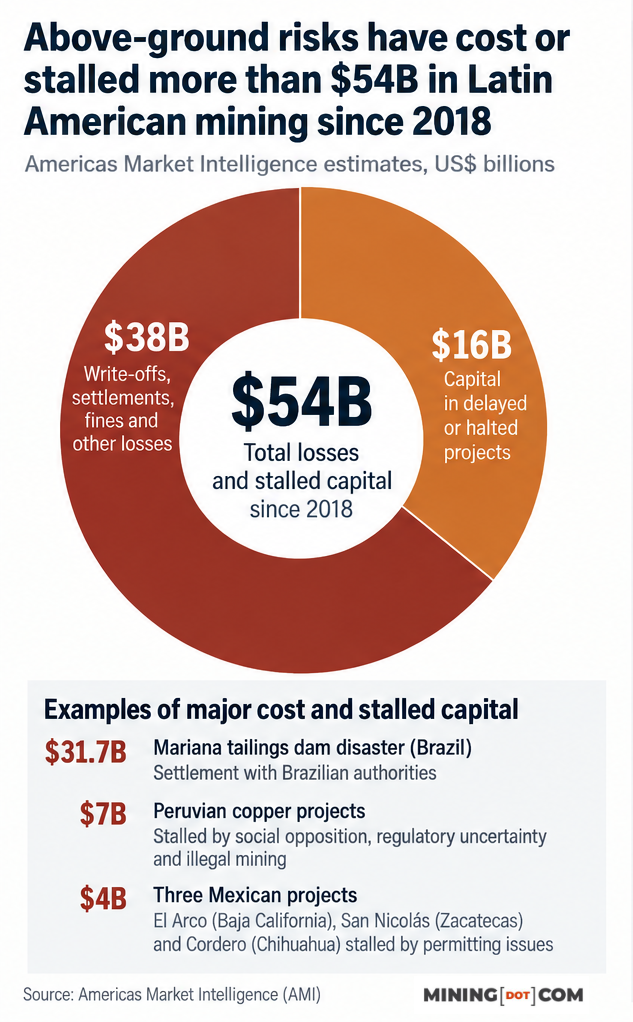
The largest single loss in AMI’s calculation comes from the 2015 Mariana tailings dam disaster in Brazil, where BHP (NYSE, LON, ASX: BHP), Vale (NYSE: VALE) and Samarco agreed with Brazilian authorities to a settlement valued by AMI at $31.7 billion to address the disaster’s environmental, social and legal consequences.
Regulatory disputes are also tying up billions in planned investment. AMI identifies about $7 billion in Peruvian copper projects stalled by social opposition, regulatory uncertainty and illegal mining. In Mexico, El Arco in Baja California, San Nicolás in Zacatecas and Cordero in Chihuahua represent about $4 billion in investment held up by permitting issues, according to AMI.
Zamanillo and Rivera identified “execution certainty” as the broadest regional constraint, particularly the predictability and duration of permitting, although security and illegal mining have become equally significant in some jurisdictions.
Execution certainty goes beyond administrative timelines, they said. Projects also need institutional and social legitimacy that can be sustained over decades. “A technically sound and economically attractive project can remain structurally vulnerable if that legitimacy cannot be built and sustained.”
That assessment echoes concerns raised by Guajardo and Guzmán, who both identified permitting uncertainty as a major barrier to investment. Investors can price demanding environmental standards and known obligations, Guajardo said, but struggle with approval processes whose duration or outcome remains uncertain after substantial capital has been committed.
The challenge differs by jurisdiction. Chile’s lengthy and complex approvals weigh on new mines and expansions, while community relations, territorial disputes and illegal mining can rival formal permitting as obstacles in Peru, Guajardo noted.
AMI cites Chile’s Collahuasi expansion as one example of how regulatory decisions can affect large investments. The country’s Second Environmental Court annulled a key permit for the $3.2-billion expansion of the world’s sixth largest copper mine in May, after finding shortcomings in the treatment of community observations, requiring additional review of certain environmental and social issues.
First Quantum Minerals’ (TSX: FM) Cobre Panamá provides a more extreme example of political, legal and social pressures converging. The $6.8-billion copper mine was ordered closed after Panama’s Supreme Court ruled in late 2023 that the law approving its concession contract was unconstitutional. The operation had represented about 5% of Panama’s gross domestic product and 75% of its mineral exports and supported about 54,000 direct and indirect jobs, according to figures cited by AMI.
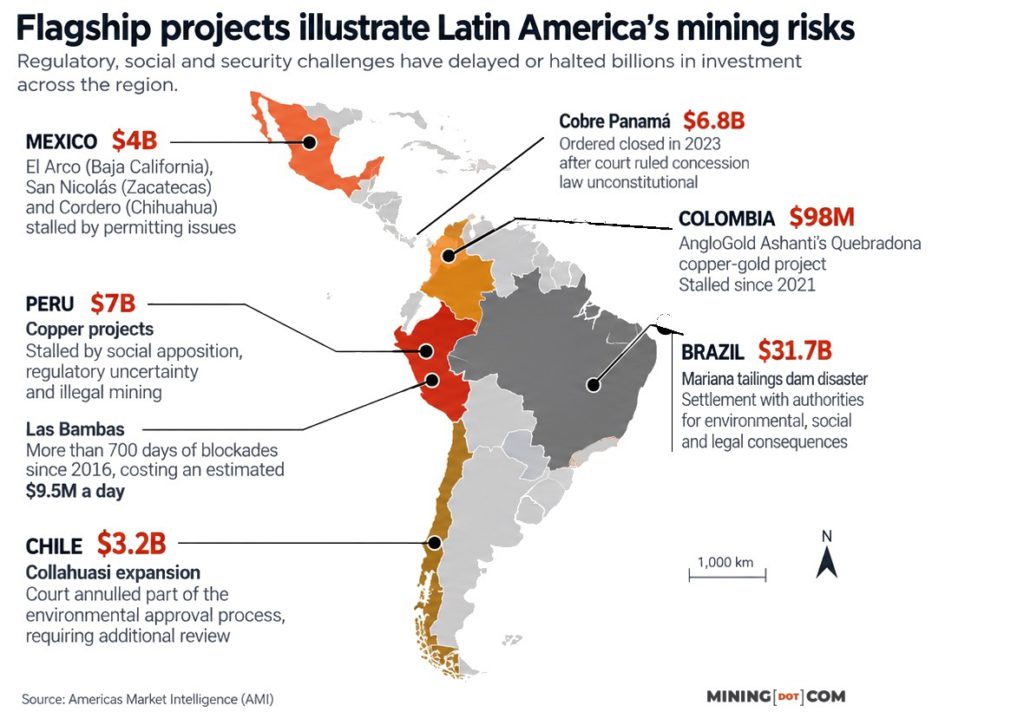
In Colombia, AngloGold Ashanti (NYSE: AU)(JSE: ANG)(ASX: AGG) has written off $98 million on its Quebradona copper-gold project, stalled since 2021, and is targeting 2027 for a new environmental impact assessment.
Security presents another challenge. Zijin Mining said in 2024 that it had lost control of 60% of the tunnels at its Buriticá gold mine in Colombia to illegal miners backed by the Gulf Clan.
Zamanillo and Rivera said weakening legitimate formal mining where state capacity is limited can create space for illegal or “anomic” extraction, making security part of a wider structural challenge rather than an isolated operating risk.
Investment shifts
Above-ground risk is not necessarily driving miners out of Latin America. Instead, companies are becoming more selective about where and when they commit capital as governments worldwide compete to build mineral supply chains.
Guajardo said miners increasingly favour expansions around existing operations, where infrastructure and community relationships are already established, over large greenfield projects with longer and less predictable routes to production.
Zamanillo and Rivera see the trend less as capital retreating from Latin America than as an intensifying global competition for mineral investment. Several countries are trying to improve their position, including Argentina through its incentive regime for large investments (RIGI) and Chile through permitting reform, while Brazil has pursued a critical-minerals strategy and Ecuador has moved to reopen access to mining concessions.
Argentina has continued integrating mining projects with RIGI, which is designed to provide greater investment certainty and incentives for large projects. The government approved the Vicuña copper-gold-silver project for the regime this year and has updated mining investment rules aimed at simplifying procedures and strengthening predictability.
Peru encapsulates the trade-off. Its copper geology and development pipeline remain attractive, but social conflict and security conditions can alter project timing and risk. Chile remains a major destination for copper capital, though approval timelines can influence development priorities.
Community disputes demonstrate how those risks become operating costs. Peru’s Las Bambas copper mine has faced more than 700 days of blockades along its transport corridor since commercial production began in 2016, according to AMI. Stoppages have cost about $9.5 million a day based on estimates cited by the consultancy from Peru’s mining union.
John Price, co-director of AMI’s mining and risk practice, traced part of the conflict to an early plan to transport copper concentrate by pipeline to Cusco. The pipeline was abandoned after MMG (HKEX: 1208) acquired Las Bambas, with concentrate instead transported by truck through communities along the route.
“If you do not take the time to really engage with the community, and if you do not fulfil the promises that you make, it will come back to bite you,” Price said.
AMI argues earlier monitoring of community, political, regulatory and security threats can reduce costs because those risks increasingly overlap and cannot easily be managed in isolation.
Zamanillo and Rivera remain positive about the region’s longer-term prospects, but said geology alone will not determine which jurisdictions capture the next wave of investment. Infrastructure, execution certainty, security, financing and legitimacy will increasingly determine whether mineral resources become operating mines and processing capacity.
“The region has no shortage of mineral resources,” Guajardo said. “Its challenge is to provide a credible route for developing them.”
Latin America has been at the centre of a growing global power struggle this year, as governments and investors focus on who controls critical minerals and the supply chains behind them.
If the region matters to you, don’t miss MINING.COM’s regional series tracking the geopolitical forces reshaping it and why markets are increasingly driven by global alliances as much as local politics.
Countries in the series:
Source: https://www.mining.com/latin-america-mining-risks-carry-54b-price-tag/