




On August 7, as US President Donald Trump hosted mining executives at a roundtable in Washington, representatives of all 14 accredited US mining schools attended a parallel Department of Energy workforce event. They left with the first serious federal funding for mining education in a generation, more than $180 million in total, part of a package of deals the White House put at more than $2 billion and Bloomberg tallied at $3 billion.
The biggest slice is a new DOE programme called PROSPECT (Providing Opportunities for Specialized Education in Critical Technologies), worth up to $100 million and aimed at doubling the number of graduates with mining, minerals and supply chain credentials within two years. DOE puts the country’s need at about 6,000 new mining engineers over the next decade.
The Department of War proposed another $81.3 million for three schools, with Colorado School of Mines in line for $32.7 million for a critical minerals innovation and commercialization hub in Golden, South Dakota Mines received $25 million for a scholars consortium with the University of Kentucky and Missouri S&T, and Johns Hopkins got $23.6 million for a recycling hub.
The PROSPECT funding notice is, however, “subject to availability of appropriated funds,” and Congress has yet to pass a single FY2027 spending bill, leaving the government on a stopgap that runs out on December 11.
The Department of War awards are also still listed as proposed. The only money moving so far is a $16 million PROSPECT Planning Prize launched on September 14, which offers up to $1 million per school for plans to grow credential output within two years. Applications close on October 5. A GEM Consulting study found that public capital in mining increasingly comes with workforce conditions attached and singled out the $180 million education line as money that “could ease workforce shortages affecting multiple projects.” Measured against the more than $10 billion already committed to US rare earths and magnets by Bloomberg’s count, the people side of the ledger is getting less than two cents on the dollar.
The NDAA provision is stuck in the Senate
The legislative route that put mining schools on the defence agenda this summer has gone nowhere since the House passed the fiscal 2027 National Defense Authorization Act by 216 votes to 212 on July 22. The bill authorises about $1.14 trillion in discretionary defence spending and carries the surviving core of Rep. Burgess Owens’ Mining Schools Act, now Section 1883 of the text passed by the House (numbered 1853 in the committee mark and in Owens’ own press release).
Section 1883 directs the Department of War to use Defense Production Act authorities to support workforce development in the mining, processing, refining and recycling of critical minerals through university partnerships, scholarships, tuition assistance and on the job learning. It also orders an assessment of whether certain awards should be conditioned on a company’s participation, which would make training a term of the contract.
The section authorises no money, and it is not the Energy Department grant programme with an advisory board that Owens’ release describes. That programme exists only in the standalone bill, H.R.2457, which has not had a markup since it was referred to the House Natural Resources Committee in March 2025. The Society for Mining, Metallurgy & Exploration has been pushing a version of the bill since at least 2022, when the number of accredited programmes had already fallen from 25 in the early 1980s to 14.
The Senate has neither taken up the House bill nor passed its own since a July 14 cloture vote on the motion to proceed to S.4784 failed 50 to 46, with Democrats objecting to the Iran war and the size of the bill. We could find no equivalent workforce section in the Senate text, and no conference has been convened. Congress has passed an NDAA every year for more than six decades, usually in the final weeks of December, which points to a vote after the November 3 midterms. In the meantime, the August package, which runs on existing DOE and Department of War authorities, has overtaken the bill.
Other measures announced earlier in the year have moved only on paper, including a May 29 presidential memorandum that approved critical position pay of up to $400,000 for as many as 400 federal roles recruiting investment and engineering talent, and the Office of Personnel Management turned it into a final rule on August 26, but no hires under the authority have been reported. The Critical Mineral Mining Education Act (H.R.7021 and S.3612), which would fund a $10 million a year mining Fulbright through the State Department, has not moved since January.
The National Science Foundation’s Critical Materials Crossroads Engine, led by the University of Missouri Kansas City and selected in July for up to $160 million over 10 years, held its launch at Kansas City’s Union Station on August 21. Only $15 million is committed for the first two years, with the remaining $145 million tied to milestone reviews. The launch materials list rare earth elements among the target materials alongside nickel, cobalt, lithium, graphite and gallium, but no rare earth separation track has been named.
A pipeline that shrank for decades
Only 14 US universities offer accredited mining engineering degrees, namely Alaska Fairbanks, Arizona, Colorado School of Mines, Kentucky, Michigan Tech, Missouri S&T, Montana Tech, Nevada (Reno), New Mexico Tech, Penn State, South Dakota Mines, Utah, Virginia Tech and West Virginia. Twelve universities, among them Berkeley, Columbia, Ohio State and Texas A&M, have closed mining programmes since 1985. US schools awarded 700 bachelor’s and master’s degrees in mining in 1981, a level never reached again, and according to SME mining engineering enrolment fell from nearly 1,500 in 2015 to fewer than 600 in 2023.
Estimates of how many graduates the system produces vary with the source, as South Dakota Mines says fewer than 170 mining engineers a year, the National Mining Association says about 200, and Reuters counted just over 200 undergraduate mining and metallurgical degrees in 2023. Federal completions data compiled by Data USA show 285 mining and mineral engineering degrees at all levels in 2024, down 5%, with Colorado School of Mines (60), Missouri S&T (46) and Arizona (24) accounting for nearly half.
On any of those counts, output is less than half the roughly 600 a year implied by DOE’s estimate of need, and Bloomberg puts it at about a fifteenth of China’s. Doubling output, which is PROSPECT’s goal, would roughly close that gap, although PROSPECT counts credentials and not only four year degrees.
Colorado School of Mines warned of a “grey tsunami” three years ago, when it put the number of US mining workers expected to retire by 2029 at 221,000, more than half the workforce. The estimate, which goes back to a 2014 SME briefing and was restated this summer as “within three years”, remains the only national figure available, and every measurable trend since has pointed the same way. US mining employment fell 20.4% over a decade, 71% of mining leaders surveyed by McKinsey said the talent shortage is already blocking production targets, and only 11% of young people say they would likely work in mining while 70% say they probably or definitely would not.
Juniors feel the squeeze most, with junior geologists now charging $500 to $600 a day, rates that four years ago belonged to senior geologists. US projects already take more than 30 years to move from discovery to production, and a shrinking pool of experienced technical workers is slowing the engineering studies that come before a mine is built.
Flynn says the money goes to the wrong end of the chain
In July, retired Gen. Charles Flynn, former commander of US Army Pacific, argued that the federal rare earth buildout was missing the mark. About 90% of the raw material mined domestically still goes abroad for processing, nearly half the mining workforce reaches retirement age by 2029, and federal funding goes mostly to large producers while bypassing junior miners, their service providers and training. A $200 million grant to a single company, he noted, still leaves an 18 month gap before offtake begins.
“The country needs to think in terms of industrial systems and not just a collection of announcements and grants,” Flynn said.
Two months later the August package has answered his call for training money but done nothing for juniors, as the Office of Strategic Capital loans announced the same day went to Niron Magnetics, Sunrise Energy Metals and Sila, all companies past the exploration stage. His other proposal, modular processing plants on military land, is already under way, with four companies building on army bases and $725 million going to Energy Fuels and $500 million to Phoenix Tailings. The Pentagon has spent about $1 billion on rare earths since 2020 and expects its own magnet needs to reach about 10,000 tonnes a year by 2030.
From January 1, 2027, US defence contractors may no longer use Chinese magnets, a rule that applies to a country that used about 48,000 tonnes of magnets in 2025 against 300 tonnes of domestic supply. Even US-subsidised output is still being routed east because the domestic separation and metallisation steps needed to consume it have yet to be built.
New plants will need people to run them
USA Rare Earth broke ground on September 9 on a $1.2 billion magnet plant in Blacksburg, South Carolina, with 6,400 tonnes a year of sintered NdFeB capacity, about 490 jobs and commissioning from 2028. The workforce line in the announcement was $250,000 for Spartanburg Community College’s new SPARK Center, roughly 0.02% of the capital cost, at a company that has lined up $1.6 billion in federal support. MP Materials says its $1.25 billion magnet campus in Texas, pitched at more than 1,500 jobs, is now “officially vertical.”
Energy Fuels began building its $104 million White Mesa heavy rare earth expansion in Utah on July 29, with terbium and dysprosium circuits due by the end of 2027, while its $1.9 billion purchase of German magnet maker VAC, which employs more than 1,000 people in Hanau, still awaits approval from Berlin. Buying a trained magnet workforce is one way to get one. Vulcan Elements this week won a US Army contract to supply magnets for drones, its tenth with the Department of War, from a North Carolina plant with 10,000 tonnes a year of planned capacity and about 1,000 jobs. Cyclic Materials opened a 25,000 tonne a year recycling plant in Mesa, Arizona, 17 months after announcing it, employing “dozens” of skilled workers.
Building a plant does not guarantee it will perform, as Serra Verde in Brazil has shown with recoveries of 20% to 30% during ramp up against about 80% planned. The operation, which USA Rare Earth absorbed this month, has both the ore and the equipment, and its troubles point to the kind of operating experience China exports least willingly. EnerVenue cited much the same thing this week when it dropped a $264 million Kentucky battery plant for China, pointing to the “density of hydraulics, pneumatics and automation specialists” there.
MP Materials sued USA Rare Earth in May, accusing its rival of a pattern of recruiting MP employees to misappropriate trade secrets on magnet production, a sign of how scarce that experience already is outside China.
China treats rare earth expertise as a strategic asset
By Reuters’ count, at least 11 Chinese universities and technical colleges run dedicated rare earth degree programmes, enrolling more than 500 students a year and supported by more than 40 specialist laboratories, while no comparable undergraduate degree exists anywhere else. China’s Ministry of Education added a Rare Earth Materials Science and Engineering major to the national undergraduate catalogue in 2024, first approved at Inner Mongolia University of Science and Technology in Baotou, 150km from the world’s largest rare earth mine.
Chinese financial media reported in June that Jiangxi University of Science and Technology in Ganzhou had been approved for a second major, Rare Earth Science and Engineering, and this term the university started an innovation class in the subject led by Li Chaozhong, dean of its rare earth school. “In China, I used to hire kids right out of university and they’re immediately productive. Anywhere else I need to train them for three years,” Constantine Karayannopoulos, former chief executive of Neo Performance Materials, told Reuters.
Reuters reported last October that there are only a couple of dozen experts in rare earth separation and refining in the US, Europe and Japan combined, compared with thousands in China, and that Beijing had started to catalogue its experts to make sure they do not travel abroad. China has long banned the export of rare earth extraction and separation technology and added magnet making technology to the list in December 2023.
On September 15, State Council Decree No. 841 took effect, allowing authorities to bar Chinese citizens from leaving the country if they breach export control or technology trade rules, or if they “may endanger” national industrial or technological security. The decree sets no time limit on such bans and allows notice to be withheld on national security grounds. It does not name rare earths, but Chinese commentators told Asia Times it is aimed at sectors where Beijing already restricts exports, rare earths among them.
China’s magnet shipments to the US fell 21% in August to 512 tonnes, and some US buyers have waited more than six months for export licences. US Treasury Secretary Scott Bessent said on Wednesday that the trade truce, which includes the suspension of China’s October 2025 rare earth controls, would be extended by two months to January 10 as Xi Jinping began a state visit to Washington, although Beijing had yet to confirm the extension. JL Mag, the world’s largest magnet maker, is meanwhile targeting 60,000 tonnes a year of capacity by 2028, against MP’s planned total of about 10,000 tonnes.
The three years of training Karayannopoulos describes matter because MP’s Texas campus and USA Rare Earth’s South Carolina plant both commission in 2028, while a student who started a US mining degree this month graduates in 2030.
Allies are short of engineers too
The usual answer, that the US can draw on Australian and Canadian graduates, does not survive a look at those countries’ enrolment data. In Australia, first year mining engineering enrolments fell from 267 in 2012 to 34 in 2018, and at UNSW from 120 in 2014 to six in 2018. Adelaide’s undergraduate degree is gone, Monash no longer offers one, and geoscience degree completions fell 40% over eight years, according to the Australian Geoscience Council.
The Minerals Council of Australia expects nearly half the country’s mining engineers to retire within the decade, and Canberra’s answer has been migration rather than education, with a skilled migration plan released on September 17 that prioritises engineers, geologists and metallurgists.
Canada has the most rigorous forecast, with the Mining Industry Human Resources Council’s June outlook putting the cumulative hiring requirement from 2026 to 2035 at 246,422 workers against a gap of 65,712, and acute shortages possible as early as 2027. Mining engineering enrolment peaked at 1,431 in 2014 and was down to 809 by 2022, yet seat utilisation averaged just 56% between 2021 and 2024, which means the places exist but the students do not.
Dalhousie closed its programme in 2024, while Saint Mary’s in Halifax expected a first resource engineering cohort of 20 to 25 students this autumn. Ottawa is relying on a C$81 million workforce alliance and scholarships, and the Young Mining Professionals scholarship fund grew by a third this year. The updated Critical Minerals Strategy is still pending.
Britain had five mining schools turning out more than 300 graduates a year in 1990, but Camborne School of Mines paused the country’s last undergraduate mining degree in 2020 and relaunched it only in 2025/26, and the UK opened a £25 million critical minerals fund in August that includes a magnet hub with a skills element. In Germany, RWTH Aachen closed its MSc in Mineral Resources Engineering to new entrants from 2024/25, although TU Bergakademie Freiberg is going the other way with a new raw materials bachelor’s from 2027/28. The EU’s Raw Materials Academy aims to train 100,000 learners by 2030 rather than grant degrees, and the Critical Raw Materials Act contains no skills article.
Where the top schools are
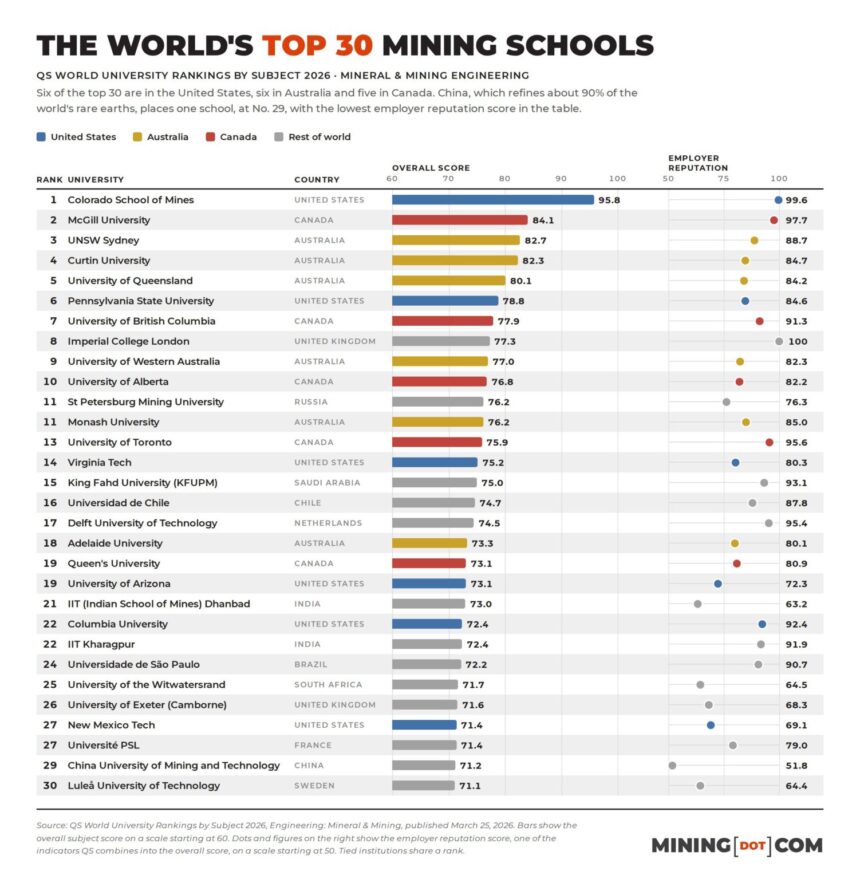
The 2026 edition of the QS subject ranking for mineral and mining engineering, published in March and current until the 2027 tables arrive next spring, puts Colorado School of Mines on top with an overall score of 95.8, more than 11 points clear of McGill in second place, while the rest of the top 30 fall within a band of about six points. MINING.COM last ran the list in 2022, when Curtin and Queensland sat second and third.
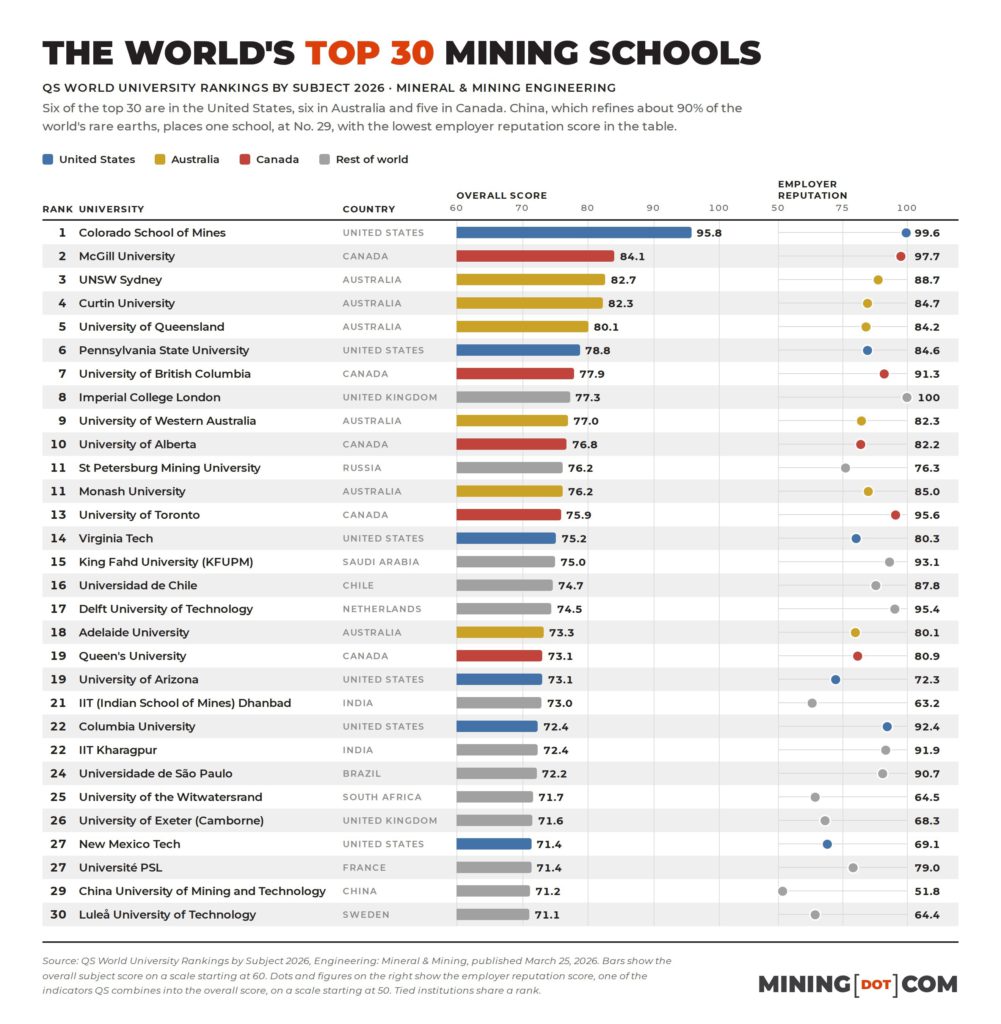
The US, Australia and Canada hold 17 of the top 30 places between them, and all three have seen enrolment fall hard. China places a single institution, China University of Mining and Technology at No. 29, with the lowest employer reputation score in the table, a reminder that QS measures academic and employer reputation among a largely Western survey panel rather than graduate numbers or industrial relevance.
Missouri S&T produced the second most US mining engineering degrees in 2024 and does not appear in the top 30, while Imperial College London scores a perfect 100 on employer reputation at No. 8 even though its mining department no longer exists under its own name. Russia’s St Petersburg Mining University sits at No. 11, ahead of Toronto, Virginia Tech and Arizona.
Where enrolment is growing
Colorado School of Mines says undergraduate mining engineering enrolment has doubled in three years, from 101 students in 2023 to about 183 by May, and this autumn it launched a minor in mineral processing and extractive metallurgy aimed at critical minerals recovery. DOE’s latest $10 million round of critical minerals research funding went partly to Mines and the University of Arizona, where the MiningWerx pilot processing hub has $3.85 million in federal and state money. The University of Texas at El Paso is recruiting its first mining engineering class for autumn 2027 with $52 million from industry and the state, targeting 100 graduates a year, roughly a third of current national output.
Companies are also building pipelines of their own, and Neo Performance Materials’ partnership with Tallinn University of Technology in Estonia covers joint curricula and internships and is the only formal rare earth talent pipeline of its kind we have found outside China. USA Rare Earth’s demonstration plant in Wheat Ridge, Colorado runs a multistage solvent extraction circuit with 28 engineers, scientists and technicians on rotating shifts, a useful measure of what each new separation line needs in people. MP Materials grew from eight contractors in 2017 to 998 employees at the end of 2025, which shows a well funded operator can build a workforce, although juniors and service companies do not have MP’s balance sheet.
What comes next
The August 7 package is the first time Washington has put real money into mining education, and it deserves credit for that, but it amounts to $180 million, most of it proposed or awaiting appropriation, against more than $10 billion committed to plants. Section 1883 authorises no money and sits in a Senate that has not taken up the bill, and the Mining Schools Act has gone 18 months without a markup. The plants commission in 2028, this autumn’s freshmen graduate in 2030 and UTEP’s first class in 2031 at the earliest.
The next test comes on October 5, when applications close for the PROSPECT Planning Prize and the number of schools competing will show how much capacity exists to scale up. Congress then has until December 11, when the stopgap funding bill expires, to decide whether PROSPECT’s $100 million becomes real money, and on January 10 the extended truce covering China’s rare earth controls is due to run out.