




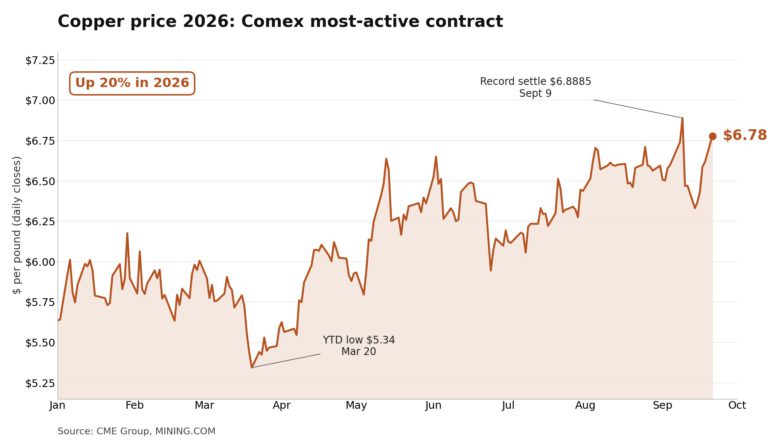
Copper rose for a fifth straight session on Monday as signs of tightening supply in China and a rally in equities pushed the metal back toward the record it set earlier this month.
Comex copper for December delivery climbed as much as 3.3% to $6.8410 a pound in New York, its highest since 10 September, and was trading at $6.7770 (about $14,940 a tonne) around midday, up 1.3% on the day. Benchmark three-month copper on the London Metal Exchange touched $14,710.50 a tonne, also a high since the 10th, before easing back to around $14,650.
Copper posted its 11th weekly advance in 12 on Friday. The metal hit an all-time high of $14,875 a tonne on 10 September before doubts over the timing of US tariffs on refined metal and hawkish messaging from the Federal Reserve knocked it back. The Fed raised its benchmark rate by a quarter point last week, its first hike since July 2023, and warned that more increases may follow. Higher borrowing costs typically dampen demand for industrial commodities.
Funds cut their net long positions on Comex copper in the week to September 15 as the tariff picture stayed muddled, but speculative buying has returned on expectations that Chinese fabricators will restock ahead of the country’s holidays on September 25 and from October 1 to 7, according to Saxo Bank’s Ole Hansen.
China pays up, London flips
Chinese buyers are paying up for metal. The Yangshan premium, the fee paid on top of LME prices for copper delivered to the country’s main import hub outside Shanghai, finished last week at $124 a tonne, its highest in nearly four years, before easing to $119 on Monday.
That scarcity is unlikely to ease before year-end. Several Chinese refineries are due for planned maintenance in October and November, Shanghai Metals Market said, capping any jump in domestic supply, while congestion at Shanghai port makes it hard to judge how quickly imported cargoes will land.
The clearest signal of tightness is on the LME itself. Cash copper is now trading at a $26 a tonne premium to the three-month contract, a backwardation that has swung from an $86 discount only a week ago. Buyers paying more for metal today than for delivery in three months’ time means they cannot wait, and the exchange’s stocks show why: of the 255,900 tonnes in LME warehouses on Monday, 115,450 tonnes, or 45%, are cancelled warrants already booked for withdrawal, after another 9,600 tonnes were cancelled in Asia. Metal actually available to the market has shrunk to 133,725 tonnes.
The other side of the ledger is the United States. Comex warehouses hold 696,204 tonnes, some 69% of all exchange-monitored copper, after importers rushed metal in ahead of tariffs that Washington has yet to impose. That pile is no longer growing: stocks slipped by 65 tonnes last week, the first weekly decline since April, according to The Copper Journal, and the spot premium of Comex over LME has narrowed to about 1.6 cents a pound so far in September, the tightest since April.
With storage at the Port of New Orleans, the main Comex delivery hub, largely full and another 100,000 tonnes of African and South American copper due over September and October, the US is fast running out of room to absorb more.
The macro backdrop also helped on Monday. Oil slid on hopes of diplomacy in the Iran war, easing fears that crude near $100 a barrel would slow the world economy, and stock markets rallied ahead of this week’s summit between US President Donald Trump and China’s Xi Jinping.
Miners lag the metal
Copper equities followed the metal higher on Monday but the sector remains firmly in the red for September after the pullback from the 10 September peak, when copper producers led a sell-off across the mining sector.
Freeport-McMoRan, the largest listed copper producer, rose 0.6% to $71.94 in New York, lifting its market value to $103.3 billion, but is still down 5% for the month. The Phoenix-based company’s Grasberg troubles in Indonesia, together with Ivanhoe Mines’ output cut at Kamoa-Kakula in Congo, have removed some 600,000 tonnes from this year’s expected global supply and could see mined copper output fall in 2026 for the first time since 2017, Sprott Asset Management said last week.
Southern Copper added 0.7% to a market value of $166.3 billion, which puts the Mexican company narrowly ahead of Rio Tinto at $165.2 billion for the second spot in the MINING.COM ranking of the world’s most valuable miners. Southern Copper briefly overtook Rio in August before slipping back, and remains 5.7% lower for the month.
In Toronto, First Quantum Minerals gained 2.5% to a value of $26.4 billion. The company last week secured a UK patent for its trolley-assist haulage system, which it says can cut truck diesel use by up to 90% on uphill hauls. Lundin Mining rose 2.1% to $20.8 billion but is nursing a 7.7% loss for September after cutting its 2026 guidance, and Ivanhoe Mines, which fell out of the Top 50 after the Kamoa-Kakula downgrade, climbed 2.8% to a valuation of $12.6 billion.
Teck Resources rose 1.2% in New York, valuing the Vancouver-based company at $32.5 billion as it waits on Chinese approval for its $53 billion merger with Anglo American, which was up 2% in US trading. Glencore, a 44% partner at Collahuasi, stands between the combined group and $1.4 billion a year of copper synergies from integrating the mine with Teck’s Quebrada Blanca.
Capstone Copper edged up 0.6% in Toronto after agreeing to sell its Cozamin mine in Mexico to Luca Mining for up to $385 million, including $60 million contingent on copper averaging above $7 a pound between 2027 and 2029. Capstone, which will focus on Chile and Arizona, is down 9.4% for the month. Luca jumped more than 8%.
The diversified majors have fared worse than the pure plays. Glencore’s US-listed shares fell 3.1% on Monday, cutting the Swiss company’s value to $84.8 billion, and are down 9.3% in September as the fallout from its dealings with iron ore trader Radiant World continues. BHP, worth $220.5 billion, is down 8.4% for the month after output at its Escondida mine in Chile slumped 22% in July, and Antofagasta, which cut its 2026 guidance, has lost 9.5% in London, where the company is valued at $48.3 billion.
The setbacks at the majors underscore the supply problems that have supported prices. Chile’s output fell 9.4% in July and state-owned Codelco has pushed back a restructuring plan that could cut up to a fifth of its workforce, while Zambia’s Konkola Copper Mines only restarted its Nchanga smelter on Monday after a maintenance shutdown that stretched to 106 days from a planned 60.
Copper is now up 20% in 2026 and trades less than 2% below its all-time high.
(With files from Reuters and Bloomberg)
Source: https://www.mining.com/copper-prices-bounce-as-us-runs-out-of-warehouse-space/